




Ohio DOT, Otto Initiate 'Smart Mobility Corridor'
The State of Ohio is investing $15 million to install advanced highway technology along its the 35‑mile stretch of U.S. 33 northwest of Columbus.
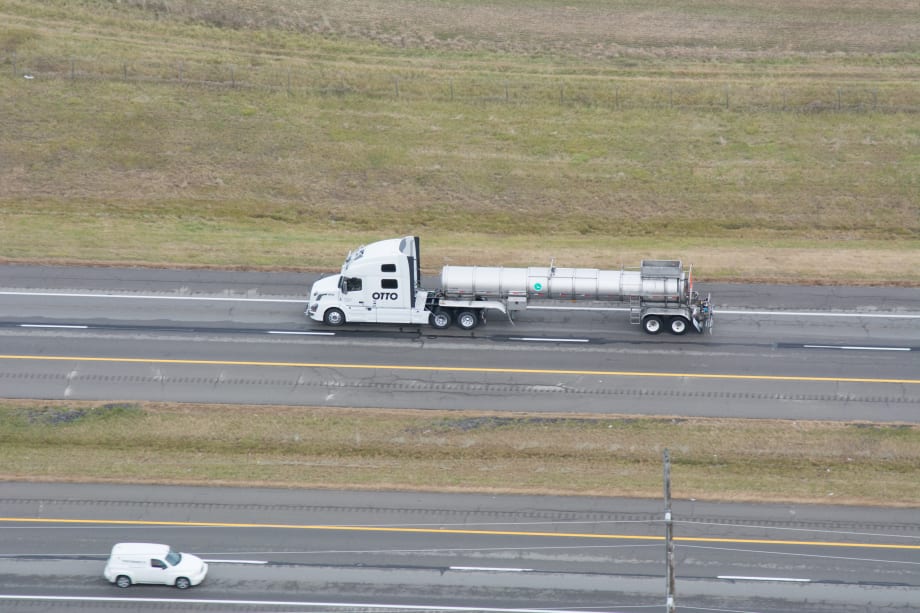
Otto's self-driving tractor pulls an Ohio DOT-owned tanker along U.S. 33 northwest of Columbus. The state will install sensors and fiber-optic cable along the route to support further autonomous and connected-vehicle testing. Photos: Ohio DOT
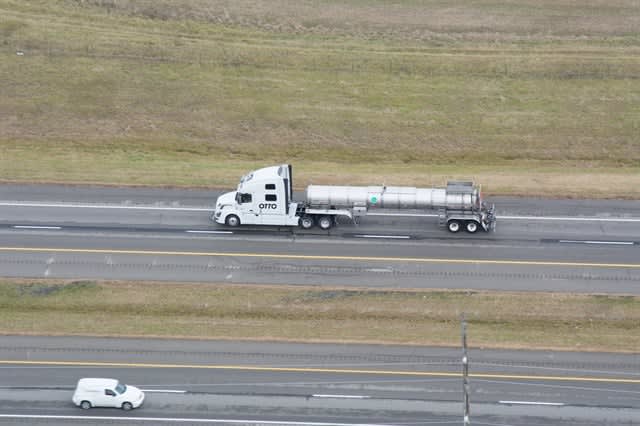
Otto's self-driving tractor pulls an Ohio DOT-owned tanker along U.S. 33 northwest of Columbus. The state will install sensors and fiber-optic cable along the route to support further autonomous and connected-vehicle testing. Photos: Ohio DOT
The State of Ohio is investing $15 million to install advanced highway technology along its "Smart Mobility Corridor" - a 35‑mile stretch of U.S. 33 northwest of Columbus. It was used Wednesday, Nov. 30 for a demonstration run by Otto, a developer of self-driving vehicle technology .
Gov. John Kasich announced the project today at a ceremony in suburban Dublin. He said the state’s partnership with leading automotive research centers and local governments in the region will create an ideal proving ground to safely test innovative technologies that will change the way people and products are transported in Ohio and across the world.
After the event, Otto's self-driving tractor pulled an Ohio Department of Transportation tanker trailer from Dublin to East Liberty. A driver was in the cab, ready to take over if anything went amiss, but it didn't, ODOT said. Otto also plans to run its truck on the Ohio Turnpike later this week.
“Some of the world’s foremost automotive researchers are working here in Ohio, at both ends of this corridor, and this project provides them with the perfect location and state-of-the-art infrastructure for safely testing autonomous and connected vehicle technologies,” Kasich said.
“Ohio has been at the heart of automotive manufacturing and innovation since the industry’s earliest days. Those ties strengthen with each passing year and innovations developed here will continue to build on our state’s historic role as a world leader in transportation technology,” he said.
The Smart Mobility Corridor, 35 miles of four-lane, limited access highway, will be equipped by the ODOT with high-capacity fiber optic cable to instantaneously link researchers and traffic monitors with data from embedded and wireless sensors along the roadway.
These links will allow testing smart transportation technologies on a highway that carries up to 50,000 vehicles per day through rural and urban settings in a full range of weather conditions. This data will also provide more frequent and accurate traffic counts, weather and surface condition monitoring, and incident management improvements, said ODOT spokesman Matt Bruning.
“Data collected on this corridor will allow automotive innovators to test and refine jobs‑creating technologies that are going to help move people and products more safely and efficiently than ever before,” said ODOT Director Jerry Wray.
“By being one of the first – and best positioned – states to embrace autonomous and connected vehicle technology, Ohio can also be among the first to benefit from its rewards, giving Ohioans a safer, better driving experience and offering businesses reduced transportation costs, faster access to markets and increased efficiencies,” he said.
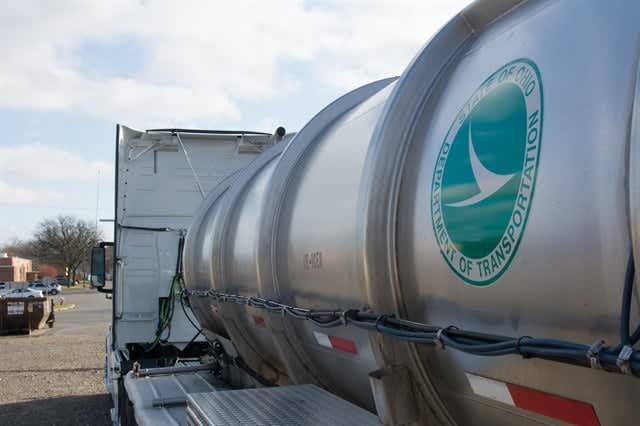
Fairings indicate that Otto's tractor usually pulls van trailers, but on Wednesday it took an ODOT tanker along the U.S. 33 route. The trailer hauls pavement deicing brine, but was empty during the demonstration.
ODOT’s partners in the project include Honda R&D Americas, the Transportation Research Center at East Liberty, and Ohio State University’s Center for Automotive Research. Local governments along the route, including the City of Dublin, City of Marysville and Union County, are cooperating.
The Smart Mobility Corridor will also align with work underway to develop Columbus as a hub for intelligent transportation, spurred by a $40 million “Smart City” grant from the U.S. Department of Transportation and more than $90 million committed to date by private-sector partners.
Work to install sensors and a fiber optic network along the corridor is scheduled to begin in May 2017 and last throughout the summer. Traffic disruptions are not expected during installation.
The Smart Mobility Corridor is a key component of the state’s new Smart Mobility Initiative, a collaborative effort between ODOT, the Ohio Department of Public Safety, Wright-Patterson Air Force Base, Case Western Reserve University, University of Cincinnati, University of Dayton, Wright State University, The Ohio State University, Transportation Research Center, and Ohio Turnpike and Infrastructure Commission.
The state’s investment announced today also complements another U.S. Department of Transportation grant, $6 million awarded to Dublin, Marysville, and Union County, and matched by local funds, to expand their fiber optic networks linking to U.S. 33, install highway sensors, and retrofit government vehicles to send and receive data.
As autonomous and connected vehicle research expands throughout the state, the Ohio Turnpike with its existing fiber-optic network is set to become the centerpiece of a contiguous, interstate highway test corridor eventually stretching from New York to Detroit and Chicago.
More Fleet Management

How Telematics Improves Visibility, Control, and Performance in Refrigerated Fleets
Explore how telematics help refrigerated fleets improve visibility, uptime, efficiency, compliance, and cargo protection across connected cold chain operations.
Read More →
What the U.S.-Canada Trade War Means for Trucking
Escalating U.S.-Canada tariffs could disrupt cross-border freight, reduce truck volumes, raise costs, and create new uncertainty for carriers on both sides of the border.
Read More →
What Are Trucking’s Top Concerns for 2026?
The American Transportation Research Institute wants to know what's worrying trucking fleet managers, drivers, and other stakeholders in its annual Industry Issues survey.
Read More →

American Trucking Associations Looks for a New Leader
ATA President and CEO Chris Spear abruptly left his job at the association on August 21, at a pivotal time for the trucking industry.
Read More →
Public Wi-Fi Cybersecurity Risks: How Truck Drivers and Fleets Can Protect Their Data
Public Wi-Fi can expose truck drivers and fleets to credential theft, malware, and other cyber threats. Here’s how to reduce the risk on the road.
Read More →
For Nicky Cupp, Fleet Innovation Starts With Frustration
HDT Truck Fleet Innovator Nicky Cupp turns everyday pain points at Fraley & Schilling into opportunities for better technology and smarter processes.
Read More →
Adam Buttgenbach’s Approach to Electric Trucks: Start With Where They Fit
HDT Truck Fleet Innovator Adam Buttgenbach helped PepsiCo build one of North America’s largest EV fleets by focusing on where electric trucks make operational sense.
Read More →
Deen Albert: Let Automation Do the Math, People Make the Decisions
HDT Truck Fleet Innovator Deen Albert makes sure people are still at the heart of operations at Grand Island Express, even while adopting artificial intelligence tools. AI-assisted dispatch helped boost revenue 25% with the same number of trucks.
Read More →
Trimble’s New AI Agent Takes Aim at Fleet Back-Office Busywork
Arc Agent works across Trimble TMS products to automate repetitive tasks such as freight orders, maintenance, invoices, fuel costs and more.
Read More →
How HDT’s 2026 Truck Fleet Innovators Are Rethinking Fleet Operations
Meet five trucking leaders who are challenging assumptions, solving operational problems, and putting innovative ideas to work.
Read More →