As Hurricane Matthew Approaches, States Prepare for Emergency
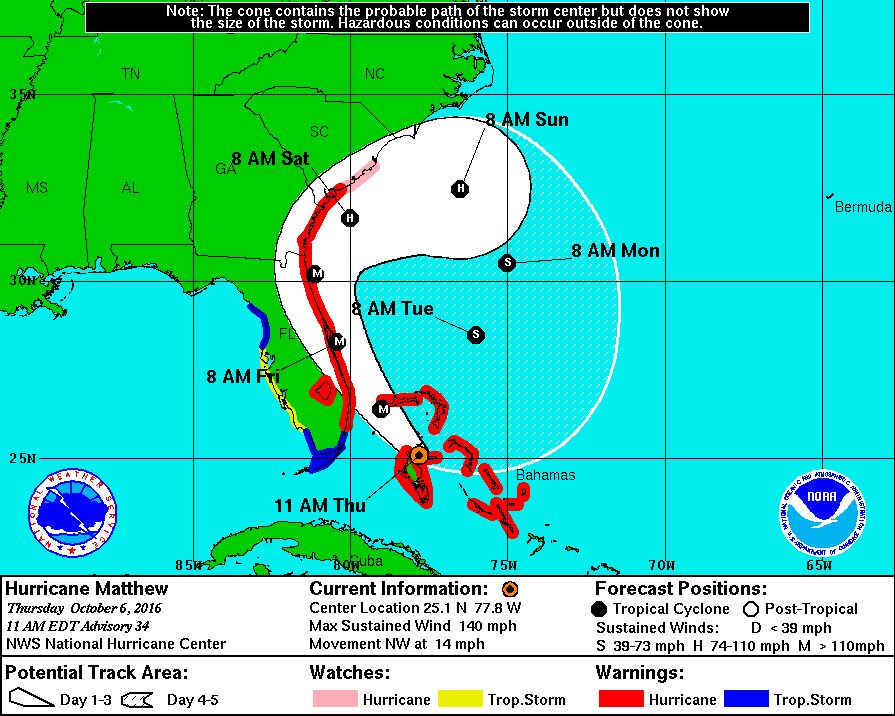
With Hurricane Matthew strengthening to a Category 4 storm before making landfall, states from Florida through North Carolina are preparing for the worst with road closures, evacuations and suspensions of certain transportation rules.
by Staff
October 6, 2016
Source: National Weather Service
3 min to read
Source: National Weather Service
With Hurricane Matthew strengthening to a Category 4 storm before making landfall, states from Florida through North Carolina are preparing for the worst with road closures, evacuations and suspensions of certain transportation rules.
The storm is expected to hit Florida first on the night of Oct. 6. Gov. Rick Scott declared a state of emergency and urged Florida residents to evacuate dangerous areas, telling reporters at a morning briefing, “This storm will kill you.”
Ad Loading...
As a Category 4 hurricane with sustained winds of up to 145 mph, Matthew is expected to be historically destructive. The areas of Florida directly in its path have not seen a storm this severe since 1850, according to the Washington Post.
Around 1.5 million Florida residents live in areas designated for evacuation, and the state has suspended tolls on sections of major highways like the Florida Turnpike and Interstate 75, according to the Miami Herald.
By declaring a state of emergency, Florida will implement the reversal of traffic on roads and highways to better handle traffic coming out of evacuation zones. The state will also suspend certain trucking regulations, including hours of service, size and weight restrictions for vehicles transporting emergency equipment, services, supplies or agricultural commodities. However, size and weight limits still apply on the state's bridges and similar structures.
Ad Loading...
South Carolina and North Carolina have also declared states of emergency suspending certain regulations for trucks traveling through those states.
In South Carolina, truck weight limits have been increased to 90,000 pounds; a permit is still required for vehicles larger than that. Hours of service has also been suspended for truckers during the emergency.
South Carolina is asking its residents to get at least 100 miles from the coast and is reversing traffic on Interstate 26 for evacuation. Lane reversals will also occur on Interstate 526 in North Charleston and Interstate 77 in Columbia.
North Carolina is also suspending certain size and weight restrictions up to 90,000 pounds and in other specific circumstances. Hours of service will also be waived for anyone transporting essential fuels, food, water, medical supplies, feed for farm animals, livestock or poultry and for vehicles used to restore utilities. North Carolina has issued mandatory evacuation orders for certain high-risk areas near the coast, but the impact of the hurricane is not expected to be as harsh as in the lower states.
Georgia has also issued mandatory evacuations for around 50,000 residents in coastal areas to the east of Interstate 95. Eastbound lanes of Interstate 26 are designated contra-flow lanes and will be reversed in the event of a mandatory evacuation from coastal Georgia, according to the Georgia Department of Transportation.
Ad Loading...
American Trucking Associations is urging drivers to take appropriate precautions and avoid any areas affected by the storm if possible.
"As we all continue to track and monitor Hurricane Matthew, we encourage drivers - commercial and commuter alike - to make good travel decisions," said Chris Spear ATA president and CEO. "There is no delivery or trip that is worth putting yourself or others in harm's way."
The trucking industry will be critical to recovery after the storm, stated Spear, as trucks would deliver goods to meet the needs of communities affected by Matthew.
"Every day, trucks deliver essentials like water, food and fuel to communities across the country, and once this storm passes, trucks delivering these critical goods will be on the move, delivering them to people who need them most," said Spear.
The unanimous SCOTUS ruling in the closely watched Montgomery v. Caribe case allows state negligence claims against freight brokers that hire unsafe motor carriers, raising new liability and vetting concerns among brokers.
Can technology help prevent truck crashes? In this HDT Talks Trucking Short Takes episode, K&B Transportation explains how it’s using cameras, speed management tools, cellphone-blocking technology, and other systems to improve safety and reduce risk across its fleet.
Fleet safety is evolving fast—and technology is at the center of it. Learn how a former commercial vehicle enforcement officer turned director of safety at K&B Transportation is embracing real-world safety technology.
Winter roadway “pileups” aren’t one crash — they’re a chain reaction. Here’s what triggers them, how truck drivers can spot the danger early, and what to do if you're suddenly trapped in the mess.
Detroit’s next-generation ABA6 safety system adds cross-traffic detection and enhanced side guard assist with left-turn protection, targeting high-risk urban scenarios.
The American Transportation Research Institute will examine driver coaching, regulatory impacts — including the "Beyond Compliance" concept —and weather disruptions that shape trucking operations.
New requirements add firm deadlines and independent review steps, addressing long-standing complaints about inconsistent rulings and slow response times.