




Eaton, Cummins Show Direct Drive Powertrain, UltraShift Enhancements
The two companies collaborated on the latest version of the Smart Advantage powertrain, aimed at regional highway service.

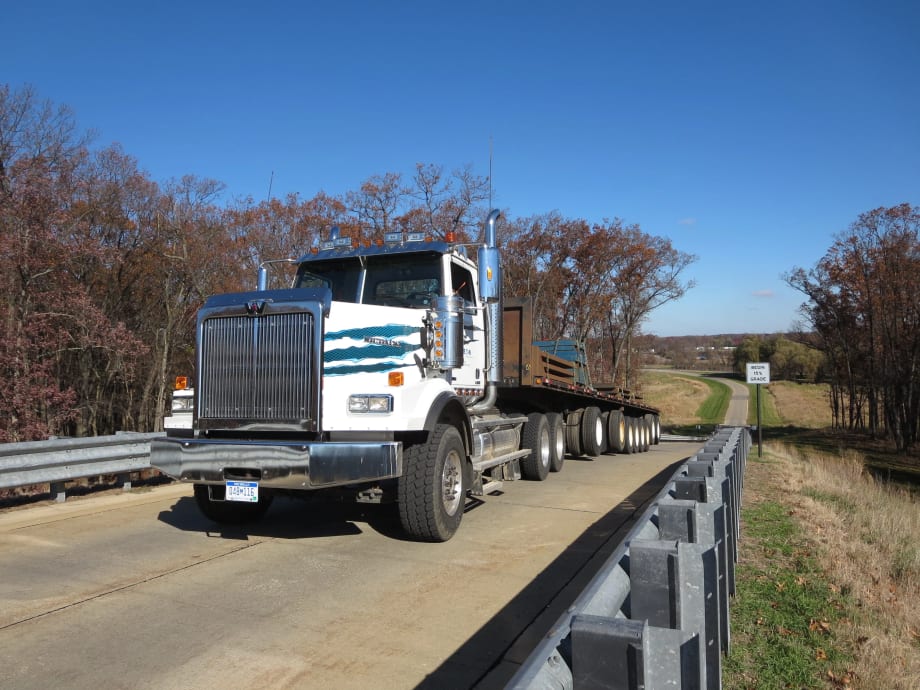
Urge to Move feature in an UltraShift Plus vocational gearbox allowed easy starting of this 125,000-pound GCW rig on 8 and 15 percent upgrades at Eaton's Proving Grounds.
Photo: Tom Berg
Urge to Move feature in an UltraShift Plus vocational gearbox allowed easy starting of this 125,000-pound GCW rig on 8 and 15 percent upgrades at Eaton's Proving Grounds.
Eaton Corp. and Cummins Inc. have developed another version of their Smart Advantage powertrain series, using a 10-speed automated manual transmission with a 1 to 1 top-gear ratio. The direct-drive product is aimed at regional on-highway tractors, according to executives of the two companies.
Separately, Cummins also announced a 2017-model ISX15 diesel that will emphasize high service availability, or uptime, while Eaton outlined two low-speed maneuverabilty enhancements for its highway and vocational-series automated transmissions.
A media briefing and demo were held at the Eaton Proving Grounds near Marshall, Mich., on Nov. 4. Reporters drove or rode in trucks on the grounds, and those with commercial driver’s licenses took tractors onto nearby public highways to experience how the new products performed.
Smart Advantage DD
As with previous offerings, the two companies collaborated on the direct-drive version of the Smart Advantage powertrain. It’s aimed at certain operations, like regional truckload and less-than-truckload freight hauling, where cruising speeds are 62 mph or less, said program managers Ryan Trzybinski of Eaton and Mike Taylor of Cummins. The 10th-direct gearing will allow the transmission to stay in top gear much of the time to keep revs low and capitalize on the powertrain’s fuel economy potential.
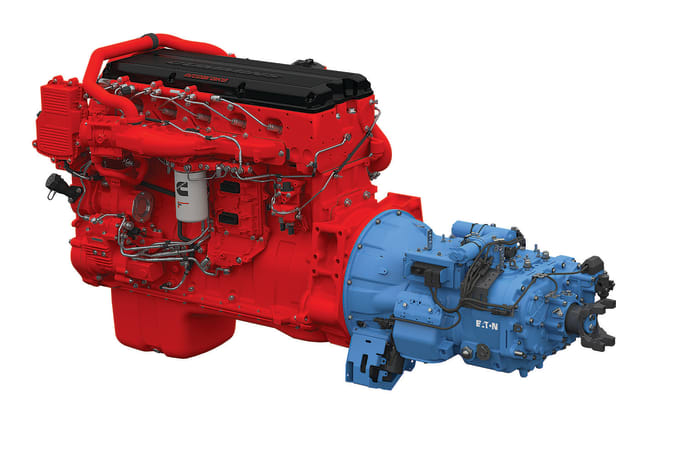
Latest Smart Advantage powertrain uses 2017 ISX15 and an automated transmission with a direct-drive 10th gear.
Photo: Tom Berg
Using “fast” axle ratios, engine revs at cruise can be as low as 1,250 rpm, an “underspeed” specification for the best possible fuel economy with good performance, thanks to the large ISX15’s healthy peak torque. The new DD powertrain complements the existing overdrive-geared version of the Smart Advantage AMT series, and early next year Cummins and Eaton will publicize figures showing the products are the most economical heavy-duty powertrains available, they said.
All Smart Advantage powertrains use the ISX15 because it’s able to operate at low rpm’s, Taylor explained. The ISX12 needs to cruise about 200 rpm higher so is better as a vocational engine and is less suitable for Smart Advantage use. The DD version was shown off on Wednesday with the 2017-model ISX15.
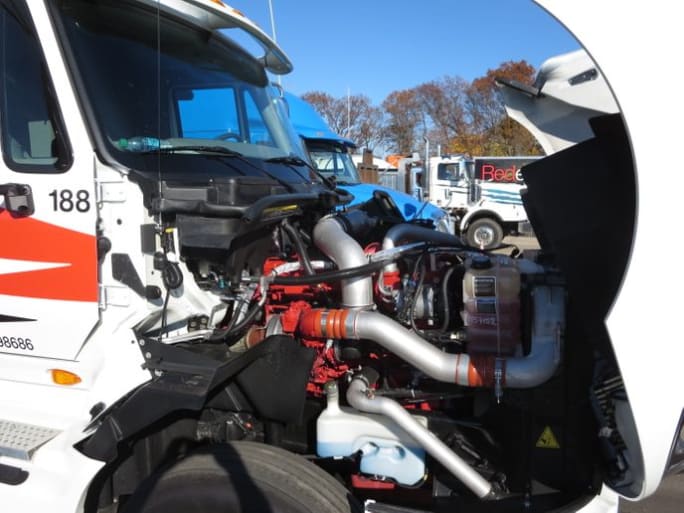
Development of the 2017 ISX15 emphasized uptime, said Patrick Fosdick, a program manager. That includes reliability along with complete and quick service, so parts and tools will be available at dealers, and their service departments will be ready to work expeditiously on the engines.
The engine uses the previously announced EcoFit Single Module aftreatment package, which is up to 60% smaller and 40% lighter compared to the current CO filter and diesel particulate filter.
Low-Speed Maneuver Features
New low-speed maneuverability features for the UltraShift Plus series include “Blended Pedal” and “Urge to Move” clutch engagement, said Evan Vijithakumara, product strategy manager. They allow precise movement of a truck to more precisely place loads of aggregates or concrete, for example, and make a driver’s work easier.
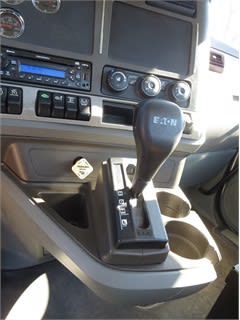
Blended Pedal and Urge to Move works in D, R, L and M modes in various vocational and highway UltraShift Plus automated transmissions.
The new features are available all versions of the UltraShift Plus series and Fuller Advantage automated transmissions. The features work thusly:
Blended Pedal – Gradual or quick clutch engagement depending on the accelerator’s position. Alternating a light foot with pedal release sends the clutch face partially against the flywheel, then disengages it. This can be enabled when the transmission is in Low or Manual Modes, and in Reverse. It is akin to a driver using the clutch pedal of a manual transmission to slip the clutch to move the truck very slowly and for very short distances, or to positively engage the clutch to get out of mud or soft ground.
Urge to Move – When the feature is enabled in Drive, Manual, Low or Reverse, the driver releases the brake pedal and the clutch smoothly engages at engine-idle speed, moving the truck forward or rearward and keeping it moving as long as the service brakes are off. The powertrain then is in “creep” mode, or the driver can push the accelerator to gain speed. As demonstrated later, Urge to Move can start heavy trucks on steep grades with little or no driveline vibration.
When applied to on-highway UltraShift Plus transmissions, the features make certain tasks easier, said John Mater, a product service manager. One example is backing into a loading dock; another is hooking onto and dropping a trailer, when precise clutch engagement allows moving smoothly under or away from the trailer’s nose.
Blended Pedal and Urge to Move can be programmed into the transmissions' electronic controls using Eaton Service software by dealers and some customers. Roadranger service technicians will also do it, often at no charge as part of a fleet visit, Vijithakumara said.
More Fuel Smarts

How Fuel Delivery Shapes Engine Performance
Fuel delivery depends on more than what happens at the injector. For fleet, maintenance and technical professionals, looking at the full path from pump to injector can provide useful context for understanding engine performance.
Read More →
East Coast Port Launches $45M Electric Truck Push
The Port Authority of New York and New Jersey announced millions in incentives for zero-emission drayage trucks, yard tractors, and new charging hubs near the port.
Read More →
California Bill Could Shed Light on Electric Truck Prices
Why do battery-electric Class 8 trucks remain so expensive? A California bill headed to Gov. Gavin Newsom would give fleets and state agencies more visibility into what manufacturers charge.
Read More →

Detroit Opens Orders for EPA 2027 Engines
Detroit isn’t starting from scratch to meet EPA 2027 diesel emissions standards. Its Gen 6 DD13 and DD15 engines keep much of today’s platform while updating the fuel and aftertreatment systems.
Read More →
Zero-Emission Truck Corridor Planned for West Coast
California, Oregon, Washington, British Columbia and Baja California are coordinating plans for truck charging and hydrogen fueling from Canada to Mexico.
Read More →
A Closer Look at Kenworth’s Electric T880E Vocational Truck [Video]
Learn more about Kenworth's T880E battery-electric vocational truck at the Paccar Technical Center, including its range, applications, upfitting considerations, and PTO options, in this HDT Spotlight video.
Read More →
Kenworth T880E Brings EV Power to Vocational Trucks
A closer look at the Kenworth T880E’s range, charging, powertrain and upfit options — and where fleets are showing the most interest.
Read More →
Jennie Abarca Is Proving Electric Trucks Can Do the Job
HDT Truck Fleet Innovator Jennie Abarca is building confidence in fleet electrification one load at a time while openly sharing the challenges she encounters along the way as a small-fleet owner.
Read More →
Cummins Adjusts 2027 Engine Rollout After EPA Proposal
The engine maker will gradually introduce its new Model Year 2027 diesel engines while continuing to offer current models during the transition, citing the EPA's proposed emissions rule changes.
Read More →
EPA Proposal Could Ease 2027 Truck Costs and Buying Uncertainty
The proposal doesn't change the tougher NOx standard, but it would revise key implementation requirements that manufacturers say have driven up costs and complicated fleet purchasing decisions.
Read More →