




Test Drive: Cummins-Eaton Powertrain Smooth as Silk
Cummins and Eaton may have finally nailed it with their SmartAdvantage Powertrain combo, reports Equipment Editor Jim Park in July's Test Drive. The SmartAdvantage powertrain offers fuel and weight saving, as well as a very, very good driving experience.

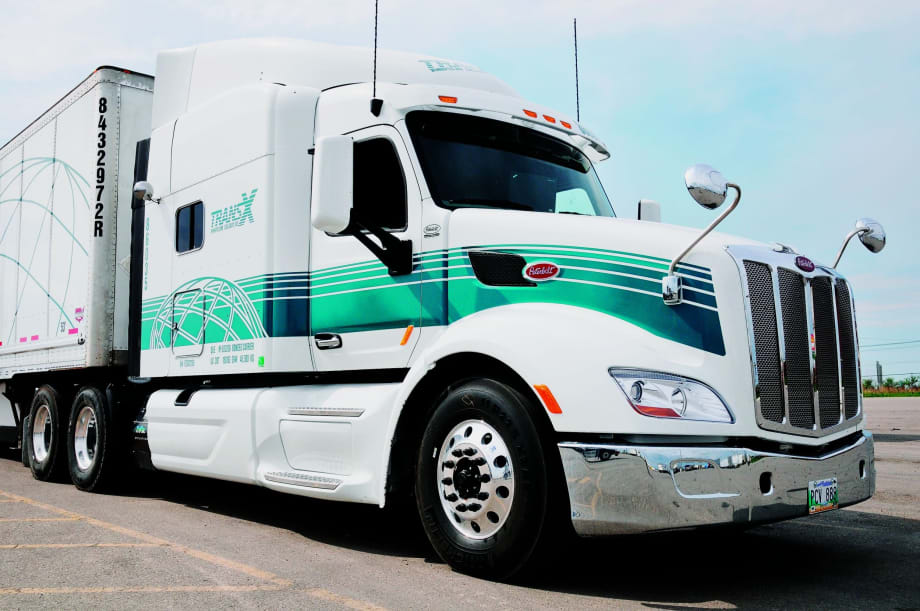
The brand-new Peterbilt Model 579 loaned to us by TransX Ltd. had less than 40 miles on the clock. The SmartAdvantage powertrain makes it a very nice place to work. Photo: Jim Park
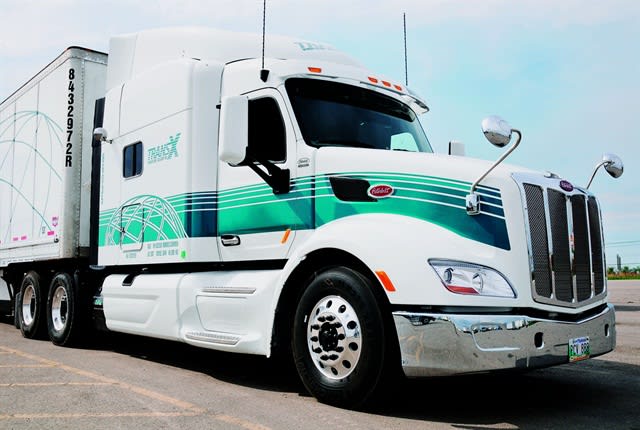
The brand-new Peterbilt Model 579 loaned to us by TransX Ltd. had less than 40 miles on the clock. The SmartAdvantage powertrain makes it a very nice place to work. Photo: Jim Park
Cummins and Eaton may have finally nailed it with their SmartAdvantage Powertrain combo. The marketing literature shows the Cummins engine in its natural red, bolted to a blue Eaton transmission. They could easily have made them both the same color, given how closely they now seem to be tied.
The close collaboration between the two engineering groups has definitely paid off, leaving precious little to complain about. The Eaton Fuller Advantage that’s part of the SmartAdvantage powertrain is a very smooth-shifting, low-rpm, automated manual transmission that offers weight savings, eliminates the need for an external cooler, requires less lubricant and delivers all the fuel-saving features we could ask for from a box full of gears. Of course Cummins makes a large contribution to the effort too, with its SmartTorque2 and Vehicle Acceleration Management features. The engine and transmission share critical data, determining the torque required to deliver the power level drivers need in the most fuel-efficient way.
I had a full day last month to get to know this new combo a little better. I visited the Winnipeg, Manitoba terminal of TransX Ltd. The company had ordered a significant number of the new powertrains, and graciously delayed putting one of them into service so I could drive it right off the showroom floor, so to speak. TransX has about 1,700 trucks and about 4,000 trailers running across Canada and all through the lower 48. The company sits in the number 3 position of Canada’s top carriers.
Company president and owner, Louie Tolaini, a veteran driver who started trucking the late 1950s with a truck that didn’t even have a driver’s door, says he’s quite impressed with the SmartAdvantage combo so far.
“It’s the first time I can remember a manufacturer promising something and the product performing even better than they said it would,” he says. “Drivers complain about their seats, for heaven’s sake, but I haven’t yet heard a complaint about this new engine and transmission.”
The SmartAdvantage uses an interesting transmission that has a lot in common with the manual version, called Fuller Advantage. Eaton’s Ryan Trzybinski, Product Planning manager for NAFTA Commercial Vehicle Business, says the Advantage concept for both products is based on a new precision lubrication system that sprays lubricant directly into the gear mesh rather than relying on the traditional oil bath to splash lubrication throughout the case.
“The reduced churning losses with the precision lube system can improve fuel economy by 1.5% to 2%,” he says. “On top of that, the oil cooler has been eliminated, saving more weight and up to 12 feet of tubing. We also changed some non-stress bearing parts of the housing from cast iron to aluminum, saving a total of about 82 pounds on the SmartAdvantage system.”
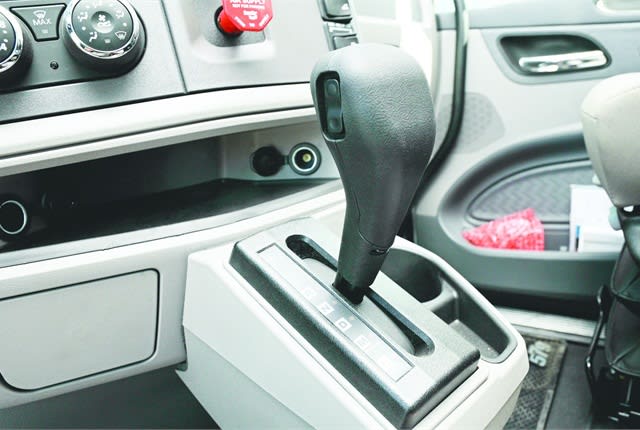
Eaton’s Advantage driver interface is easy to use, and the upshift and downshift are in exactly the right place. Photo: Jim Park
The difference between the manual and automated versions of the Fuller Advantage transmission is the final gear ratio and the step between 9th and 10th gears. The manual version has a 0.73:1 final ratio, while the automated version used in the SmartAdvantage powertrain has a 0.80:1 final drive. The step between the top two gears is 26% rather than the more traditional 37% step found in the manual.
While the intermediate-sized 26% step between 4th and 5th and 9th and 10th might baffle an inexperienced driver using a manual shifter, the automation handles it with aplomb.
“We went with a smaller step between the top two gears to keep the engine within the sweet spot of the fuel map as much as possible,” says Trzybinski. “We worked more closely with Cummins than we have ever done, sharing fuel maps, grade and mass calculations and more, to downspeed the entire drive line. Our goal, using a 2.64:1 drive axle, was an engine speed of 1,145 rpm at the fleet’s intended cruise speed. It will shift between 9th and 10th more often than a traditional overdrive, but that’s intentional to keep the engine speed in the most fuel-efficient range as much as possible.”
The truck I drove had a slightly different axle ratio, 2.92:1 rather than 2.64:1, likely because of Canada’s higher gross weights and dearth of Interstate-like highways. I noted engine and road speeds of 1,200 rpm in 10th gear at 62 mph, 1,075 rpm in 10th gear at 55 mph, 1,500 rpm in 9th gear at 62 mph and 1,200 rpm in 9th gear at 50 mph.
Gearing the truck the way Eaton recommends would produce engine speeds about 50 rpm lower than I observed.
Cummins says peak torque in the top two gears is 1,750 pounds-feet at a fuel-sipping 1,000 rpm. That gives the engine plenty of latitude before downshifting. Cruising on level ground, the ISX usually drifted down to 1,050 before downshifting. On a slight grade the transmission downshifted from 10th to 9th at 1,050 at 58 mph.
There are no hills anywhere close to where I started in Winnipeg that would demand a downshift from 9th to 8th, but I did run over a railroad overpass -- about 2%, I estimate -- several times at different speeds to simulate a sustained pull. Starting into the hill at 50 mph in 9th gear, it downshifted into 8th at 1,050 rpm.
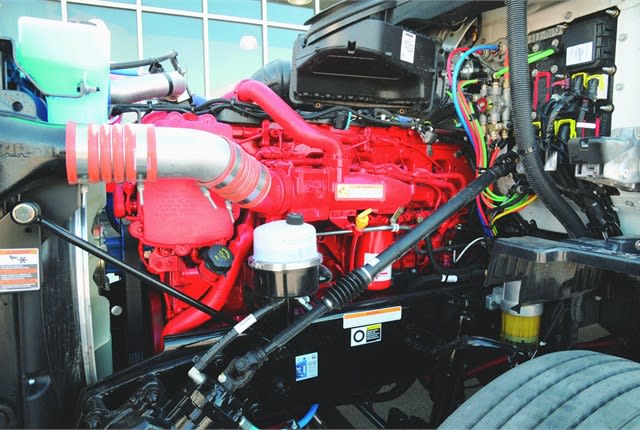
At 450 horsepower, the big-block ISX isn’t exactly working up a sweat. It’s adequately powered, but the 1,750 pounds-feet of torque in the top two gears make it feel a whole lot bigger. Photo: Jim Park
From a full stop up to cruise speed, this transmission proved to be the smoothest-shifting Eaton automated I’ve ever driven. I don’t think the engine ever exceeded 1,300 rpm under normal, unhurried acceleration. With my foot right into it, it climbed to 1,400 a couple of times, but that was the exception.
The truck I drove had an rev limiter set to 1,600 rpm, but it only went that high once. This proved problematic on another occasion when I was looking for a faster takeoff, where 1,900 or 2,000 rpm might have helped. The engine wouldn’t let me go there. Cummins says the rpm limiter is a customer-preference setting.
Cummins also has developed a clever system called Vehicle Acceleration Management that limits power output very judiciously, thus eliminating fast launches. A diligent driver of a loaded truck would never notice the difference. A hot dog driver on a lightly loaded truck might suspect his or her fuel filters were partially plugged. It takes off a little slower than might be expected, but it gets up through the gears quickly enough.
During a spell of city driving, I never noticed the transmission hunting for a gear. Every gear choice was the right one and all the shifts were in exactly the right engine speed range. When coasting into a traffic light, it downshifted low in the engine’s rpm range, so I found myself manually downshifting to get the revs up for better engine brake performance. That was done through a simple and intuitive touch of a button on the shifter knob.
I did have to slide the fifth wheel forward, and I found that exercise a little awkward without a clutch pedal. The clutch engages as the throttle pedal is depressed, so modulating the torque to the drive wheels was a bit tricky.
Trzybinski admits it takes a bit of getting used to, and said fleets would be wise to explain to drivers how it should be done before the need arises.
“It would be very difficult to damage the clutch doing that, because we’ve added the ability to sense clutch abuse,” he says. “If it overheats, a ‘clutch abuse’ warning light comes on. If the abuse continues, the transmission will eventually not go into gear until it cools down. It’s a logged fault code, so drivers with high incidences of CA warnings can be coached.”
Eaton’s product literature says the Fuller Advantage automated transmission weighs just 564 pounds (less clutch housing, lubricant and end yoke), which makes it the lightest automated manual in their portfolio. It uses roughly half the lube of its competitors (based on literature comparisons), and it’s much tamer than some of Eaton’s past automated manuals.
Eaton and Cummins say the SmartAdvantage powertrain offers fuel savings of 3% to 6% compared to a baseline 2013 Cummins ISX15 mated to an LAS (linehaul active shifting) UltraShift Plus transmission.
Stacked up, the SmartAdvantage’s advantages look pretty appealing. Add to that very, very good drivability, and you have a powertrain option that puts Eaton and Cummins squarely back in the game.
The Cummins/Eaton SmartAdvantage powertrain is available at International, Paccar and Volvo. Cummins says the ISX12 diesel will be available with the SmartAdvantage package by the third quarter 2014, and that a package for a higher 110,000 GCW is in the works.
More Fuel Smarts

How Volvo Updated Its D13 for EPA 2027 [Watch]
Volvo’s updated D13 promises lower emissions without sacrificing performance or fuel economy. Take a closer look at what changed inside the engine in this HDT Spotlight video.
Read More →
Diesel Price Spike Shortens Payback for Natural Gas Trucks, Report Says
Energy Vision estimates fleets could recover the higher purchase price of an RNG-fueled Class 8 tractor in 1.3 to 2.8 years under current fuel-price scenarios.
Read More →
Calstart Becomes Catalyst Mobility, Reflecting Broader Focus
Calstart is now Catalyst Mobility, reflecting the nonprofit’s growing national role in clean transportation, including zero-emission trucks, infrastructure and incentive programs.
Read More →

Record Diesel Prices Squeeze Trucking Fleets
Average U.S. diesel prices have climbed to nearly $6 a gallon, surpassing the 2022 record as tight refinery capacity and Middle East disruptions keep fuel costs elevated.
Read More →
How Fuel Delivery Shapes Engine Performance
Fuel delivery depends on more than what happens at the injector. For fleet, maintenance and technical professionals, looking at the full path from pump to injector can provide useful context for understanding engine performance.
Read More →
East Coast Port Launches $45M Electric Truck Push
The Port Authority of New York and New Jersey announced millions in incentives for zero-emission drayage trucks, yard tractors, and new charging hubs near the port.
Read More →
California Bill Could Shed Light on Electric Truck Prices
Why do battery-electric Class 8 trucks remain so expensive? A California bill headed to Gov. Gavin Newsom would give fleets and state agencies more visibility into what manufacturers charge.
Read More →
Detroit Opens Orders for EPA 2027 Engines
Detroit isn’t starting from scratch to meet EPA 2027 diesel emissions standards. Its Gen 6 DD13 and DD15 engines keep much of today’s platform while updating the fuel and aftertreatment systems.
Read More →
Zero-Emission Truck Corridor Planned for West Coast
California, Oregon, Washington, British Columbia and Baja California are coordinating plans for truck charging and hydrogen fueling from Canada to Mexico.
Read More →
A Closer Look at Kenworth’s Electric T880E Vocational Truck [Video]
Learn more about Kenworth's T880E battery-electric vocational truck at the Paccar Technical Center, including its range, applications, upfitting considerations, and PTO options, in this HDT Spotlight video.
Read More →