





The shift to the independent contractor model "is correlated with a 30% decline in wages between 1980 and 1995."
Contractor/Employee Debate Heating up at Ports
Are drivers who handle the drayage of intermodal containers into and out of the nation's ports employees or independent contractors? The controversy was visible this week at ports on both coasts.
July 23, 2015
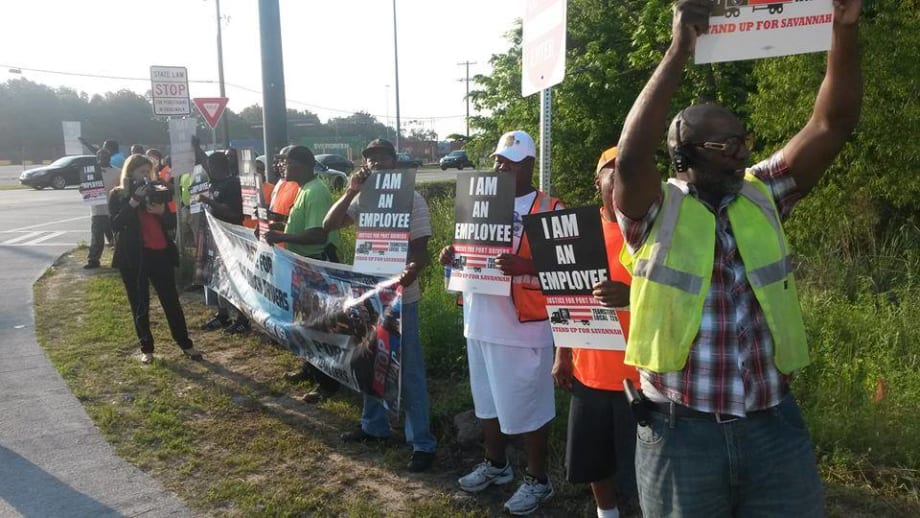
Some port drivers in Savannah believe they are "misclassified" as independent contractors. Photo via Justice for Port Truckers.
5 min to read
Some port drivers in Savannah believe they are "misclassified" as independent contractors.Photo via Justice for Port Truckers.
Are drivers who handle the drayage of intermodal containers into and out of the nation's ports employees or independent contractors? The controversy was visible this week at ports on both coasts.
The Teamsters union has been active in trying to get independent contractors at the ports declared employees. By law, independent contractors cannot be part of a labor union. Some truckers agree that port companies are improperly misclassifying workers and creating hardship for drivers. Others would rather maintain their status as independent businesspeople.
At the Los Angeles-Long Beach ports, this week saw the sixth strike against Pacific 9 Transportation. Across the country in Savannah, Ga., port truckers testified as the Georgia Senate held a committee hearing on employee misclassification.
A 2014 report by the National Employment Law Project says approximately 80% of port truck drivers are labeled independent contractors and estimates that 80 percent of those, or 50,000 workers, are misclassified. The report says the shift to the independent contractor model "is correlated with a 30% decline in wages between 1980 and 1995," but it is unknown if the report took into account the 1980 deregulation of the trucking industry, which resulted in lower trucker profits and wages overall.
Southern California
In Southern California, state agencies have ruled in a number of cases that the drivers at individual companies were misclassified as independent contractors. The Teamsters union now represents more than 400 drayage company drivers in the region.
This week's strike against Pacific 9 is the latest in an ongoing battle between the company and the Teamsters-backed group Justice for Port Drivers.
In April last year, Pac 9 reached a settlement with the National Labor Relations Board and agreed the drivers were employees. However, according to Barb Maynard with the Justice for Port Truck Drivers/Teamsters Port Division, the company never implemented the agreement to convert the drivers to employees, so the NLRB withdrew the settlement and the charges remain pending.
Meanwhile, the Pac 9 drivers' wage and hour claims with the California Division of Labor Standards Enforcement remain active, with hearings set to begin Monday.
One company that had previously been targeted by the Teamsters decided to open a sister company this year, Eco Flow, where drivers voted this month to join the Teamsters union. Eco Flow is owned by Los Angeles investment company Saybrook Capital, which also owns TTSI, a drayage company that has operated in Los Angeles-Long Beach port for years. Vic La Rosa is president of both companies, reports the Journal of Commerce, and TTSI continues to do business on the owner-operator model.
Maynard reports that some Pac 9 drivers, while on strike earlier this year, applied for work as employees with Eco Flow.
Working its way through the California state legislature is a bill, AB 621, which would give port drayage companies an opportunity to voluntarily participate in a limited amnesty program by entering into a consent decree that would require the motor carrier to pay all wages and benefits owed to previously misclassified independent contractors and all taxes owed to the state. In exchange, the motor carrier would be relieved of liability for statutory or civil penalties.
Savannah
In Savannah, a group called Stand Up for Savannah claims that after expenses, the owner-operators in the second-largest East Coast port end up grossing $6.90 an hour.
This week, members of that group, as well as legal experts, trade groups and a labor union, testified at a hearing held by the Georgia Senate Insurance and Labor Committee assigned to study the issue of worker classification.
According to BusinessinSavannah.com:
More than a dozen truckers took a turn at the microphone to share their complaints with senators. Some talked of attempts 25 years ago to address the same issue — attempts that resulted in their being cited for violating federal laws against collusion. A couple called for a strike that would cripple port operations, and one even warned that frustrations could boil over to the point of violence.
However, not all port owner-operators are clamoring to organize and become employees. One of them is Jim Stewart, a longtime port owner-operator in Savannah.
Responding to some of the testimony reported on at the recent hearing, Stewart says, "Anyone who is forced to live in his truck because he is homeless, due to the fact he hauls cargo so damn cheap, was never in the trucking business in the first place. They blame everyone but themselves for their own mistakes." Nobody, he says, "forced" these drivers to sign a contract to lease/buy a truck.
If these drivers want to be employees, Stewart says, they can get a job with a company as an employee. "Why change laws that affect the majority of truckers out here who are perfectly happy in an ownership situation?"
Stewart suggests that if Teamsters or government officials truly were interested in bettering the truckers' situation, they would focus on federal "truth in leasing" laws so drivers would be less likely to sign independent contractor agreements that treat them like indentured servants.
Congestion and cash-strapped states
Other factors play into this battle, as well, including the increasing problems with congestion at the ports, and states looking to fill coffers that still haven't recovered from the Great Recession.
Port owner-operators who can make multiple short trips each day actually can earn more money than if they were paid by the hour like most employee drivers. However, as major ports have become more congested, drivers have lost earning power, leading them to push for unionization, which can only be achieved through becoming employees rather than contractors.
In addition, as states struggle to balance budgets, more state legislators are becoming interested in cracking down on employee misclassification and what's known as "wage theft."
For instance, in 2013, New Jersey passed a bill to clamp down on misclassification in the trucking industry, especially at ports, but it was vetoed after efforts from the New Jersey Motor Truck Association.
More Drivers

Truck Drivers Need More Than Another Alert
Fleets have more visibility into truck health, safety events, and driver activity than ever. The next challenge is turning all that information into useful guidance for the person who has to decide what to do next.
Read More →
FMCSA Removes 110 Truck Driver Training Schools from Certified ELDT List
Federal regulators also are targeting more than 160 additional training providers and launching a nationwide audit of third-party CDL skills testers as part of a broader crackdown on trucking fraud.
Read More →
Hours of Service Pilot Programs: FMCSA Readies for 2027 Rollout
Two pilot programs could eventually reshape hours-of-service rules, giving truck drivers options to pause their 14-hour clock or use longer split sleeper rest periods.
Read More →
Medical Cards, English Proficiency Reshape Roadcheck Violations
Medical-card violations jumped to the top of the driver out-of-service list during CVSA’s 2026 International Roadcheck, while English-language proficiency violations appeared among the leading violations for the first time.
Read More →
Driver Trust Can Make or Break the Success of Fleet Safety Technology
New Teletrac Navman research suggests that onboarding, transparency about driver data, and positive feedback can play a significant role in how commercial drivers respond to safety and coaching technology.
Read More →
EEOC Sues KLLM Over Alleged Sex Discrimination in Driver Training
KLLM is facing a federal sex-discrimination lawsuit over policies the EEOC alleges put female truck driver trainees at a disadvantage.
Read More →
FMCSA Moves to Codify English Language Requirements for Commercial Drivers
By changing regulations on English-language proficiency requirements for commercial drivers, rather than relying on a guidance memo, the FMCSA said future administrations won't be able to walk back the Trump administration's stricter enforcement with just a memo.
Read More →
Drivers Put Western Star Trucks to the Test at Star Nation Experience
Watch to get an inside look at the Western Star trucks, technology, and community behind the Star Nation Experience 2026!
Read More →
Trump Administration Looks to Put More Veterans Behind the Wheel
The Freedom Haulers program pulls together existing and expanded programs at several federal agencies to recruit veterans to drive commercial heavy-duty trucks and cut the red tape for them to get a CDL, training, and employment.
Read More →
Putting Mack’s Command Steer to the Test
A test drive of Mack’s Command Steer active steering system evaluates how it can make truck driving easier and less tiring.
Read More →