




Obama Administration Weighs In with Highway Bill
The Obama administration put down its marker for the next highway program with the GROW America Act, a $302 billion, four-year bill funded by a one-time infusion from a change in the corporate tax code. The House and Senate are working on their versions with no word yet on how they will pay for them, although the Senate Finance Committee will hold a hearing May 6: New Routes for Funding and Financing Highways and Transit.


Photo: Evan Lockridge
The Obama administration put down its marker for the next highway program with the GROW America Act, a $302 billion, four-year bill funded by a one-time infusion from a change in the corporate tax code.
The House and Senate are working on their versions with no word yet on how they will pay for them, although the Senate Finance Committee will hold a hearing May 6: New Routes for Funding and Financing Highways and Transit.
The administration’s bill continues the work of the current law by proposing measures to speed up project delivery, improve the governance of the program and expand financing methods. And it contains no earmarks. But it departs from past practice with a provision that would allow tolling on existing Interstates, a move that is drawing fire from trucking and other highway interests.
The bill also proposes a fundamental change in the trucking industry’s business model. Over-the-road drivers typically are paid by the mile, but the bill would require carriers to pay drivers at least the federal minimum wage for time spent waiting to be loaded or unloaded.

Photo: Evan Lockridge
“The (Federal Motor Carrier Safety Administration) believes that safety could be significantly increased if drivers were compensated for these waiting periods,” the administration says in its analysis of the bill.
In another important provision, the bill proposes $10 billion for investment in freight transportation and gives “shippers, transportation providers and freight workers a real seat at the table for making investment decisions.”
Specifically, the bill would create incentives for states to prepare strategic multimodal freight plans and coordinate with neighboring states.
It also has numerous truck safety provisions that mostly refine current programs, although there are at least two new initiatives.
One would eliminate carriers’ ability to submit proof of qualification as a self-insurer in lieu of other security such as bonding.
FMCSA said it has determined that the self-insurance program, which benefits fewer than 50 carriers, does not improve safety.
Another provision would let FMCSA recall electronic logging devices that do not meet certification standards. This is in anticipation of the electronic logging mandate that is pending at the agency.
Funding
The heart of the bill is a one-time adjustment to the corporate tax code that would yield $150 billion for the Highway Trust Fund.
It is a sign of the times that this idea, a long shot at best, may be the most likely route to success for funding the next highway bill.
The Fund, the principal source of money for the federal highway program, is on track to run into the red by late August. This is forcing state transportation departments to suspend future projects, which in turn is raising the pressure on Congress to do something about funding.
Any reform to the tax code has a high degree of political difficulty but this one at least offers the hope of partisan compromise. Rep. Dave Camp, R-Mich., chairman of the House Ways and Means Committee, also has proposed corporate tax reform as a way to pay for the next highway bill. The two proposals differ in detail but both arise from the same impetus to improve the corporate tax code and promote growth, as well as to replenish the Fund.
Neither party wants to pay for the highway program the old-fashioned way, by raising the federal fuel tax. Some on Capitol Hill are advocating that approach, but they are too few to have an impact.
Since Congress is not likely to come to terms on this before the Fund runs into the red, it will have to extend the current program with funds from the general treasury, as it has done in the past.
Close followers on the Hill foresee an extension of the current program that gets members past the November elections and into early next year. Another possibility: uncertainty about the outcome of the election – there’s at least the possibility that control of the Senate could flip to the Republicans – could generate support for yearlong extension.
The administration said it is offering this approach but is open to all ideas. “(We) will work closely with Members of Congress of both parties on a solution that will invest in more job creating transportation projects,” the administration said.
Reaction
Sen. Jay Rockefeller, D-W.Va., said the bill is a step in the right direction. He chairs the Senate Commerce Committee, which has responsibility for the safety provisions of the bill and which will hold its first hearing May 7.
He said he’s pleased that the administration proposed significant new funding and will consider their approach, but added that it will not be easy to settle on a solution.
Another important voice, the U.S. Chamber of Commerce, also said the bill is a step forward and contributes to the debate but the funding proposal does not hit the mark.
“The Chamber continues to believe that raising federal gasoline and diesel taxes is the simplest, most straightforward way to address the revenue problem in the near term,” said Bruce Josten, executive vice president for government affairs.
American Trucking Associations, also a strong supporter of the fuel tax as the primary mechanism for paying for highways, said that apart from its support for growing the highway program, the bill is a disappointment.
“Any proposal that moves away from a user fee funded transportation system is not going to be acceptable to the American trucking industry, period,” said ATA President and CEO Bill Graves in a statement.
The association also has doubts about viability of the administration’s plan to use one-time proceeds from a tax reform idea that is unlikely to pass, coupled with inefficient highway tolling or private capital financing, Graves said.
ATA also is concerned about the proposal to require carriers to pay drivers for wait time. DOT is trying to impose a one-size fits all compensation model on a diverse industry, said Dave Osiecki, executive vice president.
The Owner-Operator Independent Drivers Association applauded the administration’s bid to get drivers paid for wait time, and to eliminate the self-insurance option.
But OOIDA opposes the tolling provision and said the funding approach is shortsighted.
The International Bridge, Tunnel and Turnpike Association applauded the administration’s move to lift the ban on tolling Interstates, but other interests, including ATA, strongly oppose the idea.
Tolling is an inefficient way to raise highway money, said Miles Morin of the Alliance for Toll Free Interstates.
“The option for states to place tolls on existing interstate capacity has existed for 23 years and not a single state has used tolls in this way – not just because the idea is unpopular, but because it’s bad policy,” Morin said in a statement.
UPS chairman and CEO Scott Davis was supportive of the proposal in general.
“UPS commends (Transportation) Secretary (Anthony) Foxx and the U.S. Department of Transportation for their commitment to a plan that would increase the capacity, fluidity and connections of America’s integrated surface transportation network,” Davis said in a statement.
AAA, the leading automobile advocacy group, applauded the administration for being first out of the gate but said the funding provision falls short.
“This proposal does continue the trend of addressing the Highway Trust Fund shortfall with a solution that is short-term and politically palatable rather than long-term and fiscally responsible,” said AAA president and CEO Bob Darbelnet in a statement.
Other Provisions
Here’s a quick rundown on other important provisions of the bill.
Increase transit funding by 70%.
Invest $19 billion in rail infrastructure.
Expand the TIGER (Transportation Investment Generating Economic Recovery) program by $5 billion over four years.
Provide $4 billion to TIFIA (Transportation Infrastructure Finance and Innovation Act) to support $40 billion in loans.
Raise the cap on Private Activity Bonds from $15 billion to $19 billion. PABs allow private entities to issue tax-exempt bonds for certain highway and freight projects.
Give FMCSA more flexibility to decide whether or not to conduct a new entrant safety audit. The audits are not as effective as other enforcement mechanisms, the agency said.
Require FMCSA to disqualify a driver for at least a year and perhaps permanently if he operates a truck after his CDL has been revoked, suspended or cancelled for offenses while driving another vehicle.
Drop the requirement that audits and investigations of Mexican carriers approved for the long-distance cross-border pilot program be done on-site in Mexico.
By the way: the title, GROW America Act, represents a good morning’s work for legislative wordsmiths. It stands for Generating Renewal, Opportunity, and Work with Accelerated Mobility, Efficiency, and Rebuilding of Infrastructure and Communities throughout America.
More Fleet Management

What the U.S.-Canada Trade War Means for Trucking
Escalating U.S.-Canada tariffs could disrupt cross-border freight, reduce truck volumes, raise costs, and create new uncertainty for carriers on both sides of the border.
Read More →
What Are Trucking’s Top Concerns for 2026?
The American Transportation Research Institute wants to know what's worrying trucking fleet managers, drivers, and other stakeholders in its annual Industry Issues survey.
Read More →
American Trucking Associations Looks for a New Leader
ATA President and CEO Chris Spear abruptly left his job at the association on August 21, at a pivotal time for the trucking industry.
Read More →
Public Wi-Fi Cybersecurity Risks: How Truck Drivers and Fleets Can Protect Their Data
Public Wi-Fi can expose truck drivers and fleets to credential theft, malware, and other cyber threats. Here’s how to reduce the risk on the road.
Read More →
For Nicky Cupp, Fleet Innovation Starts With Frustration
HDT Truck Fleet Innovator Nicky Cupp turns everyday pain points at Fraley & Schilling into opportunities for better technology and smarter processes.
Read More →
Adam Buttgenbach’s Approach to Electric Trucks: Start With Where They Fit
HDT Truck Fleet Innovator Adam Buttgenbach helped PepsiCo build one of North America’s largest EV fleets by focusing on where electric trucks make operational sense.
Read More →
Deen Albert: Let Automation Do the Math, People Make the Decisions
HDT Truck Fleet Innovator Deen Albert makes sure people are still at the heart of operations at Grand Island Express, even while adopting artificial intelligence tools. AI-assisted dispatch helped boost revenue 25% with the same number of trucks.
Read More →
Trimble’s New AI Agent Takes Aim at Fleet Back-Office Busywork
Arc Agent works across Trimble TMS products to automate repetitive tasks such as freight orders, maintenance, invoices, fuel costs and more.
Read More →
How HDT’s 2026 Truck Fleet Innovators Are Rethinking Fleet Operations
Meet five trucking leaders who are challenging assumptions, solving operational problems, and putting innovative ideas to work.
Read More →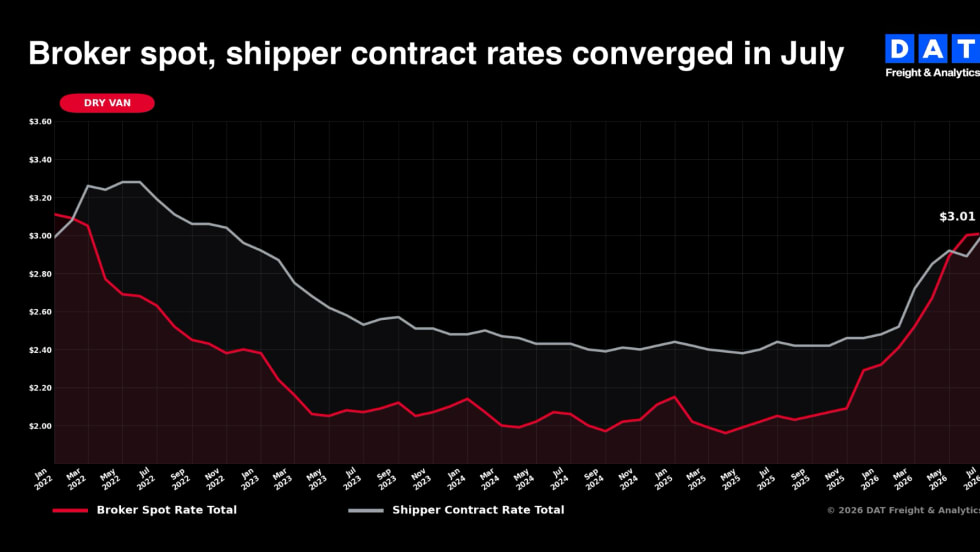
Tight Trucking Capacity Pushes Rates Higher Even as Freight Volumes Fall
“Spot rates moving ahead of contract rates have historically signaled a tightening market, but we haven’t seen a capacity-driven market quite like this one,” said DAT's Dean Croke.
Read More →