




Foxx Sends Highway Funding Proposal to Capitol Hill
UPDATED -- U.S. Transportation Secretary Anthony Foxx on Tuesday unveiled a long-term transportation bill he is sending to Congress for consideration as the House and Senate face looming deadlines to avoid the Highway Trust Fund running out of money this summer, but at least one part of it will likely draw controversy.
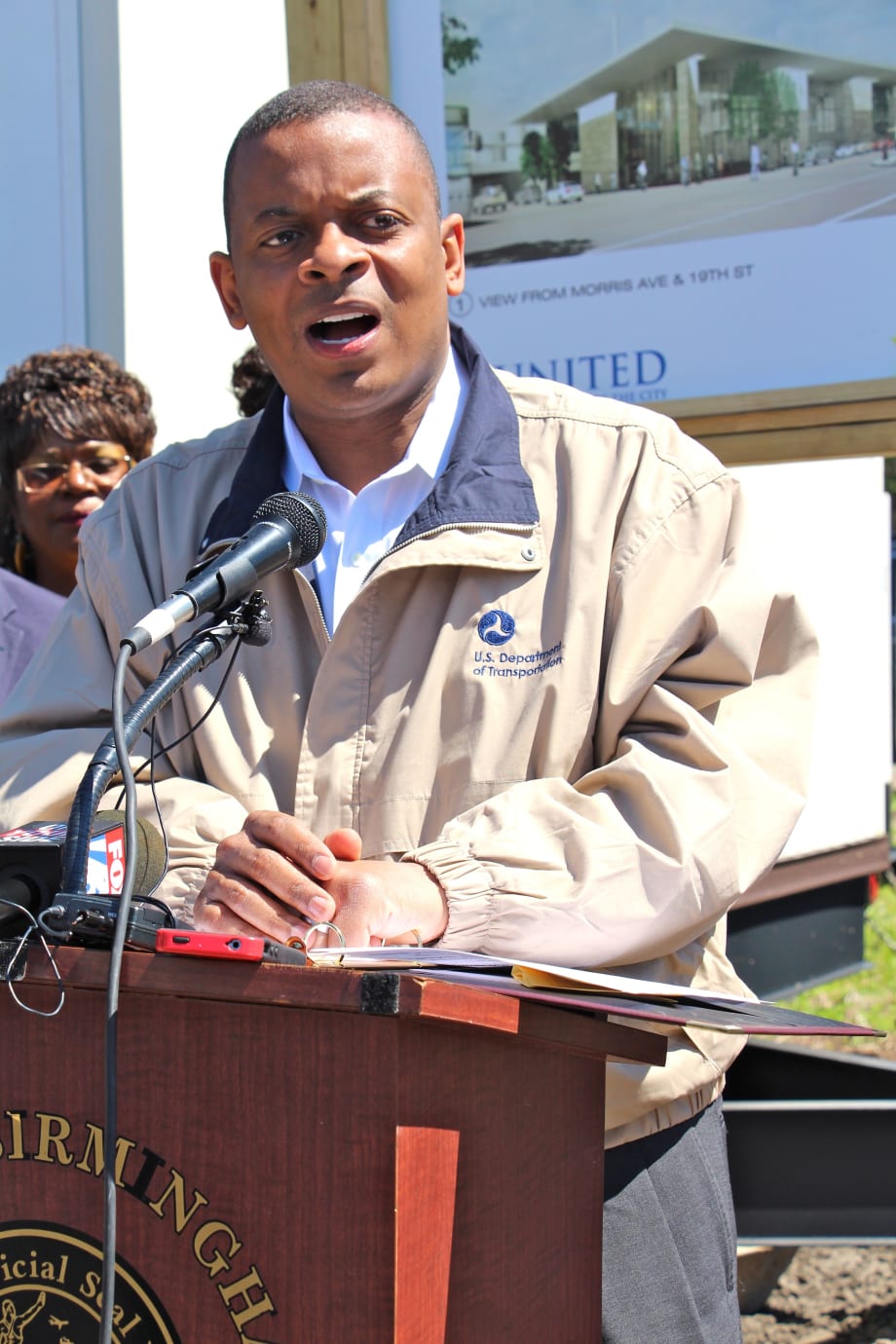
DOT Secretary Anthony Foxx in Birmingham, Ala, earlier this month on his bus tour. Photo: Evan Lockridge

DOT Secretary Anthony Foxx in Birmingham, Ala, earlier this month on his bus tour. Photo: Evan Lockridge
UPDATED -- U.S. Transportation Secretary Anthony Foxx on Tuesday unveiled a long-term transportation bill he is sending to Congress for consideration as the House and Senate face looming deadlines to avoid the Highway Trust Fund running out of money this summer, but at least one part of it will likely draw controversy.
The Grow America Act is a $302 billion, four-year surface transportation reauthorization proposal as outlined in President Obama’s budget for the 2015 fiscal year, which begins October 1, and is also when the current spending authorization expires.
According to Foxx the plan represents a number of proposals that have historically attracted bipartisan support including:
Addressing the shortfall in the Highway Trust Fund and providing an additional $87 billion to address the nation’s backlog of deficient bridges and aging transit systems;
Providing certainty to state and local governments that must engage in long-term planning;
Bolstering efficient and reliable freight networks to support trade and economic growth; and
Creating incentives to better align planning and investment decisions to comprehensively address regional economic needs while strengthening local decision-making.
In a news release, heads of all the DOT agencies, including the Federal Motor Carrier Safety Administration, were quoted about the plan.
“It will ensure fair pay for long-distance bus and truck drivers who are often paid by the miles they travel, not their total time on-duty, and face economic pressure to jeopardize safety by driving beyond the mandatory limits,” said Federal Motor Carrier Safety Administrator Anne Ferro.
Among the more controversial parts of the measure is language that would remove the current federal prohibition against putting tolls along existing interstate routes that currently have no tolls and would allow variable tolls on highways, bridges, and tunnels to manage traffic volume.
Earlier this month, Foxx traveled across the country on his Invest in America, Commit to the Future bus tour, with visits to manufacturers, bridges, freight facilities, and highway projects to raise awareness of America’s infrastructure deficit.
“I visited eight states and 13 cities as part of my Invest in America, Commit to the Future bus tour this month and everywhere I went, I heard the same thing, people want more transportation options and better roads and bridges to get them where they need to go,” said Foxx. “Failing to act before the Highway Trust Fund runs out is unacceptable and unaffordable. This proposal offers the kind of job creation and certainty that the American people want and deserve.”
According to the U. S. DOT, with the current uncertainty of federal transportation investment, many states have postponed or canceled needed transportation projects altogether.
“Despite this growing need, the Highway Trust Fund, which provides most of the federal support for state transportation projects, is on track to start bouncing checks as early as August,” the department said in a release
In January, the Department of Transportation began posting a ticker online so people can track the remaining funds, with it showing the trust fund becoming insolvent in late August or early September.
Action is expected soon on the highway funding issue, with a bipartisan group of Senators agreeing earlier this month on the outline of bill to reauthorize the federal highway program, but they still have to resolve how to pay for it.
In February, President Obama and Rep. Dave Camp both suggested one-time infusions to the Highway Trust Fund.
Obama called for $302 billion over four years in a proposal to reauthorize the federal highway program. About half of the money, $150 billion, would come from corporate tax reform, and $63 billion would go to plugging the hole in the Trust Fund.
Camp, R-Mich., Chairman of the House Ways and Means Committee, released a plan to comprehensively reform the tax code that would dedicate $126.5 billion over eight years to the Trust Fund.
In the meantime, there are a variety of other plans being kicked around Congress, including one from Sen. Tom Carper, D-Del., is a longtime supporter of raising federal fuel taxes to pay for highways, who will float that idea with his colleagues as they draft the next highway bill.
Updates adds information about tolling existing Interstate routes.
More Fleet Management

Color Match Smarter: Tools That Restore & Perform
For fleet managers and collision repair professionals keeping heavy-duty trucks on the road, getting the color right the first time isn't just about appearance — it's about efficiency, turnaround time, and bottom-line results. Discover how today's digital color tools are transforming the repair process from guesswork to precision.
Read More →
FMCSA Pauses Biennial-Update Enforcement Amid Motus Transition
Carriers whose updates were due on or after June 1 have more time, while FMCSA works to stabilize its new registration system and warns of phishing sites impersonating its new carrier registration system, Motus.
Read More →
2026 Blueprint for Countering Smarter Supply Chain Theft
Cargo theft is no longer just the cost of doing business. It's a multi-billion-dollar criminal enterprise exploiting vulnerabilities across your fleet, drivers, and supply chain.
Read More →


How Telematics Improves Visibility, Control, and Performance in Refrigerated Fleets
Explore how telematics help refrigerated fleets improve visibility, uptime, efficiency, compliance, and cargo protection across connected cold chain operations.
Read More →
What the U.S.-Canada Trade War Means for Trucking
Escalating U.S.-Canada tariffs could disrupt cross-border freight, reduce truck volumes, raise costs, and create new uncertainty for carriers on both sides of the border.
Read More →
What Are Trucking’s Top Concerns for 2026?
The American Transportation Research Institute wants to know what's worrying trucking fleet managers, drivers, and other stakeholders in its annual Industry Issues survey.
Read More →
American Trucking Associations Looks for a New Leader
ATA President and CEO Chris Spear abruptly left his job at the association on August 21, at a pivotal time for the trucking industry.
Read More →
Public Wi-Fi Cybersecurity Risks: How Truck Drivers and Fleets Can Protect Their Data
Public Wi-Fi can expose truck drivers and fleets to credential theft, malware, and other cyber threats. Here’s how to reduce the risk on the road.
Read More →
For Nicky Cupp, Fleet Innovation Starts With Frustration
HDT Truck Fleet Innovator Nicky Cupp turns everyday pain points at Fraley & Schilling into opportunities for better technology and smarter processes.
Read More →
Adam Buttgenbach’s Approach to Electric Trucks: Start With Where They Fit
HDT Truck Fleet Innovator Adam Buttgenbach helped PepsiCo build one of North America’s largest EV fleets by focusing on where electric trucks make operational sense.
Read More →