




Survey Digs into Four-Wheeler Confessions
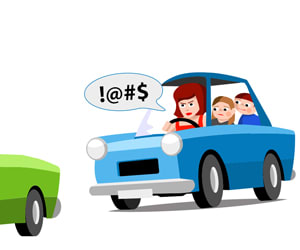
If you see a motorist cussing in front of kids in the car or flipping people off, it's most likely to be a woman, but men aren't pillars of polite driving, either -- at least according to one newly released survey.
Credit: Insurance.com
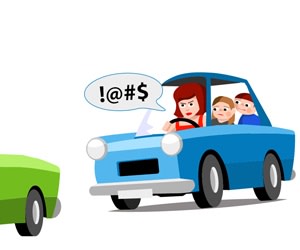
If you see a motorist cussing in front of kids in the car or flipping people off, it's most likely to be a woman, but men aren't pillars of polite driving, either -- at least according to one newly released survey.
Insurance.com
Insurance.com commissioned a survey of 1,000 adults, asking them about their rude driving behavior and if they had any regrets about it.
Meanwhile, men are twice as likely as women to key someone's car or flash drivers with their high-beams just to be mean, survey results show.
Here's what drivers admit to, with results also broken down by gender:
Honked at someone driving too slowly: 41%, (Women: 39%. Men: 43%.)
Swore in front of the kids while driving: 37%, (Women: 44%. Men: 30%.)
Flipped someone off while driving: 29%, (Women: 31%. Men: 27%.)
Brake-checked a car following too closely: 28%, (Women: 30%. Men: 27%.)
Sped up significantly to prevent someone from passing you: 26%, (Women: 25%. Men: 28%.)
Gone when it wasn't your turn at a four-way stop: 19%, (Women: 18%. Men: 20%.)
Tailgated someone on purpose because he or she was going too slowly: 18%, (Women: 21%. Men: 16%.)
Driven to the front of a merge line, then swerved and cut in: 12%, (Women: 11%. Men: 13%.)
Stolen a parking spot someone else was waiting for: 11%, (Women: 9%. Men: 13%.)
Driven in the breakdown lane around traffic: 10%, (Women: 8%. Men: 13%.)
Sped up to block another car with its signal on: 9%, (Women: 8%. Men: 10%.)
Chased after a car that cut you off so you could glare at/flip off the other driver: 9%, (Women: 7%. Men: 11%.)
Swore in front of elderly in-laws while driving: 9%, (Women: 9%. Men: 10%.)
Dinged someone's car in a parking lot and driven away: 8%, (Women: 8%. Men: 8%.)
Turned on your brights at an oncoming car just to be mean: 7%, (Women: 4%. Men: 11%.)
Keyed someone's car: 5%, (Women: 3%. Men: 7%.)
It's likely that most women aren't swearing in front of their children at home, or that anyone is flipping off an annoying person, say, in line at the grocery store. But people feel less inhibited when driving because they feel more anonymous, says Leon James, psychology professor at the University of Hawaii, who has conducted research on driving behaviors.
“Our social behaviors are for the most part conditioned by the social environment. Different rules apply to different places," he says. "The car gives us the illusion of being alone and safe in our fortress. If we do something ugly or inconsiderate we can always get away. But this is different when standing in line with others who are right there next to us."
Our socialization and culture also influence how we act behind the wheel, says James. "Our driving behavior styles are culturally determined. I call the back seat of the car 'road rage nursery.' That's when our driver education begins. We absorb how the parents or other adults drive and how they talk and complain behind the wheel," he says. "We also watch TV scenes and commercials where driving aggressively, fast and with plenty of verbal rudeness are portrayed as attractive and satisfying. So, getting behind the wheel changes the rules."
Some drivers aren't losing sleep over their rude driving habits. One quarter of people who admit to bad behavior while driving said they don't regret any of their past misdeeds.
The least-regretted action was brake-checking cars that are following too closely.
But those with a guilty conscious say they have the following regrets:
Swore in front of the kids while driving: 75%
Dinged someone's car in a parking lot and driven away: 62%
Keyed someone's car: 56%
Swore in front of elderly in-laws while driving: 51%
Gone when it wasn't your turn at a 4-way stop: 51%
Flipped someone off while driving: 47%
Turned on your brights at an oncoming car just to be mean: 46%
Stolen a parking spot someone else was waiting for: 46%
Chased after a car that cut you off so you could glare at them/flip them off: 44%
Driven in the breakdown lane around traffic: 44%
Sped up to block another car with its signal on: 42%
Tailgated someone on purpose because he or she was going too slow: 41%
Driven to the front of a merge line, then swerved and cut in: 36%
Honked at someone driving too slowly: 36%
Sped up significantly to prevent someone from passing you: 36%
Brake-checked a car following too closely: 34%
More Safety & Compliance

ZF Expands Commercial Vehicle Push in North America
ZF is expanding its North American commercial-vehicle presence with new transmission applications, electrification, trailer technology and autonomous-driving systems.
Read More →
Truck Drivers Need More Than Another Alert
Fleets have more visibility into truck health, safety events, and driver activity than ever. The next challenge is turning all that information into useful guidance for the person who has to decide what to do next.
Read More →
Tesla Wants a Self-Driving Semi. Are Cameras Enough?
Could Tesla’s camera-only autonomous driving technology work on an 80,000-pound Semi? In this commentary, HDT's Deborah Lockridge takes a look at Tesla, Cybercab, and how autonomous trucks see the road.
Read More →
What DOT’s Automated Vehicle Strategy Means for Trucking
The U.S. Department of Transportation issued a new automated-vehicle strategy that outlines plans for driverless-truck regulations, cross-state freight corridors, and federal safety standards.
Read More →
NYC Expands Speed, Pedestrian Safety Tech Across Fleet
New York City is expanding intelligent speed assistance and pedestrian-alert systems across its municipal fleet, moving the technologies from pilot programs into vehicle procurement and retrofit requirements.
Read More →
FMCSA Removes 110 Truck Driver Training Schools from Certified ELDT List
Federal regulators also are targeting more than 160 additional training providers and launching a nationwide audit of third-party CDL skills testers as part of a broader crackdown on trucking fraud.
Read More →
Beyond DOT Compliance: What Makes a Trucking Fleet Truly Safe?
A trucking fleet can follow every rule and still make unsafe decisions. The real test comes when safety conflicts with freight, productivity, or cost.
Read More →
Hours of Service Pilot Programs: FMCSA Readies for 2027 Rollout
Two pilot programs could eventually reshape hours-of-service rules, giving truck drivers options to pause their 14-hour clock or use longer split sleeper rest periods.
Read More →
New Guide Offers Pet Safety Tips for Truck Drivers
Hundreds of thousands of pets travel in truck cabs. A new safety guide from Volvo Trucks and the Center for Pet Safety offers practical advice for truck drivers who bring dogs and cats along for the ride.
Read More →
Medical Cards, English Proficiency Reshape Roadcheck Violations
Medical-card violations jumped to the top of the driver out-of-service list during CVSA’s 2026 International Roadcheck, while English-language proficiency violations appeared among the leading violations for the first time.
Read More →