




NHTSA Issues Truck Electronic-Stability Rule
The National Highway Traffic Safety Administration has issued its long-awaited final rule to require electronic stability control (ESC) systems on Class 7-8 trucks and large buses.

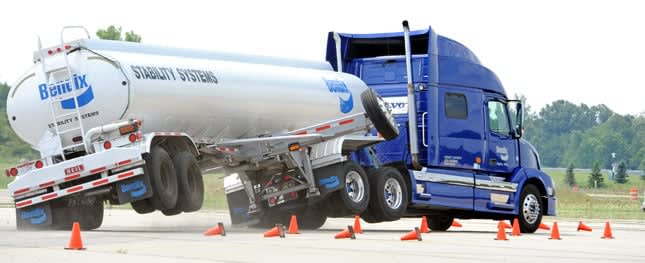
Outrigger-equipped for test-track safety, a rig demonstrates what happens when its electronic-stability control (ESC) system is not activated.
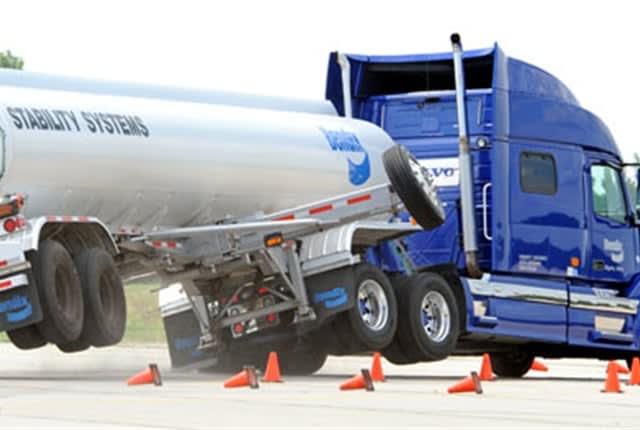
Outrigger-equipped for test-track safety, a rig demonstrates what happens when its electronic-stability control (ESC) system is not activated.
The National Highway Traffic Safety Administration has issued its long-awaited final rule to require electronic stability control (ESC) systems on Class 7-8 trucks and large buses.
The rule, Federal Motor Vehicle Safety Standard 136, will take effect for “most heavy trucks” in 2017, per NHTSA. The agency said that compliance will be achieved using a “J-turn” test that replicates a curved highway off-ramp.
“ESC is a remarkable safety success story, a technology innovation that is already saving lives in passenger cars and light trucks,” Secretary of Transportation Anthony Foxx said upon introducing the new rule on June 3. “Requiring ESC on heavy trucks and large buses will bring that safety innovation to the largest vehicles on our highways, increasing safety for drivers and passengers of these vehicles and for all road users.”
According to NHTSA, the mandate was needed because “ESC works instantly and automatically to maintain directional control in situations where the driver's own steering and braking cannot be accomplished quickly enough to prevent the crash.”
The agency stated that implementing “ESC will prevent up to 56 percent of untripped, rollover crashes-- that is, rollover crashes not caused by striking an obstacle or leaving the road.” NHTSA estimates the rule will prevent as many as 1,759 crashes, 649 injuries and 49 fatalities annually.
“Reducing crashes through ESC in these trucks and buses will save lives-– nearly 50 each year,” said NHTSA Administrator Mark Rosekind. “It will move goods and people more efficiently and reduce the toll crashes take on our economy through traffic delays and property damage. It’s a win for the safety and convenience of the traveling public and for our economy.”
The rulemaking effort dates back at least 2011, when the National Transportation Safety Board first issued a recommendation that ESC be required on heavy-duty vehicles. When the current highway bill (MAP-21) was enacted a year later, one of its provisions directed NHTSA to consider an ESC requirement for motor coaches, which are included in the final rule just issued. Also in 2012, a rule requiring light-duty vehicles to include ESC took effect.
The American Trucking Associations said it welcomed the mandate. “Ensuring the safety of America’s highways has always been ATA’s highest calling,” said ATA President and CEO Bill Graves, “and we’ve long known the positive role technology can play in making our vehicles and our roads safer. Today’s announcement by NHTSA will reduce crashes on our highways and make our industry safer.”
“Last month, NHTSA reported to Congress that truck rollover and passenger ejection were the greatest threats to truck driver safety,” said ATA Executive Vice President Dave Osiecki. “We can save lives by preventing rollovers with electronic stability control technology, and that’s a positive for our industry. Many fleets have already begun voluntarily utilizing this technology and this new requirement will only speed that process.”
Bendix Commercial Vehicle Systems LLC has advised that its supports NHTSA’s choice of ESC for its final rule requiring full-stability technology on heavy-duty vehicles. The manufacturer of ESC systems noted that the mandate will be implemented in three phases, starting August 1, 2017, for most three-axle tractors.
“At Bendix, we always prefer to let the market be the catalyst to drive safety technology adoption,” said Fred Andersky, director of government and industry affairs. “We believe ESC stands alone in terms of safety, performance, and value. And we have also seen a market acceptance of this technology – over RSC [roll stability control] – at a rate of three to one. This technology is another positive step on the part of our industry toward helping to further improve highway safety.”
According to Andersky, full-stability technology,which Bendix markets as its ESP Electronic Stability Program, “fully complies with the NHTSA rule.” He cautioned that it’s “critical for fleets currently equipping their vehicles either with ABS only or with roll-only stability systems to understand three key differences in order to better prepare for the arrival of full stability.”
He outlined those differences as follows:
“Full-stability systems use more sensors than either ABS or roll-only stability systems, creating a more comprehensive system capable of addressing both roll and directional stability. These additional sensors enable the unit to more quickly recognize factors that could lead to vehicle rollovers or loss-of-control. On dry surfaces, this means the system recognizes and mitigates conditions that could lead to rollover and loss-of-control situations sooner than roll-only options. Full-stability technology also functions in a wider range of driving and road conditions than roll-only systems, including snowy, ice-covered, and slippery surfaces. ABS systems are not designed to react to potential roll or loss-of-control situations.”
“Interventions can also differ. Full-stability systems rely on automatic brake interventions involving the steer, drive, and trailer axles, whereas roll-only systems typically apply the brakes only on the drive and trailer axles. Slowing the vehicle quickly helps mitigate rollovers faster, while slowing and redirecting can help the driver maneuver in loss-of-control situations.”
“Stability systems are the foundation for advanced active safety technologies. For example, as a collision mitigation system detects a possible collision with a forward vehicle and automatically applies the brakes in order to prevent or lessen its severity, the brake system should help the vehicle maintain its stability throughout the maneuver. This level of performance is best achieved with a full-stability system that is consistent with the new NHTSA rule.”
Andersky also pointed to the high degree of market acceptance already in place. “In our view, the market had already made its technology choice known prior to the formal introduction of NHTSA’s rule,” he said.
“Industry-wide, full stability is outselling roll-only technology three to one, up from three to two in previous years,” Andersky added. “The increasing adoption of ESC demonstrates the willingness by fleets to invest in the technology because of full stability’s ability to help reduce the number of heavy truck accidents, improve safety records, and deliver the return on investment that fleets need.”
More Fleet Management

Geotab Links Fleet Card to Vehicle Data
The new card combines fuel discounts with telematics-based purchase controls. Geotab’s analysis also points to potential savings from choosing lower-priced fuel stops.
Read More →
How MFA Helps Protect Trucking Fleets
Multi-factor authentication adds protection when passwords are stolen. Here’s how it works and where fleets should start.
Read More →
How Better Freight Data Helps Trucking Teams Get Ahead of Disruption
Trucking and logistics teams have plenty of data. The problem is getting the right information in front of the right people soon enough to act. Better-connected data can help teams spot trouble earlier and make smarter decisions before small problems become big ones.
Read More →

Trimble: Taking Artificial Intelligence in Trucking Beyond Faster Tasks
At Insight 2026, Trimble executives argued that fleets may need to redesign workflows to get more from AI as it introduced new products and enhancements. AI’s value will depend on how fleets combine automation with their people's knowledge.
Read More →
Build a bulletproof fleet: Uniting ELDs and dash cams for total compliance
An ELD can prove compliance, but it cannot always prove what happened on the road. Discover how uniting accurate ELD data with AI-powered dash cam video can help your fleet strengthen compliance, defend against liability, protect drivers and reduce operational costs.
Read More →
Nominations Open for HDT Emerging Leaders
Heavy Duty Trucking is looking for accomplished trucking fleet professionals under 40 who are making an impact and helping lead the industry forward.
Read More →
Why Private Fleets Are Taking More Freight
Private fleets are putting their own trucks on demanding customers and high-cost lanes as companies seek greater control over service, costs, and capacity.
Read More →
Color Match Smarter: Tools That Restore & Perform
For fleet managers and collision repair professionals keeping heavy-duty trucks on the road, getting the color right the first time isn't just about appearance — it's about efficiency, turnaround time, and bottom-line results. Discover how today's digital color tools are transforming the repair process from guesswork to precision.
Read More →
FMCSA Pauses Biennial-Update Enforcement Amid Motus Transition
Carriers whose updates were due on or after June 1 have more time, while FMCSA works to stabilize its new registration system and warns of phishing sites impersonating its new carrier registration system, Motus.
Read More →
2026 Blueprint for Countering Smarter Supply Chain Theft
Cargo theft is no longer just the cost of doing business. It's a multi-billion-dollar criminal enterprise exploiting vulnerabilities across your fleet, drivers, and supply chain.
Read More →