




The Future of Roadside Inspections
You're driving down the road and approaching a truck weigh/inspection station. An amber light blinks on the dash, advising that your driver and vehicle credentials, vehicle condition and trip information are being gathered and transmitted to the inspection station's computers for analysis. A few moments later, the light blinks green.


You're driving down the road and approaching a truck weigh/inspection station. An amber light blinks on the dash, advising that your driver and vehicle credentials, vehicle condition and trip information are being gathered and transmitted to the inspection station's computers for analysis. A few moments later, the light blinks green.
You just went through a Wireless Roadside Inspection, and you passed.
You roll right on by the scale, but the guy behind you wasn't so lucky. His light blinked red because something in the data transmitted by the truck to the scale house didn't add up. He'll be spending the next hour or so in the company of a truck inspector.
That's one tip of a much larger iceberg the Federal Motor Carrier Safety Administration calls its Truck Intellidrive/Freight Mobility initiative. It can be broken down to smaller subsets, including the Smart Roadside Initiative (SRI), Vehicle-to-Vehicle (V2V) communications, Vehicle-to-Infrastructure (V2I) communications, and more. Those and other initiatives are currently being examined by several agencies within the Department of Transportation as ways of improving safety and efficiency while minimizing transportation's environmental impact.
Dan Murray, vice president of research at the American Transportation Research Institute arm of the American Trucking Associations, has been watching and participating in the development of these programs through an organization called the Trucking Industry Mobility and Technology Coalition. It's jointly managed by ATRI, the Commercial Vehicle Safety Alliance, the U.S. DOT, ATA and others, and is developing a road map or a framework that shows what all this stuff is doing and what impact it all might have on the players involved.
Murray calls this DOT initiative a monumental program with fingers that extend everywhere, down to state and local governments, throughout the entire U.S. DOT, across the entire trucking industry and even into Detroit and the automotive sector.
There's no simple way to describe the impact all this could have on trucking except to say it's a game-changer.
There are two primary directions DOT's research and testing are going. One is to have all vehicles equipped with dedicated short range communications (DSRC) devices (V2I) to provide proximity warnings to and about other vehicles that would, upon sensing an incursion threat, initiate a crash avoidance procedure. The other is to develop an infrastructure where trucks would transmit data to a fixed (inspection station) or mobile (police cruiser) reader that would effectively inspect the truck electronically (SRI) based on sensor information and data gathered on various data buses on the truck. This would include driver credentials as well.
Among the challenges faced in this scenario, Murray cites as an example the protocols required to facilitate DSRC communications. Right now, DOT is pushing the 5.9 GHz protocol. It's a technology almost non-existent in trucking at the moment.
"This is perceived as the best means of messaging other vehicles at speeds fast enough to make a difference in crash avoidance at highway speeds. Cellular or Wi-Fi could never respond fast enough to recognize a threat and initiate appropriate action," Murray says. "If they're looking at a 5.9 GHz system on the truck to do something, and you don't already have it, presume that you will have to buy, install and maintain it. The upside might be that it will mitigate or prevent 6 percent of the most expensive crashes in the U.S."
The purpose of SRI is to improve the frequency and efficiency of vehicle inspections. The problem, as illustrated by Chris Flanigan of FMCSA's Office of Analysis, Research and Technology, is that physical roadside inspections are too infrequent compared to the number of face-to-face encounters trucking has with enforcement.
Flanigan pointed out that in 2008, 3 million truck inspections were conducted with a 73 percent violation rate resulting in a 25 percent out-of-service rate. Compare that with 177 million weigh inspections (staffed and weigh-in-motion) with a mere 515,587 citations - a 0.29 percent violation rate. The DOT position is that far too much time and money are spent weighing trucks for the safety gains produced.
DOT is now working toward electronic inspections where all the pertinent data could be transferred from the truck to the inspector instantly, analyzed, and responses generated in fractions of a second.
The way DOT sees it, "motor carrier safety could be improved through dramatic increases in roadside safety inspections via wireless inspections using proven technologies and processes. Driver and vehicle safety assessments occur frequently enough to ensure compliance while minimizing disruptions to safe and legal motor carrier transportation," Flanigan said during his presentation at the Technology and Maintenance Council fall meeting last September.
These are very early days for these evolving systems, but considerable work has already been done and more is in progress. Industry is just beginning to get involved. Through TIMTC, industry will have a say in how this develops, but Murray cautions that the industry's impressions of what's to come will very much depend on one's perspective.
"I see feelings on this ranging from cautious optimism to trepidation. That's based, I think, on a general lack of awareness and knowledge of what it means to 'me.'" Murray notes. "What it means will be very different from the CEO's perspective, the safety director's perspective, maintenance director's perspective, and the driver's perspective. Every one of the participants is going to have a different interface with SRI, and their expectations will be different."
In October, FMCSA conducted a real-world demonstration of wireless roadside inspection technology at its Roadside Technology Corridor on Interstate 81 in Greene County, Tenn. Using software developed by Innovative Software Engineering and communications technology provided by PeopleNet, the demonstration proved the viability of the technology.
A motor coach owned by Greene Coach Tours passed by the Greene County Tennessee Inspection Station at highway speed. As the coach approached the station, a preconfigured geofence triggered the equipment and the software to send driver hours of service information wirelessly to the John A. Volpe National Transportation Systems Center where it was relayed in real time to displays at the station. While the coach was still passing by the station, observers were able to view detailed driver duty status changes captured and calculated by electronic driver log software.
For more information on this game-changing initiative, go to www.freightmobility.org.
From the February 2011 issue of Heavy Duty Trucking magazine.
More Safety & Compliance
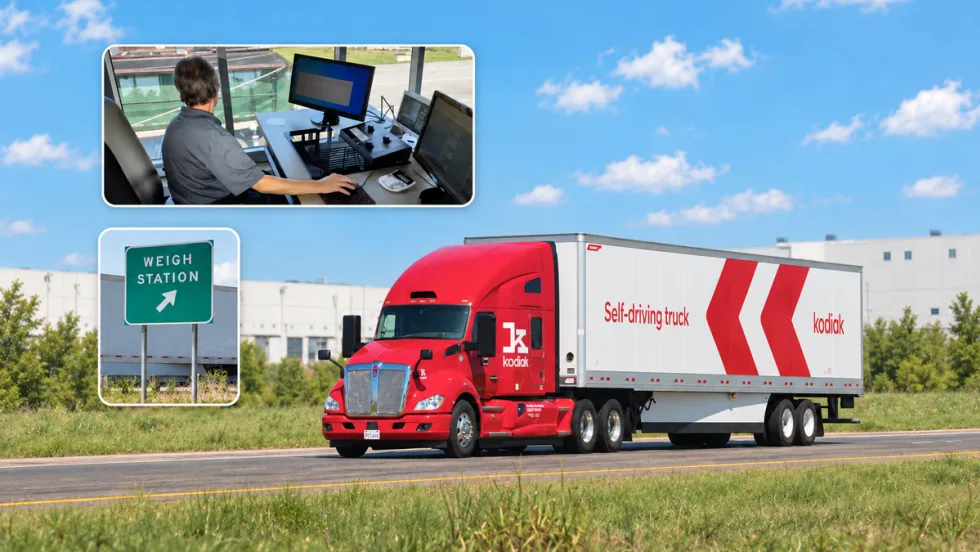
PrePass, Kodiak Connect Driverless Trucks to Roadside Enforcement
The system will allow enforcement agencies to verify Enhanced Inspection information and decide whether Kodiak’s autonomous trucks can bypass roadside screening sites.
Read More →
From One Generation to the Next: How Mentorship Builds Safer Truck Drivers
After three decades in trucking, Harold Perry shares what he's learned about driver safety, mentorship, and helping the next generation build confidence behind the wheel.
Read More →
FMCSA Pauses Biennial-Update Enforcement Amid Motus Transition
Carriers whose updates were due on or after June 1 have more time, while FMCSA works to stabilize its new registration system and warns of phishing sites impersonating its new carrier registration system, Motus.
Read More →
ZF Expands Commercial Vehicle Push in North America
ZF is expanding its North American commercial-vehicle presence with new transmission applications, electrification, trailer technology and autonomous-driving systems.
Read More →
Truck Drivers Need More Than Another Alert
Fleets have more visibility into truck health, safety events, and driver activity than ever. The next challenge is turning all that information into useful guidance for the person who has to decide what to do next.
Read More →
Tesla Wants a Self-Driving Semi. Are Cameras Enough?
Could Tesla’s camera-only autonomous driving technology work on an 80,000-pound Semi? In this commentary, HDT's Deborah Lockridge takes a look at Tesla, Cybercab, and how autonomous trucks see the road.
Read More →
What DOT’s Automated Vehicle Strategy Means for Trucking
The U.S. Department of Transportation issued a new automated-vehicle strategy that outlines plans for driverless-truck regulations, cross-state freight corridors, and federal safety standards.
Read More →
NYC Expands Speed, Pedestrian Safety Tech Across Fleet
New York City is expanding intelligent speed assistance and pedestrian-alert systems across its municipal fleet, moving the technologies from pilot programs into vehicle procurement and retrofit requirements.
Read More →
FMCSA Removes 110 Truck Driver Training Schools from Certified ELDT List
Federal regulators also are targeting more than 160 additional training providers and launching a nationwide audit of third-party CDL skills testers as part of a broader crackdown on trucking fraud.
Read More →
Beyond DOT Compliance: What Makes a Trucking Fleet Truly Safe?
A trucking fleet can follow every rule and still make unsafe decisions. The real test comes when safety conflicts with freight, productivity, or cost.
Read More →