




What You Should Know About Today's CNG Fuel Systems
Natural-gas-powered truck sales have leveled off since the drop in diesel prices, but fleets already using the fuel continue to buy them, especially CNG. What are some of the basics involved in the latest CNG tanks and fuel systems?

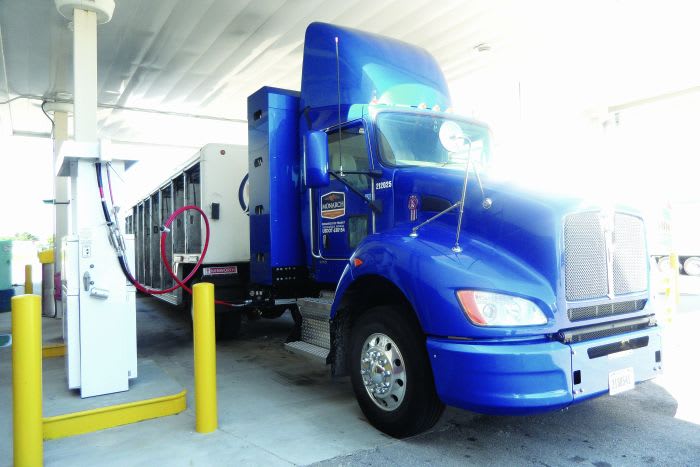
Suppliers are finding ways to hold more CNG in on-board tanks, making it viable for trucks to accomplish longer highway runs. Photos: Tom Berg
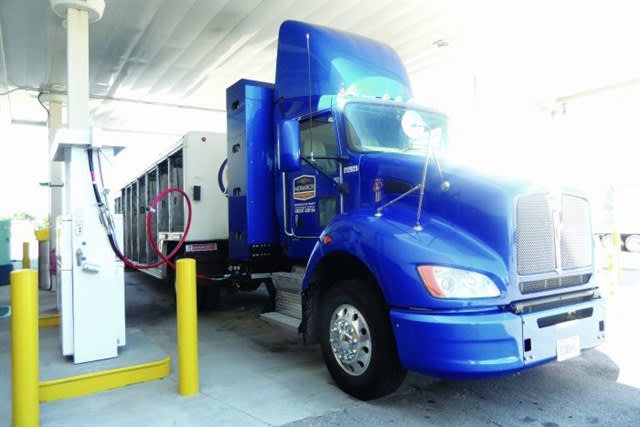
Suppliers are finding ways to hold more CNG in on-board tanks, making it viable for trucks to accomplish longer highway runs.Photos: Tom Berg
Sales of natural-gas-powered trucks have leveled off since the drop in oil and diesel prices, but fleets already using the fuel continue to buy them, especially compressed natural gas. What are some of the basics involved in the latest CNG tanks and fuel systems?
It starts with range, because the number of miles covered in a run determines the required size and number of tanks. Weight and bulk are also important, as are certain parts that can add efficiency and reliability.
The storage capacity of CNG tank systems has improved, making the fuel a better option for longer hauls than in the past. About a decade ago, when storage was more limited, it was believe liquefied natural gas (LNG) would be the choice for long haul; because it is super cold and contracts, it can be stored in tanks in goodly amounts. Less CNG can be crammed into on-board vessels, but that was fine for local operations where trucks return home daily for refueling.
Since then, suppliers have improved CNG tank capacity and found ways to stack them more efficiently behind cabs and sleepers, reducing the need for saddle tanks. These advancements make CNG usable in reasonably long over-the-road operations.
“The trend definitely is more toward compressed natural gas,” says Robert Carrick, vocational sales manager for natural gas at Freightliner. “We estimate that more than 95% of the natural gas vehicles manufactured and delivered in 2015 were CNG.”
Freightliner’s partner is Agility Fuel Systems, and that equipment is installed at Freightliner’s plant in North Carolina and at an Agility facility nearby. That facility also works on Volvo trucks produced in Virginia, but many have tanks installed at a Fontaine Modification Center near the plant, says Frank Bio, Volvo’s director of alternative-fuels sales development.
“With a couple key customers that have moved from LNG to CNG, we have seen a dramatic drop in LNG prep kits based on fuel availability, ease of maintenance, and overall value proposition,” says Kurt Swihart, marketing director at Kenworth. A mod center at the Chillicothe, Ohio, plant installs natural gas tanks and associated equipment per customers’ wishes, and some large dealerships are now qualified — something true of most builders.
In fact, Rush Enterprises, the nation’s largest dealer, last year bought a company called Momentum Fuel Technologies and now offers its own natural-gas fueling/tank system. It offers both side-mount and back-of-cab systems.
The company says its tanks are designed to maximize fill rates, with oversized plumbing with fewer bends and fittings plus a high-flow ball valve. In addition, fuel flows straight from the manifold to all tanks simultaneously. A pressure regulator allows fuel to be used at a lower psi for increased range.
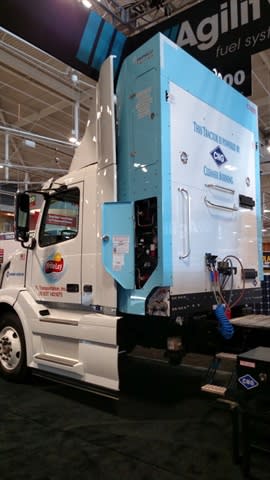
New CNG system from Agility houses four 40-diesel-gallon-equivalent cylinders in a cabinet behind this Volvo VN’s cab. Total capacity is 160 DGE, enough for up to 600 road miles, the supplier says. Stated weight is 2,150 pounds.
Weight is also addressed, with lightweight aluminum and fiberglass composite materials and 3M nanoparticle-enhanced matric resin technology.
Momentum says its system has features that increase safety. For instance, quarter-turn ball valve handles on each tank make it obvious when the valve is closed and gas flow is stopped. In addition, high-pressure fuel lines are yellow and PRD supply lines are red to indicate a live channel that is always under pressure.
Agility showed its latest CNG installation at the recent Technology & Maintenance Council annual meeting in Nashville, Tenn. It featured four tanks with a total capacity of 160 diesel-gallons-equivalent (DGE), enough gas for about 600 miles, says Paul Mader, the company’s sales manager. Previous installations were limited to 400 to 500 miles, too short for the typical trip a driver can legally cover in a day.
The new system includes an aluminum-framed and -skinned cabinet that houses the tanks and associated lines, valves, gauges and regulator. The cabinet sits close to the cab — up to 6 inches closer than previous designs — to limit a truck’s length and free up frame space. The structure sits on rubber mounts affixed to the frame rails. Tanks are lightweight Type 4’s, with plastic cores wrapped in carbon fiber; they’re neck-mounted in rubber to resist spinning that can damage lines. Total system weight is 2,150 pounds.
Like all CNG systems, the tanks’ fill pressure is 3,600 psi, which can go several hundred psi higher when gas is hot and drops as it cools and is drawn out. Gas is regulated down to 120 psi for delivery through low-pressure lines to the engine.
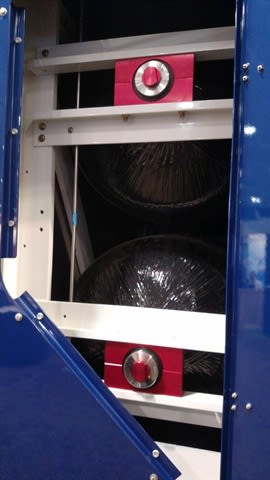
Pressure gauges, regulator, filters and lines are housed in the aluminum cabinet on this Freightliner Cascadia displayed at TMC’s expo in Nashville. Type 4 cylinders are nozzle-mounted in rubber to resist spinning that could stress lines.
Operation of the regulator is one item that gas-truck buyers should look at, says Kyle Takavitz, commercial director for Worthington Industries’ fuel systems business. Gas cools as it emerges from an orifice, which works to a customer’s benefit if the regulator is properly designed. “Ensure that you’re promoting gas to be as cold and dense as possible when it enters that engine,” he says. “Look for suppliers that can validate that performance.”
Worthington makes steel products including gas cylinders, but in the last two years it acquired a pair of gas-related companies that work with other materials and technologies, dHybrid Fuel Systems and Trilogy Engineered Solutions. Worthington also is among the partners in development of adsorbed gas storage, a technology that promises more gas to be stored in a given size tank, lower pumping and operating pressures, and therefore less overall cost.
A system also has high- and low-pressure filters that should be efficient, and need periodic cleaning, Takavitz says. How much maintenance depends on gas quality (the content of feed stocks and how well it was filtered at or near the well head), where it was transported (some pipelines are cleaner than others), time of year (which relates to system pressure), and how it’s being stored at a fueling station and on the truck.
Installation time is also cited as something to consider when choosing a system, with Worthington advertising that it can install high-pressure lines and tanks faster than its competitors, and Momentum saying it developed a “Fast-to-Fit” system using integrated brackets for quick, consistent mounting on the assembly line and aftermarket.
More Fuel Smarts
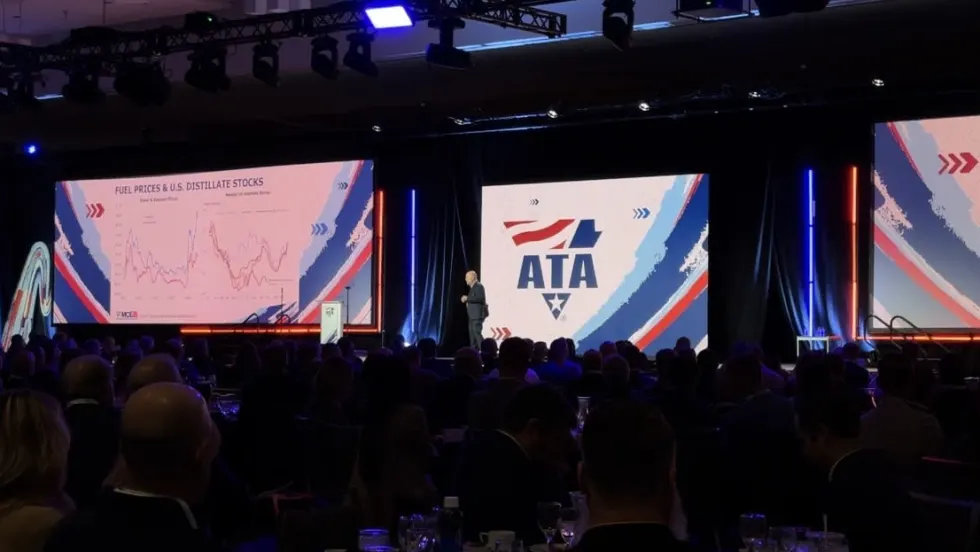
Trucking’s Diesel Squeeze Isn’t Letting Up
With diesel topping $6 a gallon nationally, ATA's Bob Costello explains why fleets should prepare for continued pressure at the pump.
Read More →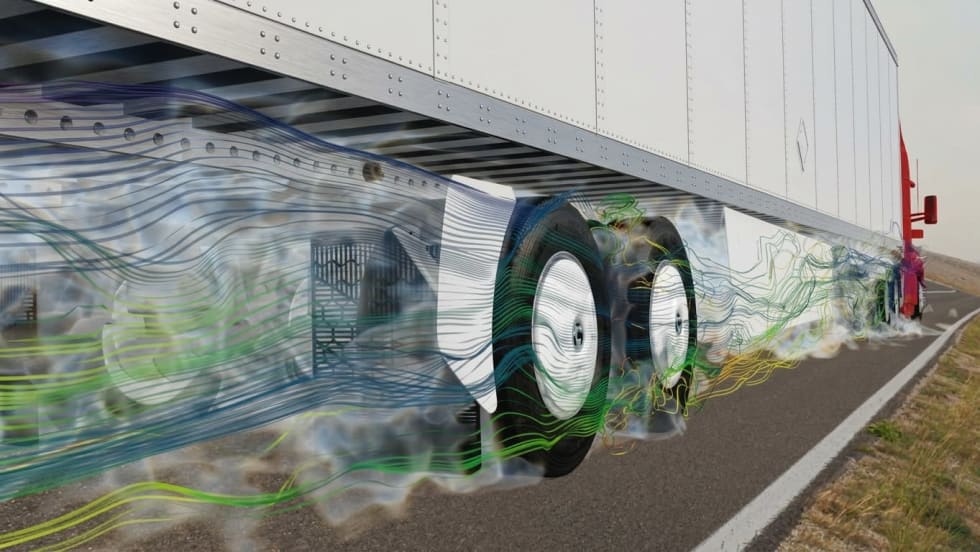
FlowBelow Redesigns Trailer AeroSlider to Cut Fuel Use
The lighter trailer aerodynamic system installs in less than 45 minutes, according to the company, with potential payback in under a year depending on fuel prices and trailer mileage.
Read More →
Why Diesel Price Relief Efforts May Fall Short
Diesel prices have eased from September’s record high, but doubts about additional Russian supply and limits on dyed-diesel tax relief mean trucking fleets still face expensive fuel. And prices could go higher.
Read More →
Why Small Fuel Savings Matter in Trucking
Can better fuel economy help pay for driver raises? In this podcast, GP Transco explains how small efficiency gains create room to reinvest in its people.
Read More →
How GP Transco Cuts Trucking Fuel Costs, a Tenth of a Gallon at a Time
What’s another tenth of a mile per gallon worth? GP Transco shares how equipment upgrades and driver coaching turn small gains into meaningful fuel savings.
Read More →
Electric Yard Tractors Move Beyond Pilots
Operating-cost savings have overtaken sustainability goals as the leading reason surveyed fleets are adopting battery-electric terminal tractors, according to new NACFE research.
Read More →
Geotab Links Fleet Card to Vehicle Data
The new card combines fuel discounts with telematics-based purchase controls. Geotab’s analysis also points to potential savings from choosing lower-priced fuel stops.
Read More →
Fleet Economics Shape Electric Truck Outlook
ACT Research expects costs, charging infrastructure, and technology improvements to drive zero-emission commercial vehicle adoption as federal regulations and incentives retreat.
Read More →
Wex Adds Cardless Fuel Payments for Over-the-Road Customers
A new fuel card feature for Wex customers offers convenience and security.
Read More →
New California Law Could Shed Light on Electric Truck Prices
Why do battery-electric Class 8 trucks remain so expensive? A California bill signed by Gov. Gavin Newsom would give fleets and state agencies more visibility into what manufacturers charge.
Read More →