




10 Things You Might Not Know About LNG
Lower diesel prices may have slowed interest in natural gas fuel, but liquefied natural gas can still be a good fit for certain applications.

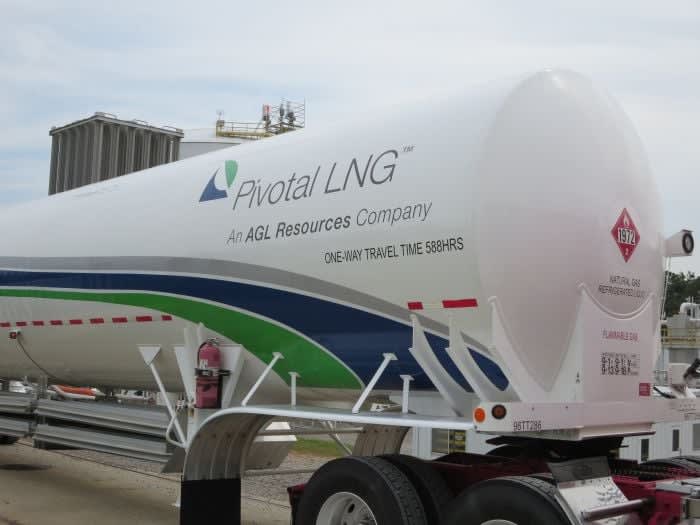
LNG is trucked from the plant to fueling facilities at fleets or truckstops. The trailers are built like a Thermos bottle, with an inner and outer skin. Photo: Pivotal
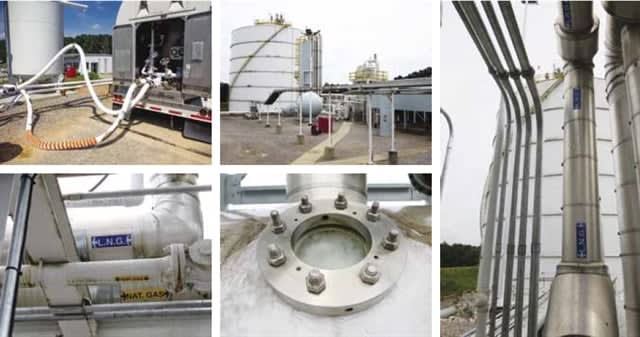
Pivotal LNG’s Trussville, Ala., facility can produce 60,000 gallons of liquefied natural gas per day and has a storage capacity of nearly 5 million gallons. Photos: Deborah Lockridge
"LNG is one of the better-kept secrets in trucking,” says David Jaskolski — and he doesn’t want it to be.
Jaskolski is senior account manager with Pivotal LNG, a subsidiary of the Georgia-Based energy company AGL Resources. AGL is one of the largest operators of natural gas liquefaction facilities in the nation and has more than four decades of experience in the LNG business.
One of its facilities, in Trussville, Ala., is dedicated to producing liquefied natural gas as an alternative fuel for vehicles. In fact, it supplies more than 1 million gallons of LNG a month for truck fleets, including for UPS fleet operations in Nashville and Knoxville, Tenn., and in Jacksonville, Fla.
“It’s still an educational process for people to understand what LNG is,” says Jaskolski.
LNG is natural gas cooled to the point where it becomes a liquid – 260 degrees below zero – making it easier to store and transport. It has been touted as a better alternative than compressed natural gas for heavy-duty trucking operations where more range, lighter weight and fast-fill operations are needed.
Jaskolski says LNG is not for everyone, but it really shines in regional applications where weight and wheelbase are a concern.
“An LNG truck with the same fuel capacity is going to weigh right about the same as a diesel fuel truck. CNG is making great strides to bring tank weights down, but they still weigh more than a comparable diesel truck,” he says.
For applications where wheelbase is a concern, such as regional operations where you want a tight turning radius, Jaskolski says LNG has the edge over CNG. It takes twice as much space volumetrically to store LNG as diesel — and nearly four times as much space to store CNG, he says.
Other indicators that a fleet might be a good fit for LNG, he said, are high fuel consumption, vehicles that are highly utilized, and where the time it takes to fuel is important.
Jaskolski discussed some of the lesser-known aspects of liquefied natural gas as a fleet fuel:
1. LNG has been used for decades by utilities as a way to store natural gas in the summer months when it is in less demand, then put it back into the pipeline system in the winter when demand is high. In fact, Pivotal’s Trussville facility originally served that purpose for the city before being acquired by AGL.
2. Starting in January, LNG will be taxed at approximately the same rate as diesel. “One of the things that has really held LNG back, is that LNG was taxed on a per gallon basis, but it took 1.7 LNG gallons to have the same diesel equivalent of energy,” explains Jaskolski. “So we were paying over 40 cents in federal excise tax.”
3. LNG is a very pure form of methane. Regular natural gas coming from a pipeline has contaminants such as ethane, nitrogen, propane, carbon dioxide and butane. Most of this drops out and is left behind during the liquefaction process. In addition, LNG does not have moisture or oil that can be in CNG, according to Jaskolski.
4. LNG is not explosive or flammable. It has to return to vapor form in order to be flammable, and even then, it has to be in a very narrow ratio of LNG-to-air before it can ignite.
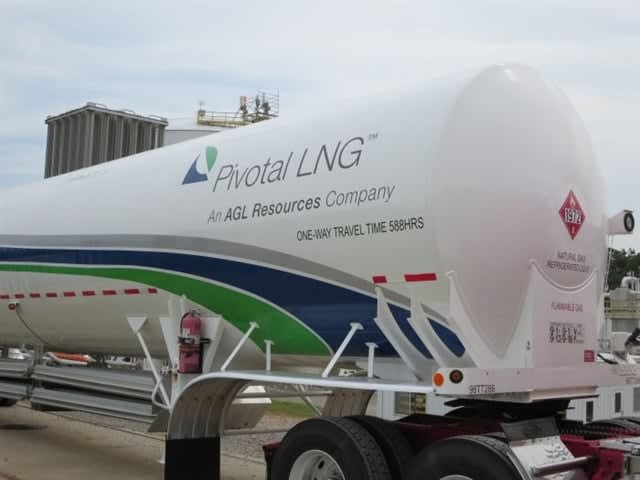
LNG is trucked from the plant to fueling facilities at fleets or truckstops. The trailers are built like a Thermos bottle, with an inner and outer skin. Photo: Pivotal
5. You don’t have to worry about spill clean-up like you do with diesel. LNG vaporizes into the air, and doesn’t mix with water.
6. You can use LNG without being near a natural gas pipeline, although you do need to be within a certain radius of a liquefaction plant. The LNG is pumped into special cryogenic tanker trucks and delivered to fleet or truckstop fueling facilities.
7. LNG is often cited as not being a good choice for vehicles that sit for long periods. Jaskolski notes that SAE standards require LNG fuel tanks to hold the fuel without venting for five days. For most trucking operations, he says, “If you’ve got a truck sitting for more than five days, you’ve got bigger issues to worry about than venting.”
8.LNG does not require extensive personal protective gear. What’s recommended is gloves and safety glasses; a coverall or apron is also a good idea. “LNG is very, very cold,” Jaskolski explains. “The best way to look at it is, how would you handle a pizza in the oven? The difference in temperature between your finger and the hot pizza oven is about the same as the difference in temperature between your finger and LNG. You have to use some reasonable judgement and be careful.”
9.When you do a fast fill with LNG, you get a full fill. That’s not the case with CNG, Jaskolski says. “With CNG, if you’re going to fast-fill a truck, the heat of compression causes that gas to be hot as it goes into the cylinder. As it cools off, it contracts, and there’s not as much fuel in the tank as you thought. With LNG, since it’s a liquid, it’s going to fill a full fill.”
10. If you have an LNG fueling facility on site, you can also get CNG off the same system. Called LCNG, it offers a cold fast fill without the heat of compression.
More Fuel Smarts

Trucking’s Diesel Squeeze Isn’t Letting Up
With diesel topping $6 a gallon nationally, ATA's Bob Costello explains why fleets should prepare for continued pressure at the pump.
Read More →
FlowBelow Redesigns Trailer AeroSlider to Cut Fuel Use
The lighter trailer aerodynamic system installs in less than 45 minutes, according to the company, with potential payback in under a year depending on fuel prices and trailer mileage.
Read More →
Why Diesel Price Relief Efforts May Fall Short
Diesel prices have eased from September’s record high, but doubts about additional Russian supply and limits on dyed-diesel tax relief mean trucking fleets still face expensive fuel. And prices could go higher.
Read More →
Why Small Fuel Savings Matter in Trucking
Can better fuel economy help pay for driver raises? In this podcast, GP Transco explains how small efficiency gains create room to reinvest in its people.
Read More →
How GP Transco Cuts Trucking Fuel Costs, a Tenth of a Gallon at a Time
What’s another tenth of a mile per gallon worth? GP Transco shares how equipment upgrades and driver coaching turn small gains into meaningful fuel savings.
Read More →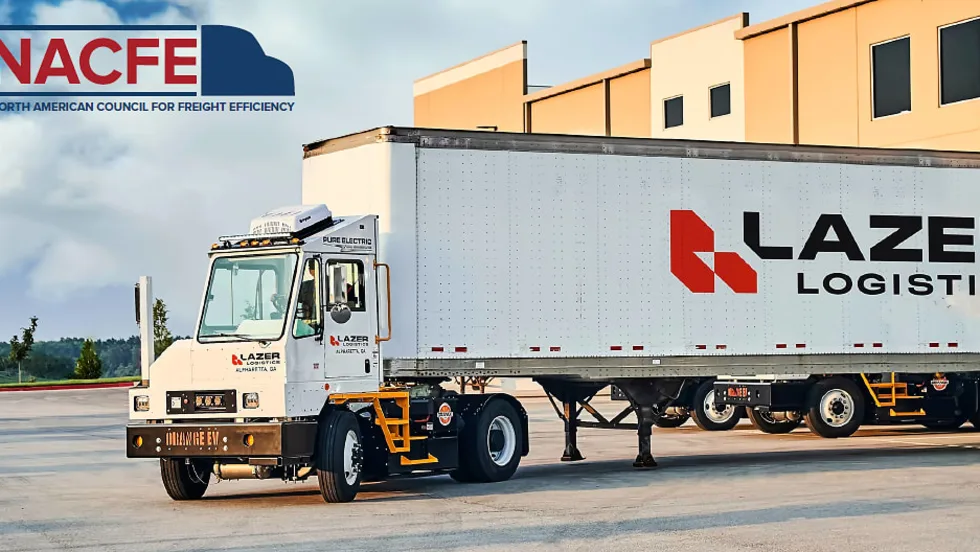
Electric Yard Tractors Move Beyond Pilots
Operating-cost savings have overtaken sustainability goals as the leading reason surveyed fleets are adopting battery-electric terminal tractors, according to new NACFE research.
Read More →
Geotab Links Fleet Card to Vehicle Data
The new card combines fuel discounts with telematics-based purchase controls. Geotab’s analysis also points to potential savings from choosing lower-priced fuel stops.
Read More →
Fleet Economics Shape Electric Truck Outlook
ACT Research expects costs, charging infrastructure, and technology improvements to drive zero-emission commercial vehicle adoption as federal regulations and incentives retreat.
Read More →
Wex Adds Cardless Fuel Payments for Over-the-Road Customers
A new fuel card feature for Wex customers offers convenience and security.
Read More →
New California Law Could Shed Light on Electric Truck Prices
Why do battery-electric Class 8 trucks remain so expensive? A California bill signed by Gov. Gavin Newsom would give fleets and state agencies more visibility into what manufacturers charge.
Read More →