





Gas vs. Diesel: The Bad Investment Only Fleet Managers Know About
Shell's New Oil Works for Mixed Diesel and Gas Fleets
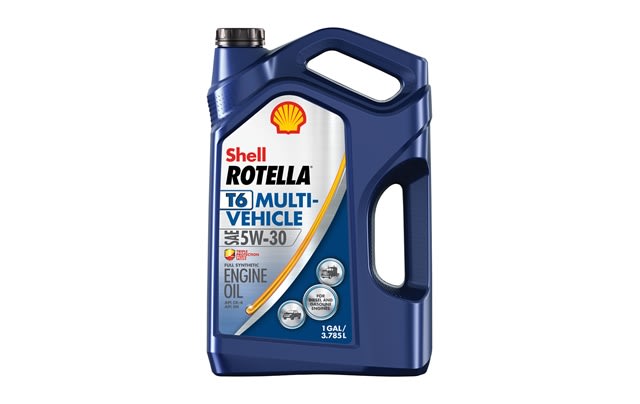
Shell Rotella's T6 Multi-Vehicle 5W-30 synthetic oil is designed for versatility, meeting the API CK-4 specification for Class 8 Trucks as well as API SN specification for gasoline trucks and vans.
September 21, 2017

Photos: Shell Rotella
3 min to read
Photos: Shell Rotella
Shell Rotella's T6 Multi-Vehicle 5W-30 full synthetic oil is designed for versatility, meeting the API CK-4 specification for Class 8 Trucks as well as API SN specification for gasoline trucks and vans.
The oil is aimed at owners of mixed fleets with Class 6-8 diesel trucks and gasoline powered pickup trucks and vans. To do this, Shell designed and tested the T6 MV 5W-30 for needed wear, oxidation and depsoit control needed in modern commercial diesel engines while also exceeding the requirements for the API SN performance category of gasoline engines.
“With Shell Rotella T6 Multi-Vehicle 5W-30, it is now possible for hard working fleets or businesses that run diesel and gasoline powered engines to carry a single oil that offers numerous benefits,” said Megan Pino, Shell Rotella global brand manager. “The full synthetic oil has been engineered to provide protection under the most severe engine conditions for both diesel and gasoline engines.”
The oil contains Shell's Triple Protection Plus technology, combining additives and synthetic base oils to protect against wear, deposits, and oil breakdown, while also offering better fuel economy with it's lower viscosity. T6 MV 5W-30 oil demonstrated strong oxidation resistance in the Volvo T-13 oxidation test, according to Shell, controlling acid build up, preventing oil thickening, and exceeding the API CK-4 limits for oxidation.
The T6 MV 5W-30 Full Synthetic oil is designed to work better at low temperature oil flow when compared to Shell's own T4 Triple Protection 15W-40. Through testing, Shell says the T6 MV 5W-30 oil had better cold cranking properties and low temperature pumpability than the T4 oil at -30 and -35 degrees Celcius, respectively.
"I think we've been able to demonstrate that there's no loss in performance, in durability, between having our 15W-40 T4 Triple Protection compared to our T6 MV 5W-30," said Jason Brown, global technology manager for heavy duty diesel engine oils at Shell. "Starting with that baseline [in performance], the T6 itself offers many benefits in and above a 15W-40. That level of viscosity change is opening a window to fuel efficiency that you don't have at 15W-40, which is cost savings. This is dollars that you can keep in your pocket."
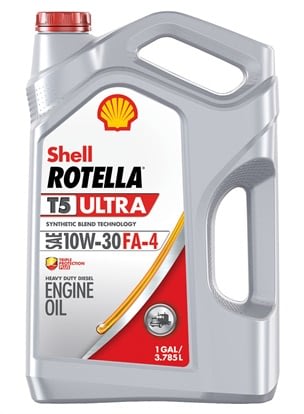
Shell also announced the T5 Ultra 10W-30 synthetic blend diesel engine oil, which meets the API FA-4 service category for 2017 diesel engines. The low viscosity oil has been formulated to offer better fuel economy and improved high and low temperature performance while meeting the reuqirments for many low emissions engines beginning in 2017.
“Shell Rotella T5 Ultra 10W-30 synthetic blend is designed for next-generation on-road diesel engines to help maximize fuel economy without sacrificing engine protection,” said Pino. “It is designed to provide protection that adapts to driving conditions and is formulated to minimize oil consumption and protect exhaust catalysts and particulate filters.”
More Fuel Smarts

Wex Adds Cardless Fuel Payments for Over-the-Road Customers
A new fuel card feature for Wex customers offers convenience and security.
Read More →
New California Law Could Shed Light on Electric Truck Prices
Why do battery-electric Class 8 trucks remain so expensive? A California bill signed by Gov. Gavin Newsom would give fleets and state agencies more visibility into what manufacturers charge.
Read More →
How Volvo Updated Its D13 for EPA 2027 [Watch]
Volvo’s updated D13 promises lower emissions without sacrificing performance or fuel economy. Take a closer look at what changed inside the engine in this HDT Spotlight video.
Read More →

Diesel Price Spike Shortens Payback for Natural Gas Trucks, Report Says
Energy Vision estimates fleets could recover the higher purchase price of an RNG-fueled Class 8 tractor in 1.3 to 2.8 years under current fuel-price scenarios.
Read More →
Calstart Becomes Catalyst Mobility, Reflecting Broader Focus
Calstart is now Catalyst Mobility, reflecting the nonprofit’s growing national role in clean transportation, including zero-emission trucks, infrastructure and incentive programs.
Read More →
Record Diesel Prices Squeeze Trucking Fleets
Average U.S. diesel prices have climbed to nearly $6 a gallon, surpassing the 2022 record as tight refinery capacity and Middle East disruptions keep fuel costs elevated.
Read More →
Sponsored•September 9, 2026
How Fuel Delivery Shapes Engine Performance
Fuel delivery depends on more than what happens at the injector. For fleet, maintenance and technical professionals, looking at the full path from pump to injector can provide useful context for understanding engine performance.
Read More →
East Coast Port Launches $45M Electric Truck Push
The Port Authority of New York and New Jersey announced millions in incentives for zero-emission drayage trucks, yard tractors, and new charging hubs near the port.
Read More →
Detroit Opens Orders for EPA 2027 Engines
Detroit isn’t starting from scratch to meet EPA 2027 diesel emissions standards. Its Gen 6 DD13 and DD15 engines keep much of today’s platform while updating the fuel and aftertreatment systems.
Read More →
Zero-Emission Truck Corridor Planned for West Coast
California, Oregon, Washington, British Columbia and Baja California are coordinating plans for truck charging and hydrogen fueling from Canada to Mexico.
Read More →