




Related: Rising Factory Orders Latest Indicator of Interest Rate Hike
Diesel Prices Inch Higher
Diesel prices in the U.S. have continued to move upward with a minor increase last week, according to the latest numbers from the Energy Department.
by Staff
March 6, 2017
2 min to read
Source: EIA
Diesel prices in the U.S. have continued to move upward with a minor increase last week, according to the latest numbers from the Energy Department.
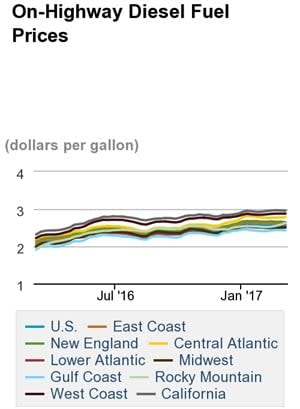
The average price of on-highway diesel fuel in the U.S. raised by a barely noticeable 0.2 cents last week, thanks to offsetting price decreases in many major regions. The average price currently stands at $2.579 per gallon, which is nearly 56 cents more expensive than it was in the same week of 2016.
Prices varied up and down when broken down by region with the largest increase hitting the Rocky Mountain area at 4.3 cents per gallon. The region with the largest drop in prices was New England, where diesel was 1.2 cents cheaper for the week.
The average price of regular gasoline was up by 2.7 cents during the same period, jumping to $2.341 per gallon at the pump. The price is 50 cents more expensive than it was in the same period a year ago.
Prices varied up and down depending on the region with the largest increase coming to the Midwest at 5.7 cents per gallon. The largest decrease occurred in New England, where gas prices dropped 1.4 cents on average.
Crude oil prices were negatively affected by a subdued economic forecast coming out of China that lowered growth expectations for the country, according to a MarketWatch report. Weak global demand, mostly as a result of Chinese economic troubles, played a major role in large oil price drops last year and with the latest economic forecast adding to it, oil prices fell on March 6.
Other factors that have affected prices include increased oil production domestically and a looming increase in interest rates.
More Fuel Smarts

Electric Yard Tractors Move Beyond Pilots
Operating-cost savings have overtaken sustainability goals as the leading reason surveyed fleets are adopting battery-electric terminal tractors, according to new NACFE research.
Read More →
Geotab Links Fleet Card to Vehicle Data
The new card combines fuel discounts with telematics-based purchase controls. Geotab’s analysis also points to potential savings from choosing lower-priced fuel stops.
Read More →
Fleet Economics Shape Electric Truck Outlook
ACT Research expects costs, charging infrastructure, and technology improvements to drive zero-emission commercial vehicle adoption as federal regulations and incentives retreat.
Read More →

Wex Adds Cardless Fuel Payments for Over-the-Road Customers
A new fuel card feature for Wex customers offers convenience and security.
Read More →
New California Law Could Shed Light on Electric Truck Prices
Why do battery-electric Class 8 trucks remain so expensive? A California bill signed by Gov. Gavin Newsom would give fleets and state agencies more visibility into what manufacturers charge.
Read More →
How Volvo Updated Its D13 for EPA 2027 [Watch]
Volvo’s updated D13 promises lower emissions without sacrificing performance or fuel economy. Take a closer look at what changed inside the engine in this HDT Spotlight video.
Read More →
Diesel Price Spike Shortens Payback for Natural Gas Trucks, Report Says
Energy Vision estimates fleets could recover the higher purchase price of an RNG-fueled Class 8 tractor in 1.3 to 2.8 years under current fuel-price scenarios.
Read More →
Calstart Becomes Catalyst Mobility, Reflecting Broader Focus
Calstart is now Catalyst Mobility, reflecting the nonprofit’s growing national role in clean transportation, including zero-emission trucks, infrastructure and incentive programs.
Read More →
Record Diesel Prices Squeeze Trucking Fleets
Average U.S. diesel prices have climbed to nearly $6 a gallon, surpassing the 2022 record as tight refinery capacity and Middle East disruptions keep fuel costs elevated.
Read More →
Sponsored•September 9, 2026
How Fuel Delivery Shapes Engine Performance
Fuel delivery depends on more than what happens at the injector. For fleet, maintenance and technical professionals, looking at the full path from pump to injector can provide useful context for understanding engine performance.
Read More →