




GHG Phase 2 Proposal More Stringent than Originally Believed
Daimler Trucks says meeting EPA's Phase 2 GHG reduction requirements, as they currently stand in the proposal stage, may not be possible under the current timeline.
September 18, 2015

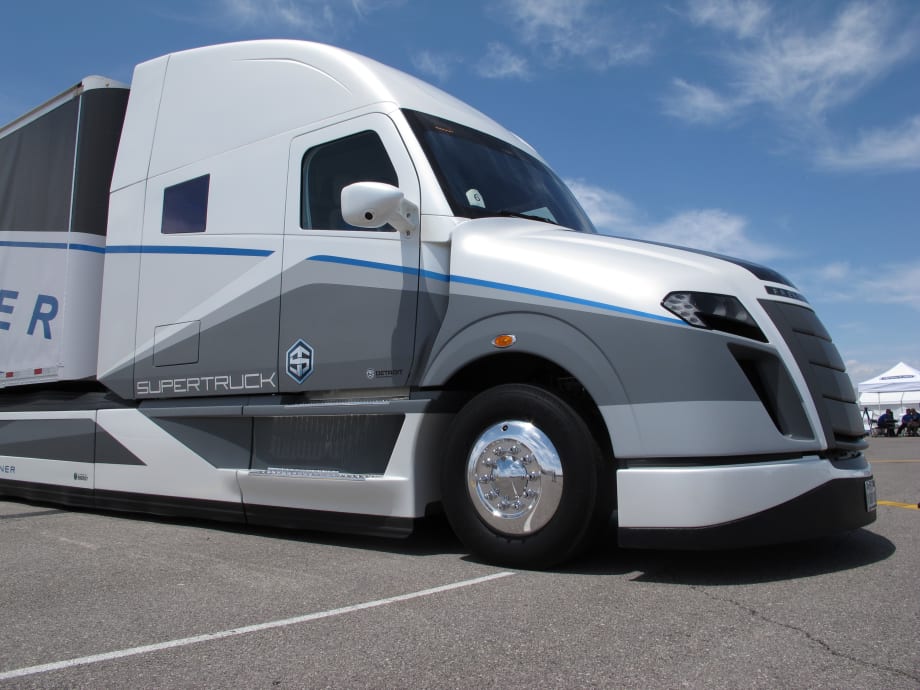
Daimler says its $30 million SuperTruck does not meet EPA's Phase 2 GHG reduction demands. Photo by Jim Park
4 min to read
Daimler says its $30 million SuperTruck does not meet EPA's Phase 2 GHG reduction demands. Photo by Jim Park
Industry is finally hearing some frank discussion about Phase 2 of the Environmental Protection Agency's Greenhouse Gas Reduction proposal. At the FTR Conference in Indianapolis Wednesday, a Daimler Trucks North America regulatory expert told attendees the standards are likely to be much more difficult to meet than originally believed.
Amy Kopin, regulatory and compliance program manager, said because of the variations that are inherent in some of the testing procedures, and the lack of reasonable compliance margins, truck and engine makers may need to design products to exceed the rule's requirements just to come in under the compliance margins.
"There are all kinds of technical provisions and problems with compliance that EPA has built into Phase 2 that make the rule almost twice as stringent as it should be," Kopin said. "They have made incorrect assumptions with many of their baselines, and they have over-estimated the rate of customer uptake on many technologies as well. These all affect the way equipment makers earn their credits, and because of that, we will have to compensate for those shortfalls in other ways."
Take engine idle shutdown timers, for example. Kopin said they are very unpopular with customers because they can't change the programming of the timer for the life of the vehicle, even if the vehicle's application changes.
"EPA assumes we will equip 30% of the trucks we sell with these regulatory idle shutdown timers in 2017," she said. "That's nowhere near realistic, and that's going to cost us 1.5%."
When it comes to aerodynamics, she said, EPA is taking away compliance margins and at the same time assuming the best-performing aerodynamic truck for their baseline rather than an average truck. That, she said, makes the rule about 2.5% more stringent than it appears.
In another example, Kopin pointed to 6x2 tractors.
"EPA has said it expects 6x2 tractors will have adoption rates in the 60% range," she said. "It's far more likely that we might see 5%. You can't use them in all states at the moment and they are illegal in Canada. There are issues with 6x2 that are beyond our control and beyond the EPA's control. Our customers need a truck they can travel with all through the country, not just select states."
Some of the real problems arise with the testing. Kopin said EPA uses coastdown testing, but that's subject to variability from weather, wind, track conditions and even the driver. She pointed to a test EPA did with a Daimler vehicle and found a 5% variation in two tests of the same truck on the same track.
"That's another 5% we now have to account for, and we'll have to be 5% more aggressive so that we can meet the standard, she said. "In other words, we have to eat the compliance margin."
She said it's the same with the fuel map tests.
"In phase 1 there's a test that measures 13 points, and we are given a 3% compliance margin because engine-to-engine comparisons can vary by as much as 1%, and even lab-to-lab comparisons can be a little different," she noted. "Now we have a test with over 100 points and EPA says no, you can't have any compliance margin."
In essence, engine makers have to do about 3% better on the test results than they really have to just to provide a margin to cover the variables. That's something the consumer will wind up paying for.
"As this rule stands today, it's really not feasible," Kopin stressed. "These are technical issues we hope the agency will modify. We would much prefer to work toward the 24% improvement they want rather than the 47% that the rule actually shows."
To put this into perspective, Kopin said Daimler's Freightliner SuperTruck – a project developed at a cost of $30 million – would not meet the Phase 2 proposal as it stands today.
The SuperTruck featured technology such as waste heat recovery and a hybrid electric drive for energy recovery. Not all vehicles can take advantage of such technology, yet EPA insists on forcing it on the industry to meet an arbitrary standard. Daimler and others who have experimented with such technology have said publicly that it's not presently commercially viable.
"EPA was okay with off-the-shelf technologies in Phase 1," she said. "This time around they want to force technologies onto trucks that are in a prototype stage today or maybe do not even exist yet. This is what they want to see brought to the market."
If time and money were of less concern than they are, Phase 2 would be great. But with customers demanding 18-month ROI on new technologies and trucks that will stay running for more than a week or two at a time, all of what EPA is asking for is looking increasingly difficult. Nobody wants a repeat of what happened when EPA forced emissions technology onto market in 2007 that had not had enough time for testing.
"We don't believe there's enough time to successfully develop all that EPA is asking for," Kopin said in her closing remarks. "We would support all this in some future time frame, but right now, there's just too much to do; too much to fix."
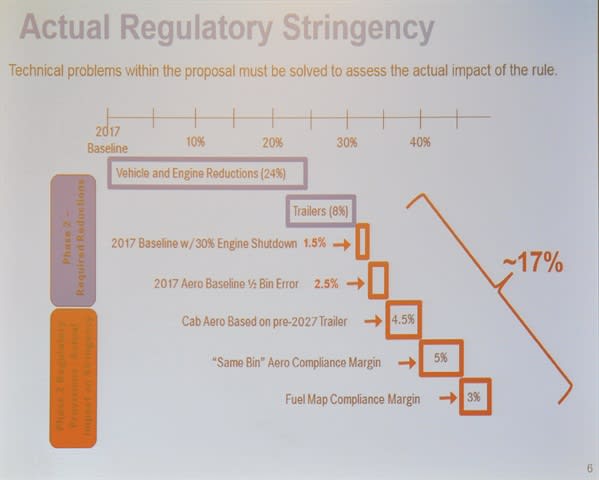
Regulatory stringency may make compliance with Phase 2 very difficult if not impossible. Slide from Daimler.
More Fuel Smarts

How Volvo Updated Its D13 for EPA 2027 [Watch]
Volvo’s updated D13 promises lower emissions without sacrificing performance or fuel economy. Take a closer look at what changed inside the engine in this HDT Spotlight video.
Read More →
Diesel Price Spike Shortens Payback for Natural Gas Trucks, Report Says
Energy Vision estimates fleets could recover the higher purchase price of an RNG-fueled Class 8 tractor in 1.3 to 2.8 years under current fuel-price scenarios.
Read More →
Calstart Becomes Catalyst Mobility, Reflecting Broader Focus
Calstart is now Catalyst Mobility, reflecting the nonprofit’s growing national role in clean transportation, including zero-emission trucks, infrastructure and incentive programs.
Read More →

Record Diesel Prices Squeeze Trucking Fleets
Average U.S. diesel prices have climbed to nearly $6 a gallon, surpassing the 2022 record as tight refinery capacity and Middle East disruptions keep fuel costs elevated.
Read More →
Sponsored•September 9, 2026
How Fuel Delivery Shapes Engine Performance
Fuel delivery depends on more than what happens at the injector. For fleet, maintenance and technical professionals, looking at the full path from pump to injector can provide useful context for understanding engine performance.
Read More →
East Coast Port Launches $45M Electric Truck Push
The Port Authority of New York and New Jersey announced millions in incentives for zero-emission drayage trucks, yard tractors, and new charging hubs near the port.
Read More →
California Bill Could Shed Light on Electric Truck Prices
Why do battery-electric Class 8 trucks remain so expensive? A California bill headed to Gov. Gavin Newsom would give fleets and state agencies more visibility into what manufacturers charge.
Read More →
Detroit Opens Orders for EPA 2027 Engines
Detroit isn’t starting from scratch to meet EPA 2027 diesel emissions standards. Its Gen 6 DD13 and DD15 engines keep much of today’s platform while updating the fuel and aftertreatment systems.
Read More →
Zero-Emission Truck Corridor Planned for West Coast
California, Oregon, Washington, British Columbia and Baja California are coordinating plans for truck charging and hydrogen fueling from Canada to Mexico.
Read More →
A Closer Look at Kenworth’s Electric T880E Vocational Truck [Video]
Learn more about Kenworth's T880E battery-electric vocational truck at the Paccar Technical Center, including its range, applications, upfitting considerations, and PTO options, in this HDT Spotlight video.
Read More →