





Related: ELD Mandate Pushes Fleets to Order Record Number of Trailers
The Quest for Lighter Trailers
Trailers need to be as light, strong, cheap and durable as possible, creating a never-ending race for an always-lighter design.
January 19, 2018
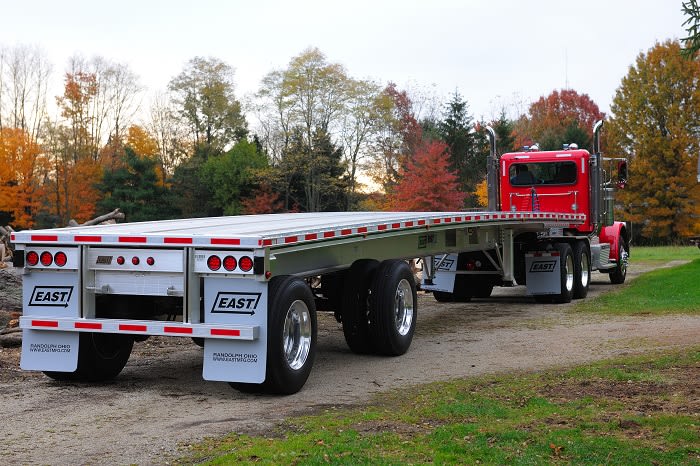
New composite materials show great promise in lightening trailer designs. But their use must be tempered by cost and maintenance concerns. Photo: East Manufacturing
4 min to read
New composite materials show great promise in lightening trailer designs. But their use must be tempered by cost and maintenance concerns.Photo: East Manufacturing
Commercial truck trailers are the kind of unsolvable puzzle engineers dream about. Regardless of what they are built to haul, all trailers conform to strict laws governing overall dimensions and weight that limit cargo-carrying capacity.
But the lighter the trailer, the more payload that can be legally carried.
That pressure has always been there, says Craig Bennett, president and CEO of Utility Trailers. But with retailers such as Amazon and Walmart pushing for ever-greater efficiency, it is more intense than ever. And in Bennett’s mind, it’s a challenge that starts — and ends — with today’s driver shortage.
“There just aren’t enough truck drivers to go around,” he explains. “And the ones that are out there don’t want to spend weeks going coast to coast. They want to go home at night.”
The result, Bennett says, is a very real push from both shippers and fleets to maximize the amount of cargo hauled by every available driver.
“But,” he adds, “fleet operations are changing at the same time. Fleets are running more regional routes today with more hub-and-spoke operations in order to get their drivers home regularly. That means more loading and unloading of trailers. Which means significantly increased duty cycles with more associated wear-and-tear on trailers — more docks getting bumped, and more forklifts pounding on trailer floors.”
The result, Bennett says, is an industry looking for lighter weight designs that can hold up to dramatically enhanced duty cycles and durability issues.
“Designing trailers that can handle these opposing operations demands can be quite a challenge for us at times,” he says with a chuckle.
Staying under the magic number
Bill Wallace, platform product manager at East Trailers, says his company is constantly working to reduce the tare weight of its flatbed trailers. He says the biggest challenge for designers is maintaining the proper strength-to-weight ratio, vital for a trailer design to effectively operate in different areas of the transportation industry without fear of premature failure.
“It’s also important because fleets today have a lot more latitude and the ability to serve a broader range of shippers than they were able to do in the past,” Wallace says. “Increasing equipment efficiency, cutting costs, increasing revenues and keeping the drivers efficient and happy. They are looking for the advantage over their direct competition. And a tough, lightweight trailer is one tool that allows them to do that.”
There are other advantages to trailer lightweighting beyond additional cargo capacity, notes Ryan Rockaway, vice president of marketing and sales for Heil Trailer.
"We see many larger fleets that are operating in 80,000-pound, long-haul applications,” he says. “And those tend to be our customers most interested in weight reduction. But the overall concept is of interest for fleets today, including heavy-duty hauls.”
That’s because lightweight trailers not only allow for more payload and thus more revenue — they also can be used to improve fuel efficiency when the trailer’s empty or lightly loaded.
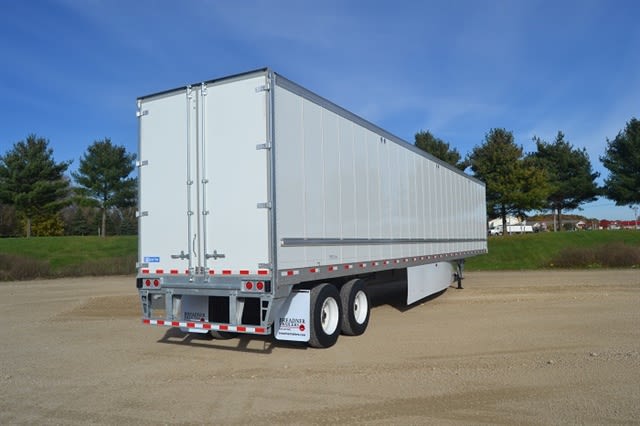
Most fleets today cube out long before they scale out their loads. But other trends continue to push trailer manufacturers to get their products as light as possible.Photo: Stoughton
New technologies and materials
Mark Ehrlich, director of Wabash National’s van line products, says advanced composite materials are being used more commonly in its designs today, but there’s a catch:
“Our core considerations when we look at lightweighting our trailers are repairability and cost-effectiveness,” he says. “Any time we look at new materials, we require them to meet those standards and make serious efforts to educate service shops on any new methods required to maintain them.”
Reefers, too, are seeing new materials and design procedures introduced, says Todd Eicher, director of engineering for Stoughton. He says promising opportunities are being afforded by new structural materials, as well as new adhesives and ways of bonding structures together.
“We’re also seeing changes in component geometry to increase stiffness by section,” he adds. This includes allowing a material reduction in floors (trending from 1.25 inches thick to 1.38 inches thick) while at the same time increasing crossmembers from 4 inches to 5-6 inches in the bay area to provide needed strength.
Lighter, cheaper and stronger may seem like an impossible puzzle to solve. But it’s not one that’s going away any time soon. The trend toward trailer lightweighting will only accelerate as trucking’s focus on ever-increasing efficiencies intensifies in the coming years.
Subscribe to Our Newsletter
More Fuel Smarts

How Volvo Updated Its D13 for EPA 2027 [Watch]
Volvo’s updated D13 promises lower emissions without sacrificing performance or fuel economy. Take a closer look at what changed inside the engine in this HDT Spotlight video.
Read More →
Diesel Price Spike Shortens Payback for Natural Gas Trucks, Report Says
Energy Vision estimates fleets could recover the higher purchase price of an RNG-fueled Class 8 tractor in 1.3 to 2.8 years under current fuel-price scenarios.
Read More →
Calstart Becomes Catalyst Mobility, Reflecting Broader Focus
Calstart is now Catalyst Mobility, reflecting the nonprofit’s growing national role in clean transportation, including zero-emission trucks, infrastructure and incentive programs.
Read More →

Record Diesel Prices Squeeze Trucking Fleets
Average U.S. diesel prices have climbed to nearly $6 a gallon, surpassing the 2022 record as tight refinery capacity and Middle East disruptions keep fuel costs elevated.
Read More →
Sponsored•September 9, 2026
How Fuel Delivery Shapes Engine Performance
Fuel delivery depends on more than what happens at the injector. For fleet, maintenance and technical professionals, looking at the full path from pump to injector can provide useful context for understanding engine performance.
Read More →
East Coast Port Launches $45M Electric Truck Push
The Port Authority of New York and New Jersey announced millions in incentives for zero-emission drayage trucks, yard tractors, and new charging hubs near the port.
Read More →
California Bill Could Shed Light on Electric Truck Prices
Why do battery-electric Class 8 trucks remain so expensive? A California bill headed to Gov. Gavin Newsom would give fleets and state agencies more visibility into what manufacturers charge.
Read More →
Detroit Opens Orders for EPA 2027 Engines
Detroit isn’t starting from scratch to meet EPA 2027 diesel emissions standards. Its Gen 6 DD13 and DD15 engines keep much of today’s platform while updating the fuel and aftertreatment systems.
Read More →
Zero-Emission Truck Corridor Planned for West Coast
California, Oregon, Washington, British Columbia and Baja California are coordinating plans for truck charging and hydrogen fueling from Canada to Mexico.
Read More →
A Closer Look at Kenworth’s Electric T880E Vocational Truck [Video]
Learn more about Kenworth's T880E battery-electric vocational truck at the Paccar Technical Center, including its range, applications, upfitting considerations, and PTO options, in this HDT Spotlight video.
Read More →