From a distance, this green tractor looks pretty much like any other International ProStar daycab. But the powerplant is very different. Senior Editor Tom Berg drives the TransPower battery-electric tractor.
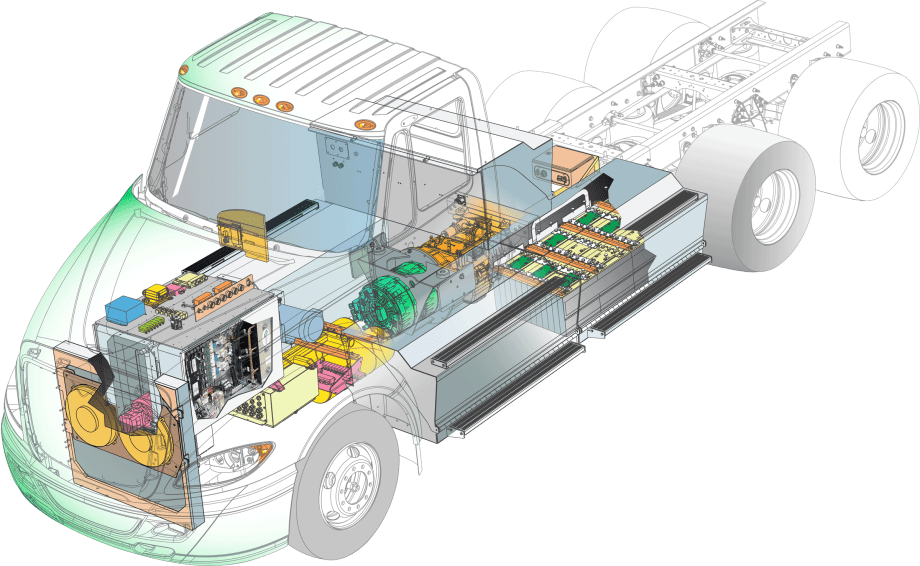
The diesel and original manual transmission are replaced by a Power Control and Accessory Subsystem and a pair of inverter-charger units. They convert 220-volt AC power during charging to 360 volts DC for storage in the batteries, and back to AC to power two electric motors (green in the illustration) that run through an Eaton UltraShift 10-speed automated transmission. Motors use as much as 150 kilowatts to make up to 400 peak hp and 880 lb-ft.
8 min to read
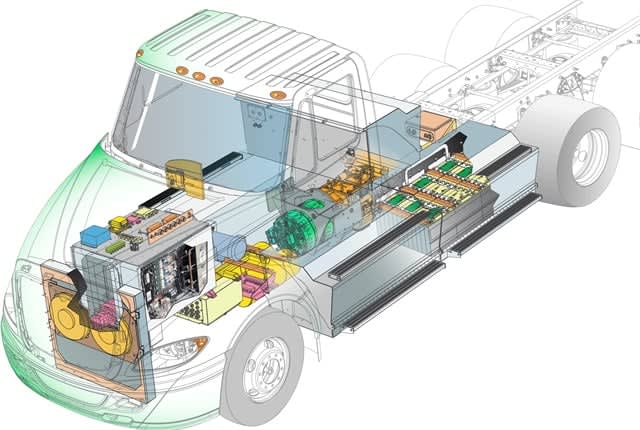
The diesel and original manual transmission are replaced by a Power Control and Accessory Subsystem and a pair of inverter-charger units. They convert 220-volt AC power during charging to 360 volts DC for storage in the batteries, and back to AC to power two electric motors (green in the illustration) that run through an Eaton UltraShift 10-speed automated transmission. Motors use as much as 150 kilowatts to make up to 400 peak hp and 880 lb-ft.
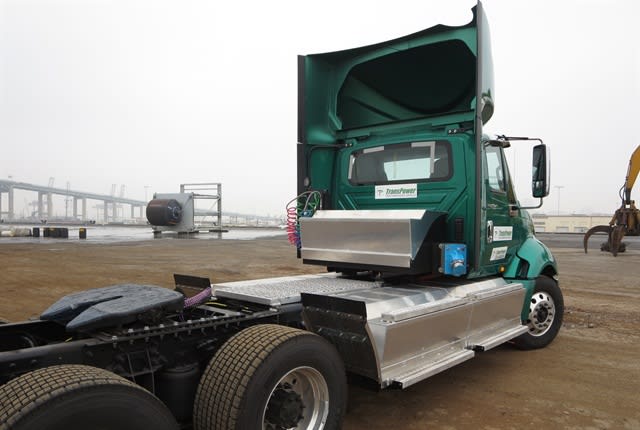
From a distance, this green tractor looks pretty much like any other International ProStar daycab. But sharp eyes will see the bulky boxes slung along each side of the frame rails, about where fuel tanks and exhaust aftertreatment equipment would normally be, and they become quite prominent as the tractor gets closer.
Ad Loading...
These boxes and another behind the cab hold 4,500 pounds of lithium ion phosphate batteries, which provide the go-power for this vehicle.
Electricity, if bought at night rates when the batteries should be charged, is a fraction of the cost of diesel fuel, yielding decent operating savings, even if the truck itself is costly. Its primary attribute is zero tailpipe emissions, important here in California where a fight against smog has been under way for many years.
Ad Loading...
This is a TransPower battery-electric drayage tractor, custom-converted from a standard diesel powertrain. Joshua Goldman, vice president for business development at Transportation Power Inc., had driven it from the company’s headquarters and plant in Poway, north of San Diego, to Long Beach’s harbor area, for me to look over and try out. Running bobtail over about 70 miles, the tractor didn’t use a lot of energy, he said. It had plenty left for our short jaunt over a freeway between Terminal Island and nearby San Pedro.
Goldman showed me around the tractor, describing those batteries and the electronic components under the hood, where a heavy-duty diesel used to be. A pair of electric motors and a mechanical gearbox – an Eaton Ultrashift automated 10-speed – are further back in the chassis. The cab’s interior appears stock, except for a laptop computer plugged into a receptacle in the dashboard to collect data. Standing still the tractor is silent and only a glowing red light on the instrument panel indicates its systems are active.
Third generation of TransPower’s ElecTruck powertrain includes four large battery boxes hung from frame rails and another mounted behind the cab. They contain lithium ion phosphate batteries whose total weight is about 4,500 pounds.
Driving the TransPower
Following his instructions, I climbed into the driver’s seat, released the parking brake, punched D on the transmission selector pad, and we moved out. Insurance restrictions prevented hooking up to a trailer, so we ran bobtail out to westbound Ocean Boulevard (Highway 47) and over the Vincent Thomas Bridge. I accelerated to 55 and 60 mph as the tractor’s large electric motors and gear-laden drivetrain whirred and whined. The sound was louder than I expected, but driveline components are much heftier than those in quieter light-duty electric trucks I’ve driven. Noise seemed less and of a futuristically different character than if a diesel were under its hood, and Goldman and I conversed in normal voice tones.
The UltraShift worked through several ratios to multiply the motors’ power and torque. As with a diesel, the transmission’s controls consider sensed loads and driver demands for performance, and select appropriate ratios. In the TransPower it employs only four or five of the available 10 in the gearbox from startup to highway speeds. An LED readout lists gear ratios being used at the moment, but they differ from the actual ones, Goldman explained.
“The transmission’s an Eaton but the controls are ours,” he said, touching on the extensive engineering and design work that went into this tractor. TransPower engineers retained Eaton’s XY shift mechanism and control module but wrote new software. In place of the stock Cummins diesel and Eaton Roadranger manual transmission (sold on the aftermarket) they installed proprietary electronic controls, and electric motors, wiring and batteries obtained from suppliers.
Ad Loading...
They fashioned mounts for mechanical and electronic components, and integrated those with the ProStar’s instruments. That’s why the dashboard and gauges look stock. Replacing the fuel gauge is a charge meter whose readings Goldman referred to in fuel terms – “one-third full,” for instance. The tractor’s batteries operate on 360 volts DC, equivalent to the charging voltage of 220 AC. Alternating current is also fed to the motors.
Performance seemed adequate but not fast like smaller electric trucks that almost sling-shot away from standing starts. Still, aided by the transmission’s skip-shifting, we moved away briskly when lights turned green, and I observed that the tractor handled and turned like a normal vehicle. Regenerative braking, which turns kinetic energy into electricity that’s stored in the batteries, was noticeable and reassuring because it helped stop the vehicle. Traffic was fairly light in San Pedro, and after meandering through the streets we headed back to the harbor area.
This is the third generation of TransPower’s road-tractor designs, carrying refinements learned from previous models in lab and field testing, according to Mike Simon, the company’s president and CEO. The fact that electric trucks emit no exhaust gases is why California’s Clean Air authorities and other interested parties awarded about $25 million in grants and investment related to electric vehicles and battery energy storage since the company's inception in 2011. About $12 million is being spent on truck development. TransPower has also fielded yard tractors, and other Class 8 types are being prepared.
One negative is high tare weight. “It is heavy,” Goldman said, “about 22,000 pounds.” But advances in battery technology and other changes are reducing that.
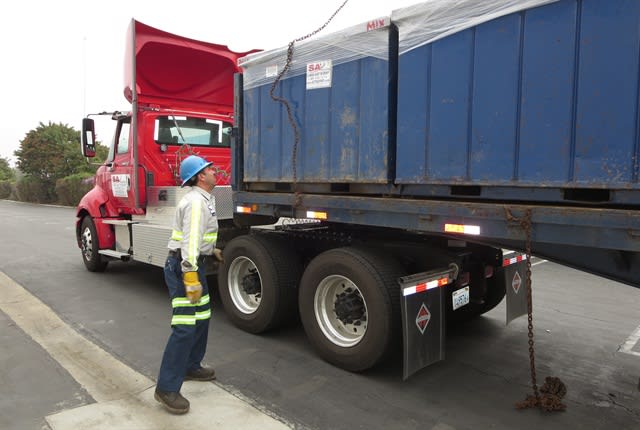
SA Recycling driver Victor Cebollos tosses a tie-down rope over scrap-filled bins he’s picked up at an automotive parts warehouse. Tractor weighs roughly 22,000 pounds, about 5,500 pounds more than a standard diesel-powered daycab. SA gets around this by assigning the electric unit to lighter loads.
TransPower in Use
An earlier version of the tractor was being run by SA Recycling, a scrap processer with a large facility on Terminal Island. David Thornburg, director of public affairs, arranged for me to ride along in it on a short pick-up run.
Ad Loading...
The driver was Victor Cebollos, one of SA’s many long-term employees. He hooked up to a steel flatbed trailer and I climbed into the passenger seat for a short trip to a Toyota Motors parts distribution warehouse. There he traded 15 empty steel bins for five others full of scrapped parts, most of them plastic. So this was a very light load, maybe 10,000 pounds including the bins.
“We can’t use it for heavy loads,” Cebollos said of the electric tractor. SR sometimes hauls dense scrap steel at the full legal gross of 80,000 pounds, but the heavy electric tractor would make such a rig legally overweight by several thousand pounds, so dispatchers keep it on lighter loads. He liked the TransPower tractor, though. “It’s smooth,” he said, “and quiet.” He also liked its clean, fumeless operation.
That’s why SA is trying it out, said Thornburg. It’s part of a long-term emissions-reduction project being run by the Ports of Long Beach and Los Angeles. The first target was emissions from steamship smokestacks. Then truckers who haul containers into and out of the ports had to get rid of old, smoky tractors and run 2007 or later-model vehicles with diesel particulate filters. DPFs have been a major part of other truck-related Clean Air efforts by the California Air Resources Board and regional Air Quality Management Districts.
“I remember Stage 1 Smog Alerts and State 2 Smog Alerts when I was growing up in the San Fernando Valley,” Thornburg said. “You don’t hear about those any more. And I remember the air down here at the port, when I first came here. The air is much cleaner now. This (the electric drayage tractor) is the next step in reducing particulate emissions at the ports, and we’re pleased to be part of it.” In mid-March he hosted a CARB delegation whose members examined the TransPower tractor and other electric-powered equipment at SA’s facility.
The tractor has been “very reliable,” he said. And with no engine and associated subsystems, it requires little maintenance aside from tires, air brakes and such. Its range of 70 to 100 or so miles has been adequate, as it returns regularly to the home terminal for recharging. And with electricity being the fuel, it’s economical to run.
Ad Loading...
Going forward
Simon at Transportation Power said a drayage tractor uses 1.25 to a bit over 3 kilowatts per mile, depending on grades, loads and road speeds. Energy cost depends on electricity rates; if it’s 12 cents per kilowatt-hour while charging overnight, the per-mile cost would be 30 cents. That’s less than a third of the $1 per mile with a diesel tractor, based on $4 per gallon and 4 mpg that’s typical in stop-and-go cycles with a lot of idling that drayage tractors see.
“There are situations when charging during the day costs 40 cents per kilowatt-hour, so the cost per mile would be about the same as diesel fuel,” he said. “So you have to be careful when you charge.”
So far TransPower has built five battery-electric drayage tractors and five yard tractors, he said. It’s currently under contract to manufacture six additional Class 8 electric-drive trucks, including a trolley-type unit that will be tested under overhead power lines, and natural gas- and fuel cell-powered series-electric hybrids that will have increased operating ranges. Also to be delivered within the next year are an experimental Class 7 hybrid truck using a natural gas-fueled microturbine, and six electric school buses.
The per-unit cost of the vehicles appears to be rather high, but much of the money has gone to “non-recurring engineering” that will be amortized through production of additional units in coming years, Simon explained. “We expect to have a total of 20 trucks and tractors deployed by next year, and our goal is to build 100 trucks and tractors in total by 2017, and to double that number each year thereafter.”
“Anything with new technology, you’re paying for the research and development,” said Thornburg at SA Recycling. “It’s like the switch to 2007 and later-model trucks with DPFs. There was added cost and maintenance expense, and everybody was upset over it. But it was added to the freight rates, and everybody survived and here we are.”
Volvo’s updated D13 promises lower emissions without sacrificing performance or fuel economy. Take a closer look at what changed inside the engine in this HDT Spotlight video.
Energy Vision estimates fleets could recover the higher purchase price of an RNG-fueled Class 8 tractor in 1.3 to 2.8 years under current fuel-price scenarios.
Calstart is now Catalyst Mobility, reflecting the nonprofit’s growing national role in clean transportation, including zero-emission trucks, infrastructure and incentive programs.
Average U.S. diesel prices have climbed to nearly $6 a gallon, surpassing the 2022 record as tight refinery capacity and Middle East disruptions keep fuel costs elevated.
Fuel delivery depends on more than what happens at the injector. For fleet, maintenance and technical professionals, looking at the full path from pump to injector can provide useful context for understanding engine performance.
The Port Authority of New York and New Jersey announced millions in incentives for zero-emission drayage trucks, yard tractors, and new charging hubs near the port.
Why do battery-electric Class 8 trucks remain so expensive? A California bill headed to Gov. Gavin Newsom would give fleets and state agencies more visibility into what manufacturers charge.
Detroit isn’t starting from scratch to meet EPA 2027 diesel emissions standards. Its Gen 6 DD13 and DD15 engines keep much of today’s platform while updating the fuel and aftertreatment systems.
California, Oregon, Washington, British Columbia and Baja California are coordinating plans for truck charging and hydrogen fueling from Canada to Mexico.
Learn more about Kenworth's T880E battery-electric vocational truck at the Paccar Technical Center, including its range, applications, upfitting considerations, and PTO options, in this HDT Spotlight video.