





Related: New Group Lobbies for Blockchain Adoption by Trucking
3 Tech Trends from McLeod User Conference
In a roundtable with trucking reporters at the McLeod 2017 User Conference in Atlanta, McLeod executives talked about a number of technology trends affecting their fleet customers and the industry at large, including ELDs, blockchain, and making sense of the vast amount of data available to fleets.
September 18, 2017

Tom McLeod talks to reporters at the McLeod Software 2017 User Conference. Photo: McLeod Software
5 min to read

Tom McLeod talks to reporters at the McLeod Software 2017 User Conference.Photo: McLeod Software
In a roundtable with trucking reporters at the McLeod 2017 User Conference in Atlanta, McLeod executives talked about a number of technology trends affecting their fleet customers and the industry at large, including ELDs, blockchain, and making sense of the vast amount of data available to fleets.
ELDs
The most looming change, of course, is the electronic logging device mandate that kicks in Dec. 18. Fleets who are waiting until the last minute may have already waited until too late, McLeod told reporters.
“I am surprised still at the number of new orders we’re getting right now that include our mobile communication module that have not selected a [ELD] provider yet.”
Using ELDs, he emphasized, goes well beyond just putting a new device in the cab.
“The management of information from electronic logs is a learning curve. It’s not just a switch you can throw. You’re not going to be able to pull into a bay at a truckstop on Dec. 17 and have a unit installed and be ready to operate the next day. That 450 mile run you’re used to making in a day, you’re not going to be able to make anymore. If your shipper holds you up for just half an hour it may cost you a half a day of service.”
In addition, he said, while there are more than 100 vendors listed as self-certified on the Federal Motor Carrier Safety Administration’s list of ELDs, “20 of those are all resellers of the same unit. From a manufacturing standpoint I think there will be supply issues.”
Some fleets, he said, won’t be able to make the transition and will go out of business. And some drivers, although not all, he predicted, will make good on their threat to quit trucking rather than use the devices.
The former, he said, will “create opportunities for the carriers that are already managing electronic logs.” And as for the latter, while the driver shortage may cause headaches for carriers, it also may help drive up rates. In addition, McLeod said, “I think the constraint on being able to find drivers will hopefully break the cycle of throughout the ‘90s all too often every time the economy would get a little better, trucking companies would go a little crazy and buy too many trucks,” resulting in overcapacity that drove down rates for everyone.
Analyzing Data for Business Intelligence
McLeod is continuing to develop ways for customers to better manage the ever-increasing flow of data that can help their businesses. McLeod IQ, introduced at last year’s User Conference, is the next generation of Business Intelligence and has been well received by customers, according to the company. It uses Microsoft Business Intelligence products to create a multidimensional cube that aggregates a fleet’s important data in a way that is easier to understand and analyze.
The initial version of IQ focused on operational insights, and over the past year, the company has expanded it to incorporate all of a customer’s financial data.
Now it also allows customers to pull in other data sources that may not be part of their McLeod system, such as the information from their mobile communications or vehicle maintenance systems. The full Microsoft Power BI suite of analysis and reporting tools also can be used with McLeod IQ.
Tom McLeod told reporters that they are working with a company in their hometown of Birmingham, Ala., to analyze large amounts of data. He referred to the “large amount of data available to our carriers through our market insight database, which has allowed us to aggregate information from all of our customers.” It can then make that data available to customers – for instance, being able to aggregate the market rate in a particular lane and how it’s trending, vs. the carrier’s rate. “This puts our carriers and brokers in stronger position to understand the rates they need to be charging in certain lanes,” McLeod said.
While some of this is already available, McLeod is working with this third party (which it does not yet want to name) to expand its data analysis and availability, including taking advantage of other data that’s available in the aggregate, such as spot rate data from Truckstop.com, even weather and traffic.
Blockchain
There’s been a lot of buzz recently about blockchain and its potential to change everything from banking to transportation.
Blockchain is a distributed ledger technology designed for transactional applications such as the movement of freight. It simplifies the management of transactional data by storing contracts and related information within transparent, auditable, secure “blocks” that are shared with multiple parties.
McLeod said its adoption in the trucking and logistics space will start with food, especially temperature-controlled products, as well as medicines – items that have a high value and a short shelf life.
In some ways, he said, the visibility blockchain could provide into the supply chain could be compared to EDI – only it offers wider visibility.
“I hesitate to say we finally are going to see the technology that could kill off EDI,” he said, noting that while the death of EDI has been predicted many times, from McLeod’s perspective there’s never been any sign of the volume of EDI transactions letting up.
“The way the blockchain visibility works, once you’ve communicated to one party, it’s also available to others in that network and so you simplify the communication requirements and you can also see what’s going on. Where in EDI, you and the receiving party may be the only ones to see that information.”
Ken Craig, McLeod’s vice president of special projects, explained that while most people are most familiar with blockchain from cryptocurrency such as Bitcoin, that confuses people. The kind of blockchain that will be used in trucking, he said, won’t be public like the type used for cryptocurrency, which also requires a vast amount of computing power.
Microsoft recently introduced the Coco Framework for enterprise blockchain networks, which stands for “confidential consortium.”
One of the benefits of blockchain, Craig explained, is that you can’t hack it because it’s distributed on every node.
“It has the potential to touch every area – not just the supply chain but areas like performance history, vehicle maintenance. You can track a vehicle from the time it leaves the factory, every time a bolt is replaced.”
More Fleet Management

What Will ATA’s New Leader Bring to Trucking's Table?
Incoming President and CEO Mark Colson’s record in Alabama offers clues about his priorities and approach following Chris Spear’s abrupt departure as the head of the American Trucking Associations.
Read More →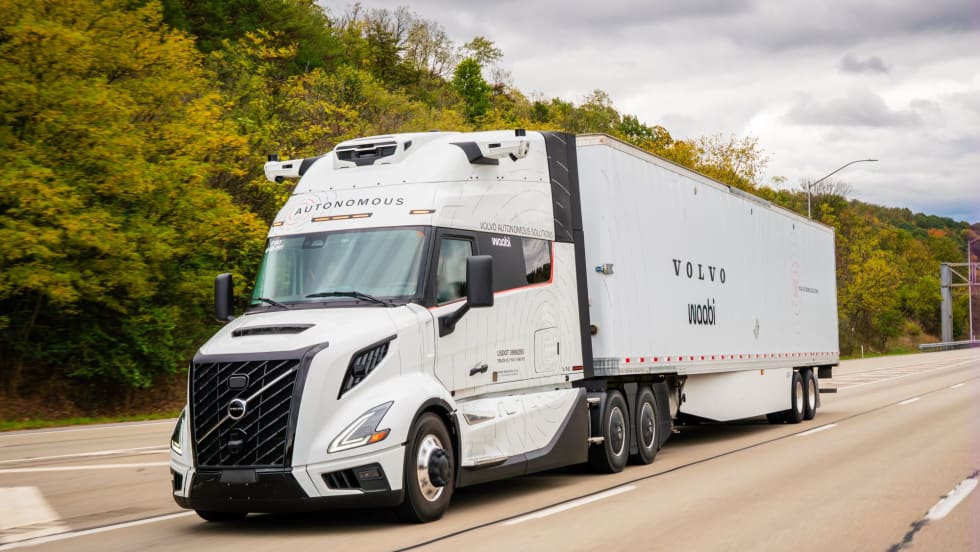
Volvo, Waabi Start Commercial Autonomous Operations in Texas
Volvo VNL Autonomous trucks, powered by the Waabi Driver, are hauling freight directly to third-party facilities for a customer in Texas.
Read More →
Samsara Launches Custom AI Agent Builder
Agent Studio lets fleets create AI tools for hours-of-service monitoring, reporting and driver support, including agents that communicate by phone.
Read More →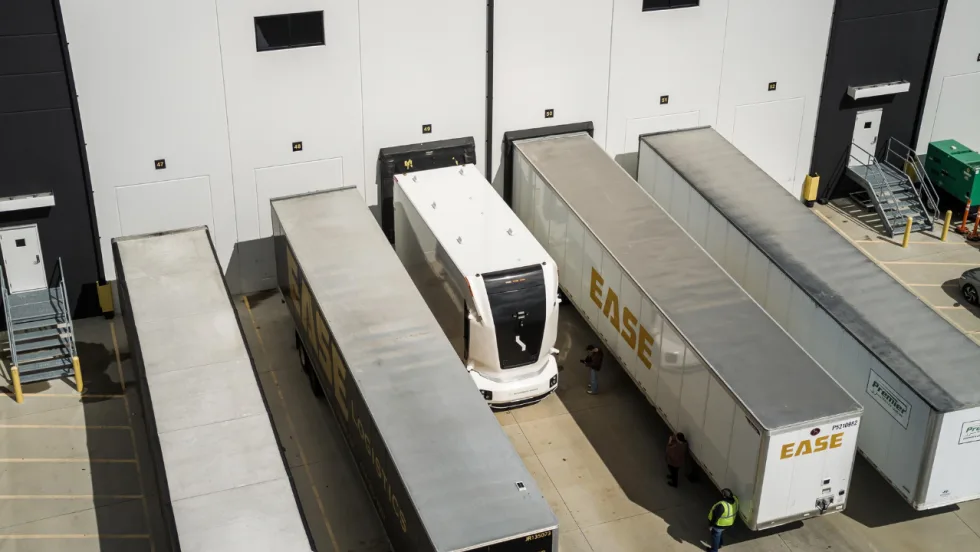
Einride Driverless Electric Trucks Begin Daily Freight Operations in Ohio
Two cabless electric trucks are hauling freight between EASE Logistics facilities in Marysville, Ohio, as part of a multi-state truck automation project.
Read More →
Geotab Links Fleet Card to Vehicle Data
The new card combines fuel discounts with telematics-based purchase controls. Geotab’s analysis also points to potential savings from choosing lower-priced fuel stops.
Read More →
How MFA Helps Protect Trucking Fleets
Multi-factor authentication adds protection when passwords are stolen. Here’s how it works and where fleets should start.
Read More →
How Better Freight Data Helps Trucking Teams Get Ahead of Disruption
Trucking and logistics teams have plenty of data. The problem is getting the right information in front of the right people soon enough to act. Better-connected data can help teams spot trouble earlier and make smarter decisions before small problems become big ones.
Read More →
Trimble: Taking Artificial Intelligence in Trucking Beyond Faster Tasks
At Insight 2026, Trimble executives argued that fleets may need to redesign workflows to get more from AI as it introduced new products and enhancements. AI’s value will depend on how fleets combine automation with their people's knowledge.
Read More →
Sponsored•September 28, 2026
Build a bulletproof fleet: Uniting ELDs and dash cams for total compliance
An ELD can prove compliance, but it cannot always prove what happened on the road. Discover how uniting accurate ELD data with AI-powered dash cam video can help your fleet strengthen compliance, defend against liability, protect drivers and reduce operational costs.
Read More →
Nominations Open for HDT Emerging Leaders
Heavy Duty Trucking is looking for accomplished trucking fleet professionals under 40 who are making an impact and helping lead the industry forward.
Read More →