




Related: IdleAir Not Letting Lower Diesel Prices Stop Idle Reduction Growth
Duke Energy Tackles Truck Idling at N.C. Distribution Facility
Duke Energy will be heading a $320,000 project to install a total of 36 electric power outlets for heavy trucks at a distribution center for Merchants Distributors in Hickory, N.C.
by Staff
July 26, 2017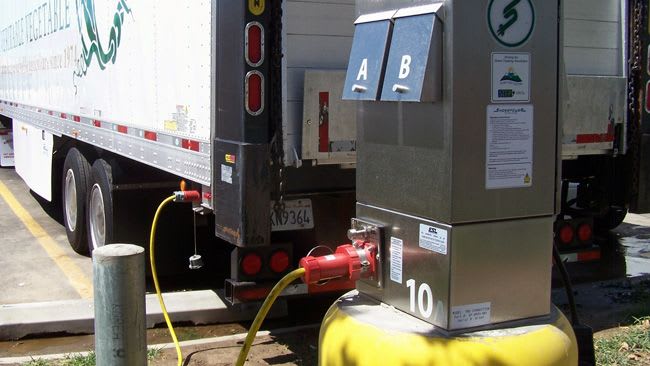
Photo via Duke Energy
2 min to read
Photo via Duke Energy
Duke Energy will be heading a $320,000 project to install a total of 36 electric power outlets for heavy trucks at a distribution center for Merchants Distributors in Hickory, N.C.
Transport refrigeration units at MDI will be able to plug into the power outlets at the facility, allowing vehicles to keep cargo cold without having to run the engine. By running off of shore power, the electrification project will lower exhaust emissions at the facility as well as save money on diesel fuel. Shorepower Technologies will install the power outlets.
Construction is currently underway at the Hickory installation and the project should be operational by this fall. This is Duke Energy’s second project in North Carolina using electricity to power trucks instead of idling engines. In May, the company announced a 24-unit project at Big Boy’s Truck Stop in the Johnston County town of Kenly. IdleAir is handling that installation and it is expected to be operational in August.
The two electrification projects are part of a 2015 settlement with the U.S. Environmental Protection Agency and environmental groups stemming from a legal case against the company for alleged violations of the Federal Clean Air Act at some of the company’s coal-fired power plants in North Carolina. The agreement required the company to spend $4.4 million on environmental projects and donations.
Duke Energy is an electric power holding company serving 7.3 million electric customers in six states in the Southeast and Midwest.
“Most trucks can use electricity to keep cargo cold when not driving,” said Melisa Johns, Duke Energy’s vice president, business development. “This project will make that technology available to trucks at MDI’s facility – providing cost savings and an environmental benefit to the local community.”
EPA has found that long-duration truck idling results in over 1 billion gallons of wasted fuel and 11 million tons of carbon dioxide emissions each year. The average hour of idling, uses a gallon of fuel, according to Duke Energy.
“MDI has invested in yard management software that will help maximize the use of the new power outlets,” said Brent Vaughan, MDI’s director, facility engineering. “This capability enables us to keep product cold using electricity, which is estimated to reduce fuel consumption by up to 31,000 gallons per year. In addition to fuel savings and reduced emissions, this project will also reduce noise and air pollution for our team and neighbors.”
More Fleet Management

Geotab Links Fleet Card to Vehicle Data
The new card combines fuel discounts with telematics-based purchase controls. Geotab’s analysis also points to potential savings from choosing lower-priced fuel stops.
Read More →
How MFA Helps Protect Trucking Fleets
Multi-factor authentication adds protection when passwords are stolen. Here’s how it works and where fleets should start.
Read More →
How Better Freight Data Helps Trucking Teams Get Ahead of Disruption
Trucking and logistics teams have plenty of data. The problem is getting the right information in front of the right people soon enough to act. Better-connected data can help teams spot trouble earlier and make smarter decisions before small problems become big ones.
Read More →

Trimble: Taking Artificial Intelligence in Trucking Beyond Faster Tasks
At Insight 2026, Trimble executives argued that fleets may need to redesign workflows to get more from AI as it introduced new products and enhancements. AI’s value will depend on how fleets combine automation with their people's knowledge.
Read More →
Sponsored•September 28, 2026
Build a bulletproof fleet: Uniting ELDs and dash cams for total compliance
An ELD can prove compliance, but it cannot always prove what happened on the road. Discover how uniting accurate ELD data with AI-powered dash cam video can help your fleet strengthen compliance, defend against liability, protect drivers and reduce operational costs.
Read More →
Nominations Open for HDT Emerging Leaders
Heavy Duty Trucking is looking for accomplished trucking fleet professionals under 40 who are making an impact and helping lead the industry forward.
Read More →
Why Private Fleets Are Taking More Freight
Private fleets are putting their own trucks on demanding customers and high-cost lanes as companies seek greater control over service, costs, and capacity.
Read More →
Sponsored•September 16, 2026
Color Match Smarter: Tools That Restore & Perform
For fleet managers and collision repair professionals keeping heavy-duty trucks on the road, getting the color right the first time isn't just about appearance — it's about efficiency, turnaround time, and bottom-line results. Discover how today's digital color tools are transforming the repair process from guesswork to precision.
Read More →
FMCSA Pauses Biennial-Update Enforcement Amid Motus Transition
Carriers whose updates were due on or after June 1 have more time, while FMCSA works to stabilize its new registration system and warns of phishing sites impersonating its new carrier registration system, Motus.
Read More →
Sponsored•September 14, 2026
2026 Blueprint for Countering Smarter Supply Chain Theft
Cargo theft is no longer just the cost of doing business. It's a multi-billion-dollar criminal enterprise exploiting vulnerabilities across your fleet, drivers, and supply chain.
Read More →