




Related: Don't Mind the Bumps, Numbers Still Look Promising for 2017
ATA Forecasts Steady Rise in Truck Tonnage Over Next Decade
The ATA Freight Transportation Forecast is projecting steadily increasing freight tonnage overall and for the trucking industry for the next ten years.

Steven Martinez・Web Editor
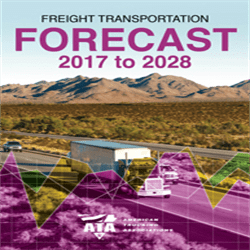
Image via ATA
3 min to read
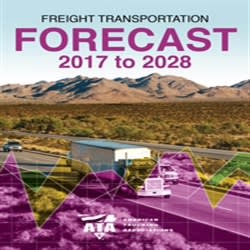
Image via ATA
The American Trucking Associations has released its latest forecast for the next decade of freight transportation, projecting continued growth for freight transportation overall and for the trucking industry.
The ATA Freight Transportation Forecast 2017 projects freight volumes to grow by 2.8% in 2017 followed by 3.4% annual growth through 2023. After that point, the report expects growth to return to a more moderate 2.3%.
In 2017, ATA projects that 15.18 billion tons of freight will be moved by all modes of transportation, rising by 36.6% to 20.73 billion tons in the next 10 years.
“As the U.S. population grows and the economy increases with it, we will see continued gains in demand for freight transportation,” said Bob Costello, ATA chief economist.
ATA worked with IHS Global Insight on the report, with IHS providing the data and forecasts and ATA publishing the analysis.
The forecast covers all modes of transportation, not just trucking, which was important because in cases where trucking is not the primary mode of transportation it usually plays some sort of secondary transportation role, Costello said in a media conference call.
Trucking is projected to grow 33.6% over the forecast period. Overall, truck volumes will continue to rise over the forecast period and will remain the dominant freight mode, but its share of tonnage is expected to dip to 67.2% by 2028 with pipelines gaining the most share.
With an increase in freight tonnage, one of the challenges for the trucking industry is figuring out how to move all of the new freight.
“Over the forecast period, capacity shortfalls will develop,” the report said. “We are starting to see some selected tightness in freight handling capacity, enough to suggest that capacity expansion will be required if the modes are going to be able to handle anticipated growth.”
ATA contends that the role of trucking could also change from a primarily long-haul to a shorter-haul model. Since 2000, the average length of haul for dry van freight in trucking has decreased from 800 to 530 miles, according to Costello. The average is not expected to shrink considerably in the near future, but with more online retail sales and an increase in distribution centers being built around the country, there could still be downward movement in that.
"There is still going to be long haul out there, but trucking's real sweet spot, and why trucks and trains really do compete on a limited basis, is because most truck freight doesn't go much over 500 miles," said Costello.
Of the major modes of freight transportation covered in the report, pipeline was projected to grow the most over the period. This was attributed to expected growth in the energy sector.
“A lot of times I get asked questions about if pipeline is really a mode of transportation, said Costello. “It absolutely is, because if it doesn’t go in a pipeline it’s going to go in another mode, whether that’s trucking or rail.”
The ATA Freight Transportation Forecast 2017 is available for purchase through ATA’s website or by calling 866-821-3468.
More Fleet Management

How MFA Helps Protect Trucking Fleets
Multi-factor authentication adds protection when passwords are stolen. Here’s how it works and where fleets should start.
Read More →
How Better Freight Data Helps Trucking Teams Get Ahead of Disruption
Trucking and logistics teams have plenty of data. The problem is getting the right information in front of the right people soon enough to act. Better-connected data can help teams spot trouble earlier and make smarter decisions before small problems become big ones.
Read More →
Trimble: Taking Artificial Intelligence in Trucking Beyond Faster Tasks
At Insight 2026, Trimble executives argued that fleets may need to redesign workflows to get more from AI as it introduced new products and enhancements. AI’s value will depend on how fleets combine automation with their people's knowledge.
Read More →

Nominations Open for HDT Emerging Leaders
Heavy Duty Trucking is looking for accomplished trucking fleet professionals under 40 who are making an impact and helping lead the industry forward.
Read More →
Why Private Fleets Are Taking More Freight
Private fleets are putting their own trucks on demanding customers and high-cost lanes as companies seek greater control over service, costs, and capacity.
Read More →
Sponsored•September 16, 2026
Color Match Smarter: Tools That Restore & Perform
For fleet managers and collision repair professionals keeping heavy-duty trucks on the road, getting the color right the first time isn't just about appearance — it's about efficiency, turnaround time, and bottom-line results. Discover how today's digital color tools are transforming the repair process from guesswork to precision.
Read More →
FMCSA Pauses Biennial-Update Enforcement Amid Motus Transition
Carriers whose updates were due on or after June 1 have more time, while FMCSA works to stabilize its new registration system and warns of phishing sites impersonating its new carrier registration system, Motus.
Read More →
Sponsored•September 14, 2026
2026 Blueprint for Countering Smarter Supply Chain Theft
Cargo theft is no longer just the cost of doing business. It's a multi-billion-dollar criminal enterprise exploiting vulnerabilities across your fleet, drivers, and supply chain.
Read More →
What the U.S.-Canada Trade War Means for Trucking
Escalating U.S.-Canada tariffs could disrupt cross-border freight, reduce truck volumes, raise costs, and create new uncertainty for carriers on both sides of the border.
Read More →
What Are Trucking’s Top Concerns for 2026?
The American Transportation Research Institute wants to know what's worrying trucking fleet managers, drivers, and other stakeholders in its annual Industry Issues survey.
Read More →