




TransComply Launches Carrier Food-Safety Compliance Tool
The Uniform Food Safety Transportation Protocol is available now for use by motor carriers to comply with mandates from shippers and their broker agents under the new Food and Drug Administration rule for sanitary transportation of human and animal food, according to TransComply.

The Uniform Food Safety Transportation Protocol is available now for use by motor carriers to comply with mandates from shippers and their broker agents under the new Food and Drug Administration rule for sanitary transportation of human and animal food, according to TransComply, the compliance-support firm that publishes and manages the UFSTP.
The UFSTP was drafted in consultation with refrigerated and agricultural carriers, brokers, shippers and refrigerated warehousing firms, said Avery Vise, president of Birmingham, Ala.-based TransComply.
Vise said the protocol establishes uniform standards for delegating responsibilities to carriers under the Food Safety Modernization Act (FSMA) for the transportation of perishable food.
He noted that the UFSTO is intended for carriers of all sizes and is modeled loosely after the Uniform Intermodal Interchange & Facilities Access Agreement (UIIA).
Beginning in April, shippers and receivers with 500 or more employees and their agents will have to comply with the FDA rule. The entire perishable-food supply chain must be compliant by April, 2018.
FDA said the food-transport rule aims “to prevent practices during transportation that create food safety risks, such as failure to properly refrigerate food, inadequate cleaning of vehicles between loads, and failure to properly protect food.”
The new rule establishes requirements for vehicles and transportation equipment, transportation operations, records, and training.
“Although the FDA rule technically exempts carriers with less than $500,000 in annual revenue,” Vise pointed out, “shippers undoubtedly will expect carriers regardless of size to adhere to common standards. The protocol is a fair and accurate reflection of best practices and minimum standards that shippers, brokers, and warehousing operations will expect from carriers.”
In the absence of industrywide acceptance of uniform commercial terms, the FDA rule likely will lead to conflicting contracting terms that would frustrate the ability of carriers to contract for the movement of perishable commodities in the spot market, according to TransComply.
Carriers participating in the UFSTP will certify to shippers and brokers that they are familiar with and will comply with FDA’s requirements for cleaning of equipment, training of personnel, recordkeeping, and refrigeration.
To participate in the protocol, carriers need to complete an application and pay a “nominal” annual participation/maintenance fee; sign the protocol to warrant their agreement and compliance with its terms and conditions; and arrange for transmission of certificates of insurance to TransComply. A listing of participating carriers with contact and insurance information will be freely available to shippers, brokers, and others at www.ufstp.com.
“The UFSTP establishes much needed standards for compliance with FSMA and we enthusiastically support the protocol,” said Jim Morse, chairman of motor carrier Refrigerated Food Express and broker RFX Inc., both based in Avon, Mass. “It’s our hope that the shipping community embraces the protocol because it is reasonable and in the best interests of all stakeholders.”
Vise said that participating in an arrangement such as the UFSTP will be “essential for small and medium-sized carriers in particular, as they do not have the time or expertise to negotiate a myriad of individual agreements with shippers and brokers or to manage their compliance with those obligations.”
“Without the protocol,” he added, “the FDA rule could present a serious challenge to the competitiveness of small independent refrigerated carriers.”
For more information on the UFSTP and FSMA, click here or email info@ufstp.com.
More Fleet Management

2026 Blueprint for Countering Smarter Supply Chain Theft
Cargo theft is no longer just the cost of doing business. It's a multi-billion-dollar criminal enterprise exploiting vulnerabilities across your fleet, drivers, and supply chain.
Read More →
How Telematics Improves Visibility, Control, and Performance in Refrigerated Fleets
Explore how telematics help refrigerated fleets improve visibility, uptime, efficiency, compliance, and cargo protection across connected cold chain operations.
Read More →
What the U.S.-Canada Trade War Means for Trucking
Escalating U.S.-Canada tariffs could disrupt cross-border freight, reduce truck volumes, raise costs, and create new uncertainty for carriers on both sides of the border.
Read More →

What Are Trucking’s Top Concerns for 2026?
The American Transportation Research Institute wants to know what's worrying trucking fleet managers, drivers, and other stakeholders in its annual Industry Issues survey.
Read More →
American Trucking Associations Looks for a New Leader
ATA President and CEO Chris Spear abruptly left his job at the association on August 21, at a pivotal time for the trucking industry.
Read More →
Public Wi-Fi Cybersecurity Risks: How Truck Drivers and Fleets Can Protect Their Data
Public Wi-Fi can expose truck drivers and fleets to credential theft, malware, and other cyber threats. Here’s how to reduce the risk on the road.
Read More →
For Nicky Cupp, Fleet Innovation Starts With Frustration
HDT Truck Fleet Innovator Nicky Cupp turns everyday pain points at Fraley & Schilling into opportunities for better technology and smarter processes.
Read More →
Adam Buttgenbach’s Approach to Electric Trucks: Start With Where They Fit
HDT Truck Fleet Innovator Adam Buttgenbach helped PepsiCo build one of North America’s largest EV fleets by focusing on where electric trucks make operational sense.
Read More →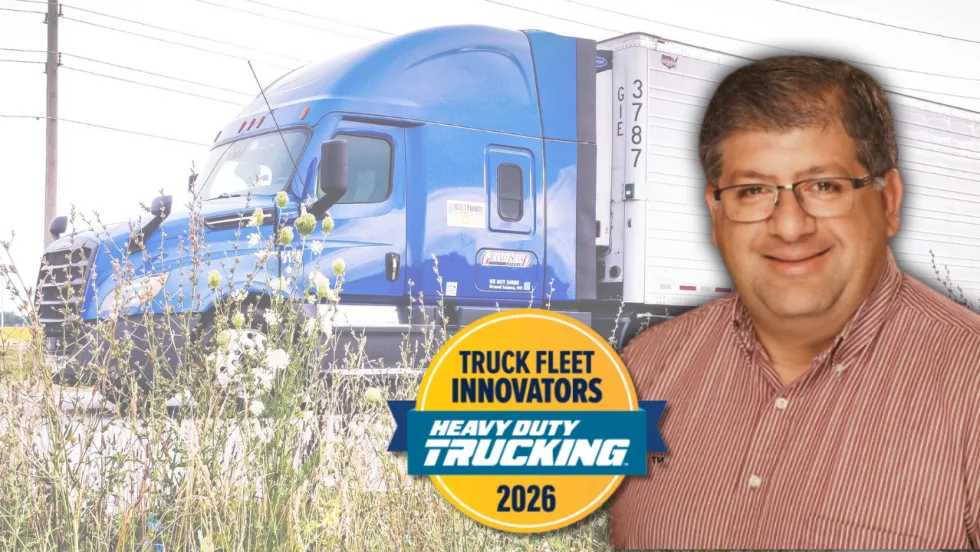
Deen Albert: Let Automation Do the Math, People Make the Decisions
HDT Truck Fleet Innovator Deen Albert makes sure people are still at the heart of operations at Grand Island Express, even while adopting artificial intelligence tools. AI-assisted dispatch helped boost revenue 25% with the same number of trucks.
Read More →
Trimble’s New AI Agent Takes Aim at Fleet Back-Office Busywork
Arc Agent works across Trimble TMS products to automate repetitive tasks such as freight orders, maintenance, invoices, fuel costs and more.
Read More →