




DOT Proposes V2V Rule for Cars; Could One for Trucks Be Far Behind?
While the National Highway Traffic Safety Commission issued a proposed rule on Dec. 13 aimed at getting vehicle-to-vehicle (V2V) communication technology on all new light-duty vehicles, NHTSA confirmed for HDT that there is “no [similar] rulemaking as of yet” in the works for commercial vehicles.

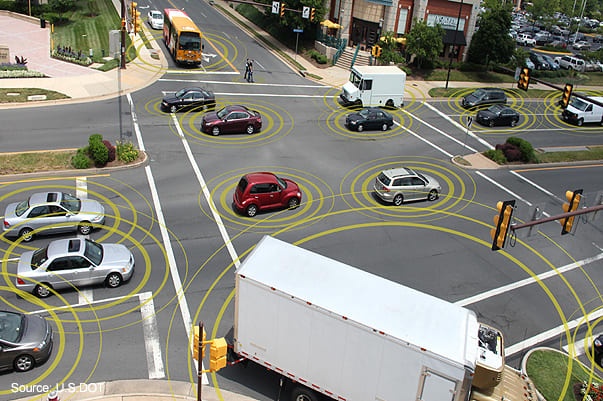
Artist rendering of connected vehicles on the road Image: U.S. Department of Transportation
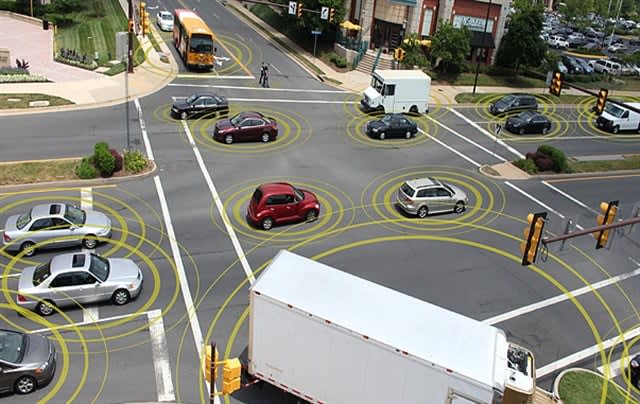
Artist rendering of connected vehicles on the roadImage: U.S. Department of Transportation
While the National Highway Traffic Safety Commission issued a proposed rule on Dec. 13 aimed at getting vehicle-to-vehicle (V2V) communication technology on all new light-duty vehicles, NHTSA Communications Director Bryan Thomas confirmed for HDT that there is “no [similar] rulemaking as of yet” in the works for commercial vehicles.
Thomas noted that “research is ongoing and we see great potential” in V2V technology for medium- and heavy-duty trucks and buses as well. Per a NHTSA fact sheet on the light-duty proposal, the agency is “working with industry” on continuing research “to adapt the technology for these vehicles.”
V2V is a companion technology for autonomously driven vehicles, including platooned trucks that are electronically linked while operating on the road.
At an October news briefing, Chris Spear, president and CEO of the American Trucking Associations, said that the lobby was determined to make sure trucking has “a seat at the table” along with the automotive industry when policies are developed to allow and further vehicle automation.
“The technology is here and will grow rapidly,” Spear said on the show floor of ATA’s Management Conference & Exposition. “Suppliers are already creating connected and automated technology.” But he added that trucking is “a different animal than the car side,” so ATA is aiming to ensure the industry’s voice is heard as federal policymaking develops.
Spear then pointed out that the first federal guidelines for the testing and deployment of autonomous vehicles, released by the Department of Transportation in September, were developed with almost no input from the trucking industry.
Asked on Dec. 13 to review the current landscape for a V2V commercial-vehicle rulemaking, ATA Executive Vice President of Advocacy Bill Sullivan told HDT that a lot has changed since Spear spoke out less than three months ago on trucking being consulted by DOT regarding such activity.
“Chris [Spear] was right in speaking out and, since then, we do have a seat at the table [with DOT],” said Sullivan. “This V2V rulemaking is for light-duty vehicles and it points in the right direction. It sets the bar high in respect to preserving a data spectrum for safety communications. We are hopeful this approach will continue under the Trump administration.”
According to DOT, the proposed rule would enable V2V communication technology on all new light-duty vehicles, “enabling a multitude of new crash-avoidance applications that, once fully deployed, could prevent hundreds of thousands of crashes every year by helping vehicles ‘talk’ to each other.”
The rule would require V2V devices to operate through standardized messaging that DOT said would be developed with industry. More specifically, NHTSA said that V2V devices would use dedicated short range communications (DSRC) to transmit data, such as location, direction and speed, to nearby vehicles.
That data would be updated and broadcast up to 10 times per second to nearby vehicles. Using that information, V2V-equipped vehicles could identify safety risks and provide warnings to drivers to avoid imminent crashes.
NHTSA pointed out that vehicles equipped with automated driving functions— such as automatic emergency braking and adaptive cruise control— could also benefit from the use of V2V data to better avoid or reduce the consequences of crashes.
DOT also announced that, separately, the Federal Highway Administration plans to soon issue guidance for Vehicle-to-Infrastructure (V2I) communications, “which will help transportation planners integrate the technologies to allow vehicles to ‘talk’ to roadway infrastructure such as traffic lights, stop signs and work zones to improve mobility, reduce congestion, and improve safety.
More Fleet Management

Could Your Truck's Connected Devices Be a Cybersecurity Risk?
ELDs, telematics systems and driver tablets help fleets operate more efficiently. But every connected device needs protection against cyberattacks.
Read More →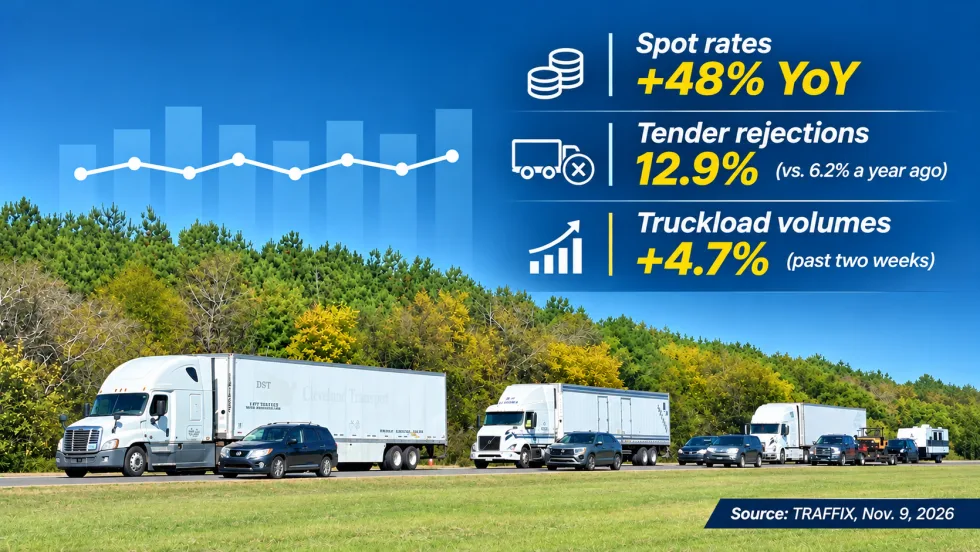
Holiday Freight Meets a Tight Trucking Market
There's no freight boom, but truckload carriers are finding themselves in a stronger position to negotiate rates. And holiday shipping demand could tighten the market further.
Read More →
What Trucking Events are Happening in 2027?
Looking for trucking-related conventions, expos, and other events? Heavy Duty Trucking has developed this list of national and larger regional trucking shows and events.
Read More →
Does Your Trucking Fleet Need a New TMS?
Artificial intelligence and better integrations promise less busywork and more useful data. Can your TMS help your company solve problems? Do you need additional vendors or an upgrade? Or is it time to look for a new platform?
Read More →
Fleet Costs Shape ACT Expo 2027 Agenda
With diesel prices high and operating expenses under pressure, ACT Expo's 2027 agenda emphasizes fuel efficiency, AI, safety and the return on fleet technology investments.
Read More →
Does Your Trucking Fleet Need a New TMS? [Video]
Cloud technology, AI and new integrations are changing what transportation management systems can do. But does taking advantage of those advances mean replacing your existing TMS?
Read More →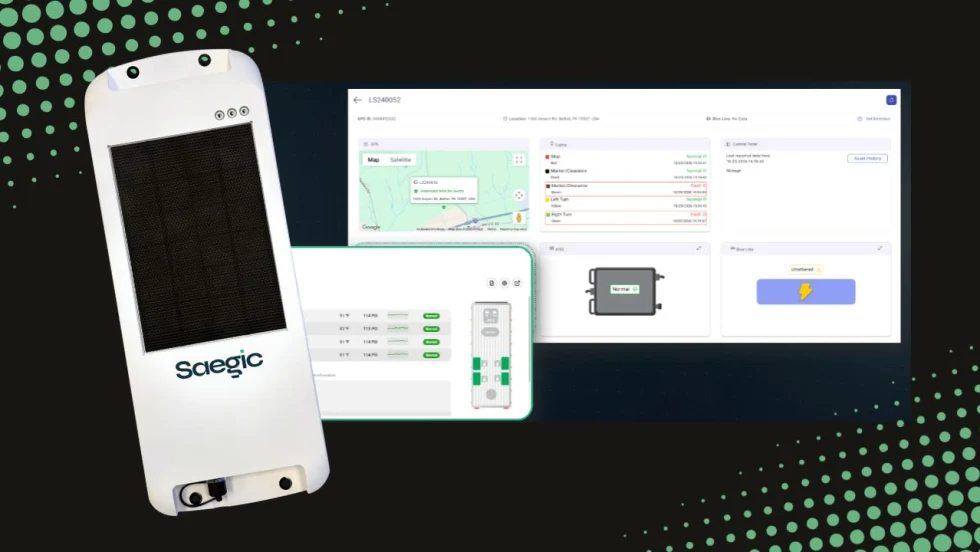
Road Ready Becomes Saegic, Launches New Trailer Telematics Gateway
Clarience Technologies is rolling out new hardware and expanding its plans for connecting trailer telematics, maintenance data, and video.
Read More →
Give Your Trucking Fleet a Cybersecurity Walkaround
Your fleet's cybersecurity policies may look good on paper. These seven checks can help you find out whether they’re working.
Read More →
Kodiak Lines Up Fleets for Driverless Trucking
An agreement for 75 trucks, a new Texas freight lane, and progress on safety validation move Kodiak closer to its planned driverless highway launch.
Read More →
ITS Logistics Settles Religious Harassment Case
The Nevada-based logistics firm agreed to pay more than $396,000 to settle a religious harassment charge involving an employee's Jewish identity.
Read More →