




Freight Index Disappoints After Offering ‘False Hope’
After offering a glimmer of “less bad” hope in August, one measure of freight shipments data in September disappointed.

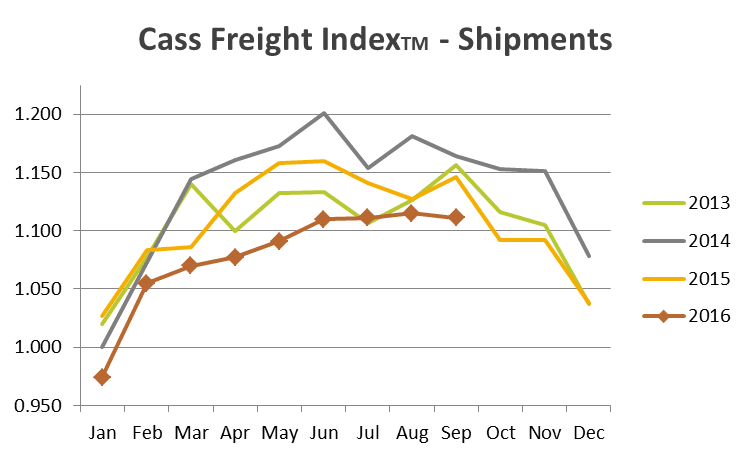
After offering a glimmer of “less bad” hope in August, one measure of freight shipments data in September disappointed -- although there are a few areas of growth.
Turns out that September report was "false hope," says the author of the monthly Cass Freight Index Report, Donald Broughton, who's managing director, chief market strategist and senior transportation analyst at the investment firm Avondale Partners.
“September data is once again signaling that overall shipment volumes and pricing continued to be weak in most modes, with increased levels of volatility as all levels of the supply chain – manufacturing, wholesale and retail – continue to try and work down inventory levels," said Broughton.
“That said, there have been a few areas of growth, mostly related to e-commerce, with lower levels of expansion being experienced in transit modes serving the auto and housing/construction industries."
In the Cass Freight Expenditures Index, expenditures (the total amount spent on freight) were up month-over-month in August, and the year-over-year rate of contraction appeared to be ‘less bad’ than the rates in May, June, July, and August.
In September, however, index measurements for freight shipments and expenditures fell 3.1% and 3.8%, respectively, compared to a year ago. It was the 19th straight month of shipment declines. Shipments dropped 0.4% last month from August. Expenditures rose 5.2% month over month, but Broughton said this was the result of the steady increase in the price of fuel over the last six months and not an increase in pricing power.
Broughton said continued weakness in freight movements is being driven by the excess of capacity in most modes, whether you're talking about trucking, rail, air freight, barge, ocean container or bulk.
“Although at first blush it appears that in most modes the gap between spot pricing and contract pricing appears to be closing slightly, this is more a function of slight declines in contract pricing than it is a function of improvements in spot pricing,” he said. “We see little reason to predict a change in course or material strength in either the contract or spot rates for most modes. Exceptions to this do remain in the parcel marketplace and forms of expedited transit supporting e-commerce.”
All this, he said, is happening against a backdrop of the U.S. economy in a state of transition.
“After the explosion in fracking activity drove the first industrial-led recovery from 2009-2014 in the U.S. since 1961, we have been patiently waiting for the consumer to take the baton of leadership in economic growth,” Broughton said. The lower fuel prices didn't prompt consumers didn’t go out and spend freely, though.
“U.S. consumers have been choosing to pay down debt and increase their savings rate. Simply put, the consumer has not yet picked up where the industrial economy left off,” Broughton said.
Adding to these problems for the economy and trucking is that inventories have been bloated, subtracting from total U.S. gross domestic product growth to the tune of around 3% the past five straight quarters. However, Broughton is somewhat optimistic inventories will fall.
He did sound an alarm about increasing talk about the Federal Reserve raising interest rates, possibly before the end of the year. His concern is that will make the already strong U.S. dollar even stronger, and that could hurt the overall economy and freight.
“Historically, a strong dollar has produced a serious headwind for freight volumes, first in all things exported, and then in a reduction of things manufactured or assembled domestically,” he said. “Nothing in the freight flow data suggests that another rate hike is warranted, or even that the first hike in December 2015 was necessary.”
On the consumer side of the equation, Broughton sees some signs of hope, especially for those retailers with a strong e-tailing or omni-channel offering.
“With the price of oil and natural gas remaining low, we see little reason to predict a resurgence in fracking or the many types of industrial activity that fracking drives. Obviously, this would also mean that the consumer would continue to enjoy improved disposable income,” he said. “As we have pointed out, the U.S. consumer has been saving and paying down debt with this disposable income for over six quarters. By this holiday season, we expect them to begin to spend at least part of their income. If not, the risk of an overall recession grows.”
More Fleet Management

Geotab Links Fleet Card to Vehicle Data
The new card combines fuel discounts with telematics-based purchase controls. Geotab’s analysis also points to potential savings from choosing lower-priced fuel stops.
Read More →
How MFA Helps Protect Trucking Fleets
Multi-factor authentication adds protection when passwords are stolen. Here’s how it works and where fleets should start.
Read More →
How Better Freight Data Helps Trucking Teams Get Ahead of Disruption
Trucking and logistics teams have plenty of data. The problem is getting the right information in front of the right people soon enough to act. Better-connected data can help teams spot trouble earlier and make smarter decisions before small problems become big ones.
Read More →

Trimble: Taking Artificial Intelligence in Trucking Beyond Faster Tasks
At Insight 2026, Trimble executives argued that fleets may need to redesign workflows to get more from AI as it introduced new products and enhancements. AI’s value will depend on how fleets combine automation with their people's knowledge.
Read More →
Build a bulletproof fleet: Uniting ELDs and dash cams for total compliance
An ELD can prove compliance, but it cannot always prove what happened on the road. Discover how uniting accurate ELD data with AI-powered dash cam video can help your fleet strengthen compliance, defend against liability, protect drivers and reduce operational costs.
Read More →
Nominations Open for HDT Emerging Leaders
Heavy Duty Trucking is looking for accomplished trucking fleet professionals under 40 who are making an impact and helping lead the industry forward.
Read More →
Why Private Fleets Are Taking More Freight
Private fleets are putting their own trucks on demanding customers and high-cost lanes as companies seek greater control over service, costs, and capacity.
Read More →
Color Match Smarter: Tools That Restore & Perform
For fleet managers and collision repair professionals keeping heavy-duty trucks on the road, getting the color right the first time isn't just about appearance — it's about efficiency, turnaround time, and bottom-line results. Discover how today's digital color tools are transforming the repair process from guesswork to precision.
Read More →
FMCSA Pauses Biennial-Update Enforcement Amid Motus Transition
Carriers whose updates were due on or after June 1 have more time, while FMCSA works to stabilize its new registration system and warns of phishing sites impersonating its new carrier registration system, Motus.
Read More →
2026 Blueprint for Countering Smarter Supply Chain Theft
Cargo theft is no longer just the cost of doing business. It's a multi-billion-dollar criminal enterprise exploiting vulnerabilities across your fleet, drivers, and supply chain.
Read More →