




ATA’s Spear Slams Proposed Speed-Limiter Rule
The president and CEO of the American Trucking Associations has bluntly assessed as “dangerous” the key provisions of the proposed federal speed-limiter rule for heavy-duty commercial vehicles.

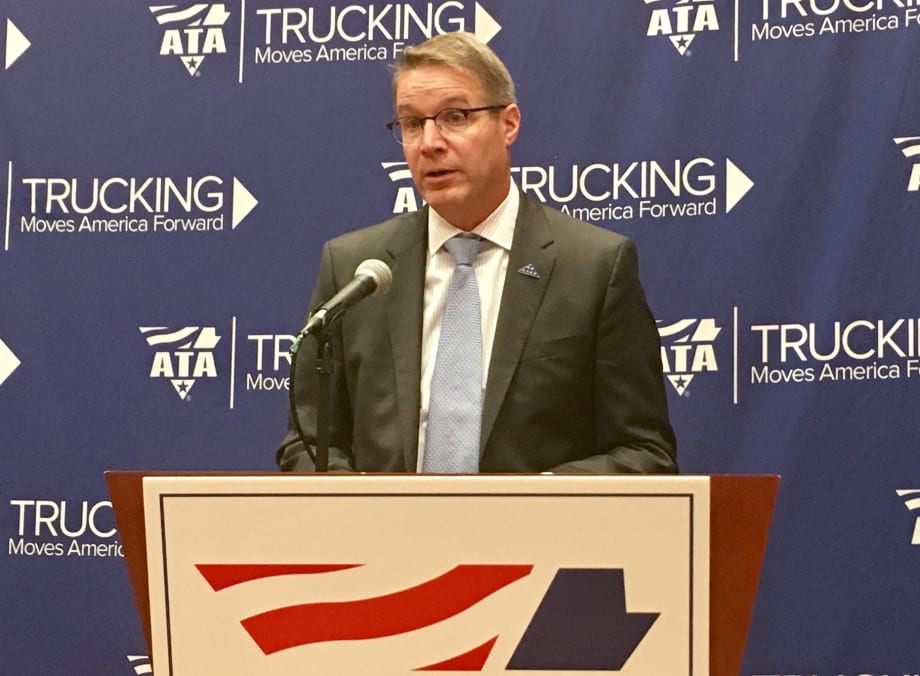
Chris Spear speaking to the press on ATA's stance on proposed speed-limiter rule. Photo: David Cullen
Chris Spear speaking to the press on ATA's stance on proposed speed-limiter rule.Photo: David Cullen
LAS VEGAS. The president and CEO of the American Trucking Associations bluntly assessed as “dangerous” the key provisions of the proposed federal speed-limiter rule for heavy-duty commercial vehicles.
Chris Spear opened his brief remarks at an Oct. 4 press conference held here at the close of ATA’s Management Conference and Exposition by stating that, “My team and myself have our marching orders.”
He said that numerous policy discussions took place at the group’s board of directors meeting that day, but for the moment, he wanted to focus on just one regulatory issue.
“I find it rather curious,” Spear began, “that it’s taken the [Obama] administration nearly eight years to bring forth this proposal.” The proposed rule was jointly issued by the National Highway Safety Administration and the Federal Motor carrier Safety Administration on Aug. 26-- after a decade-long push by trucking and safety advocates for just such a requirement.
Spear slammed the rule for its lack of specificity and the dearth of research backing it up. “The various differentials in speed from what this rule proposes and what state speed limits are is dangerous,” he stated. “What is this proposal? Three speed limits, not one. No studies to back it up. And no national cap on limits to address speed differentials.
“Our policy focus now is to develop comments on this proposal, which in my humble opinion, is flawed,” he continued. “We cannot afford to elevate risks for the motoring public with a rule that does not take into account the danger of differential speeds for cars and trucks."
Spear said the regulatory agencies have “the responsibility to study [what they’ve proposed] and come to a consensus about [setting] one speed and one national limit— not three speeds and no national limit [as is laid out in the proposal].”
He pointed out that he’s not opposed to regulating lower highway speeds for tractor trailers, which is a policy stance held for years by ATA. “We will work with our members to shape our comments” on the rulemaking,” Spear added.
ATA also announced at the press briefing that its board of directors elected Kevin Burch, president of Jet Express Inc., Dayton, Ohio, as the association’s 72nd chairman.
Burch told reporters he will put a special focus on telling those outside trucking how dedicated the industry is to safety. “This industry is filled with wonderful, dedicated professionals – from drivers and dispatchers to salesmen and executives. So I’m going to be telling that story all the time.”
“Kevin has been one of our association’s most vocal and passionate advocates,” Spear remarked. “His enthusiasm for trucking and for improving its image is infectious and will serve him and ATA well as chairman.”
Burch replaces Pat Thomas, senior vice president for state government affairs at UPS Inc. “Serving as ATA chairman has been a singular honor for me and my family,” Thomas said. “I wish Kevin all the best and believe he will be an outstanding representative of our industry.”
Related: DOT Finally Proposes Truck Speed-Limiter Rule
More Fleet Management

Color Match Smarter: Tools That Restore & Perform
For fleet managers and collision repair professionals keeping heavy-duty trucks on the road, getting the color right the first time isn't just about appearance — it's about efficiency, turnaround time, and bottom-line results. Discover how today's digital color tools are transforming the repair process from guesswork to precision.
Read More →
FMCSA Pauses Biennial-Update Enforcement Amid Motus Transition
Carriers whose updates were due on or after June 1 have more time, while FMCSA works to stabilize its new registration system and warns of phishing sites impersonating its new carrier registration system, Motus.
Read More →
2026 Blueprint for Countering Smarter Supply Chain Theft
Cargo theft is no longer just the cost of doing business. It's a multi-billion-dollar criminal enterprise exploiting vulnerabilities across your fleet, drivers, and supply chain.
Read More →


How Telematics Improves Visibility, Control, and Performance in Refrigerated Fleets
Explore how telematics help refrigerated fleets improve visibility, uptime, efficiency, compliance, and cargo protection across connected cold chain operations.
Read More →
What the U.S.-Canada Trade War Means for Trucking
Escalating U.S.-Canada tariffs could disrupt cross-border freight, reduce truck volumes, raise costs, and create new uncertainty for carriers on both sides of the border.
Read More →
What Are Trucking’s Top Concerns for 2026?
The American Transportation Research Institute wants to know what's worrying trucking fleet managers, drivers, and other stakeholders in its annual Industry Issues survey.
Read More →
American Trucking Associations Looks for a New Leader
ATA President and CEO Chris Spear abruptly left his job at the association on August 21, at a pivotal time for the trucking industry.
Read More →
Public Wi-Fi Cybersecurity Risks: How Truck Drivers and Fleets Can Protect Their Data
Public Wi-Fi can expose truck drivers and fleets to credential theft, malware, and other cyber threats. Here’s how to reduce the risk on the road.
Read More →
For Nicky Cupp, Fleet Innovation Starts With Frustration
HDT Truck Fleet Innovator Nicky Cupp turns everyday pain points at Fraley & Schilling into opportunities for better technology and smarter processes.
Read More →
Adam Buttgenbach’s Approach to Electric Trucks: Start With Where They Fit
HDT Truck Fleet Innovator Adam Buttgenbach helped PepsiCo build one of North America’s largest EV fleets by focusing on where electric trucks make operational sense.
Read More →