




Congressional Freight Panel: We Need Robust Infrastructure Funding
A congressional panel is recommending a comprehensive, multimodal approach to freight transportation with robust, sustainable funding from public and private sources. The bipartisan Panel on 21st Century Freight Transportation unanimously backs more spending on freight infrastructure – but does not take a position on where the money should come from.

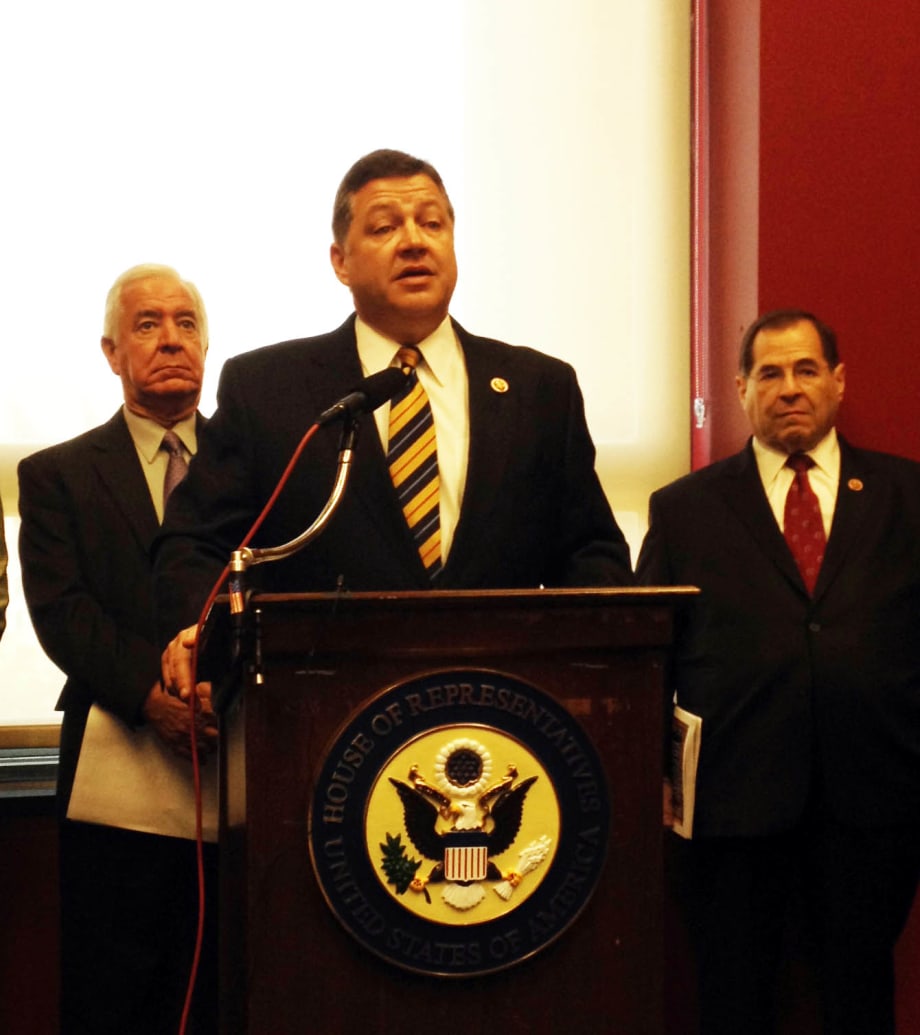
Rep. Bill Shuster, R-Pa., chairman of the House Transportation and Infrastructure Committee, talks to the press about the results of the bipartisan panel's study of freight transport.
Rep. Bill Shuster, R-Pa., chairman of the House Transportation and Infrastructure Committee, talks to the press about the results of the bipartisan panel's study of freight transport.
A congressional panel is recommending a comprehensive, multimodal approach to freight transportation with robust, sustainable funding from public and private sources.
The bipartisan Panel on 21stCentury Freight Transportation unanimously backs more spending on freight infrastructure – but does not take a position on where the money should come from.
Its recommendation on this key point is to have the secretaries of Transportation, Treasury and the Army find the best way to raise the money that’s needed.
“We’re kicking the can to some extent,” said Rep. Jerrold Nadler, D-N.Y., but he and others contend that the panel’s work is a strong beginning to what will be difficult negotiations over the highway bill that’s due this time next year.
The stakes are high. Unless Congress acts, the Highway Trust Fund will be running dry by December 2014, said former Deputy Transportation Secretary Mortimer Downey in his analysis of the panel’s report.
“Funding is one of the things that we’re going to continue to work on,” said Rep. John Duncan, R-Tenn., the chairman of the 11-member panel. The panel included six Republicans and five Democrats, all members of the House Transportation and Infrastructure Committee.
The panel was established by Reps. Bill Shuster, R-Pa., and Nick Rahall, D-W.Va., leaders of the Transportation and Infrastructure Committee, to study freight transport in preparation for drafting next year’s highway bill.
The report lists a number of funding and financing options, ranging from increasing fuel taxes to such freight options as a waybill tax or a container fee.
“We listed quite a few possibilities and direct the cabinet secretaries to pick and choose, to see if they can develop some consensus,” said Nadler, the lead minority member of the panel. The panel itself shied away from specific funding recommendations because any solution is going to require broad-based support, Nadler said.
“We believe that if we’re going to achieve the kind of consensus that Congress and the administration and the country at large will need to enact revenue sources, it has to be broader than what would come out of just this panel,” he said.
He and Duncan noted that the funding question goes beyond the scope of the Transportation and Infrastructure Committee. It falls under the jurisdiction of the Ways and Means Committee in the House, and the Finance Committee in the Senate.
Bipartisan Beginnings
The strength of the panel’s report is that it reflects bipartisan understanding of the need for more investment, Duncan and Nadler said.
“The purpose of the panel was to get the process started, to bring attention to where it has to be, to delineate the options and to get the discussion started among the members of the panel and the committee,” Nadler said.
“We made a good start toward that. The aim is to develop enough consensus by next year to pass a bill.”
Two members the panel who are on opposite sides politically, Reps. Daniel Lipinski, D-Ill., and Markwayne Mullin, R-Okla., underscored the point.
Working together on the report built relationships that will help move the highway bill, Lipinski said.
“Everyone on the panel understands that we need to work together,” said Mullin.
The panel got strong reviews from the Coalition for America’s Gateways and Trade Corridors, a group of transportation providers and state interests that has been pushing for a national freight policy.
“There’s not a lot new (in the panel’s report), but what’s new is who’s saying it,” said Mortimer Downey, a founder of the group.
“They are playing back issues we have been talking about for quite some time, but it’s coming from the right people, the members of the (Transportation and Infrastructure) Committee, saying we need to take a bold step,” he said.
Leslie Blakey, executive director of the group, said the panel’s agreement on the need for more investment is a welcome change.
“In a Congress so bitterly divided on raising taxes to have a panel agree that we need to spend more money … it’s really different from what we have heard up until now,” she said.
The Recommendations
The panel spent six months holding hearings in Washington and several states, taking testimony from a wide range of interests on the full scope of freight transportation issues.
The members came away agreeing that a coordinated national freight policy is key to U.S. competitiveness in the global market, and that the current modal infrastructure does not serve the nation’s needs.
Here are the panel’s recommendations:
Direct the Secretary of Transportation, with the Secretary of the Army and the Commandant of the Coast Guard, to establish a national freight transportation policy and designate a national, multimodal freight network.
Ensure robust public investment in all freight modes, and create incentives for additional private investment.
Improve the speed and efficiency of developing and delivering freight infrastructure projects.
Authorize dedicated, sustainable funding for multimodal freight projects of national and regional significance. Use a grant process and establish benchmarks for selecting projects.
Direct the Secretary of Transportation, with the Secretaries of the Army and the Treasury, to identify and recommend sustainable sources of revenue for all freight modes.
Review these recommendations with the Transportation and Infrastructure Committee and the Ways and Means Committee, and develop specific funding and revenue options for freight projects.
One of the subjects the panel studied was truck sizes and weights. This work did not yield any specific recommendations, however. The panel only encourages DOT to complete its Comprehensive Truck Size and Weight Limits Study in time for next year’s bill.
On another trucking issue, Duncan said the panel is recommending additional funding for driver training.
“There’s a serious shortage now in commercial drivers,” he said. “(Training) can provide a lot of good jobs.”
More Fleet Management

Color Match Smarter: Tools That Restore & Perform
For fleet managers and collision repair professionals keeping heavy-duty trucks on the road, getting the color right the first time isn't just about appearance — it's about efficiency, turnaround time, and bottom-line results. Discover how today's digital color tools are transforming the repair process from guesswork to precision.
Read More →
FMCSA Pauses Biennial-Update Enforcement Amid Motus Transition
Carriers whose updates were due on or after June 1 have more time, while FMCSA works to stabilize its new registration system and warns of phishing sites impersonating its new carrier registration system, Motus.
Read More →
2026 Blueprint for Countering Smarter Supply Chain Theft
Cargo theft is no longer just the cost of doing business. It's a multi-billion-dollar criminal enterprise exploiting vulnerabilities across your fleet, drivers, and supply chain.
Read More →


How Telematics Improves Visibility, Control, and Performance in Refrigerated Fleets
Explore how telematics help refrigerated fleets improve visibility, uptime, efficiency, compliance, and cargo protection across connected cold chain operations.
Read More →
What the U.S.-Canada Trade War Means for Trucking
Escalating U.S.-Canada tariffs could disrupt cross-border freight, reduce truck volumes, raise costs, and create new uncertainty for carriers on both sides of the border.
Read More →
What Are Trucking’s Top Concerns for 2026?
The American Transportation Research Institute wants to know what's worrying trucking fleet managers, drivers, and other stakeholders in its annual Industry Issues survey.
Read More →
American Trucking Associations Looks for a New Leader
ATA President and CEO Chris Spear abruptly left his job at the association on August 21, at a pivotal time for the trucking industry.
Read More →
Public Wi-Fi Cybersecurity Risks: How Truck Drivers and Fleets Can Protect Their Data
Public Wi-Fi can expose truck drivers and fleets to credential theft, malware, and other cyber threats. Here’s how to reduce the risk on the road.
Read More →
For Nicky Cupp, Fleet Innovation Starts With Frustration
HDT Truck Fleet Innovator Nicky Cupp turns everyday pain points at Fraley & Schilling into opportunities for better technology and smarter processes.
Read More →
Adam Buttgenbach’s Approach to Electric Trucks: Start With Where They Fit
HDT Truck Fleet Innovator Adam Buttgenbach helped PepsiCo build one of North America’s largest EV fleets by focusing on where electric trucks make operational sense.
Read More →