




Related: Trailers Are Smarter Than Ever
Panel: Trailers Next Frontier in Telematics
The power of telematics continues to advance, and there are still plenty of opportunities to be realized – especially when it comes to the rolling assets seen in a rearview mirror. A panel at the North American Commercial Vehicle Show explored the topic.
by John G. Smith
September 28, 2017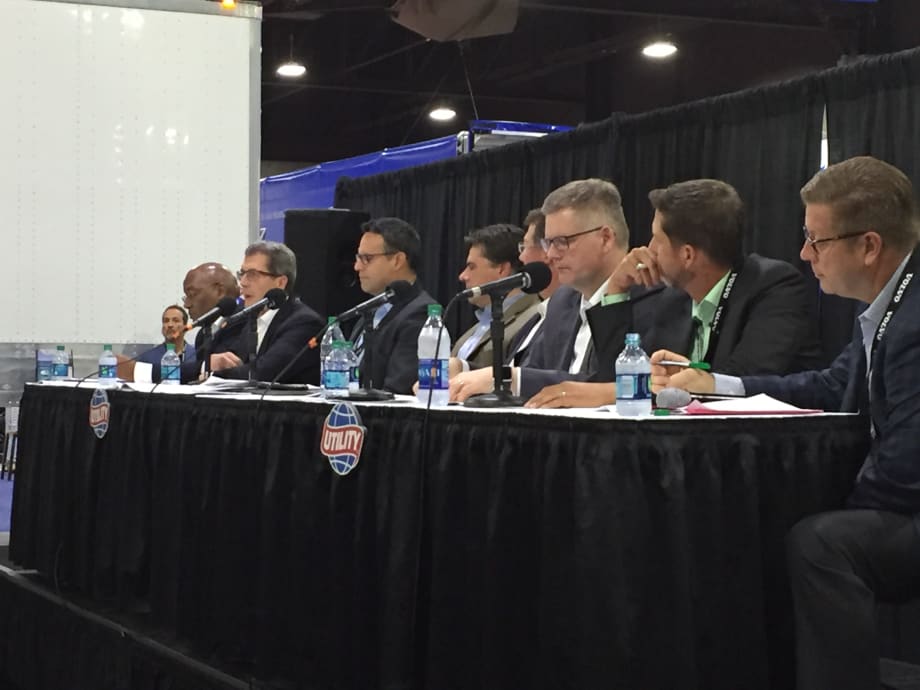
“The trailer is very much increasing in importance.” says Wabco's Jon Morrison. Photo: Deborah Lockridge
4 min to read
“The trailer is very much increasing in importance.” says Wabco's Jon Morrison.Photo: Deborah Lockridge
ATLANTA, GA – The power of telematics continues to advance, and there are still plenty of opportunities to be realized – especially when it comes to the rolling assets seen in a rearview mirror.
It’s why Utility Trailer’s Intelligent Trailer Symposium, held during the North American Commercial Vehicle Show, gathered a panel of high-profile executives to explore the promises and challenges of collecting, sharing, and using trailer-related data.
“We do spend a lot of time talking about trucks,” said Jon Morrison, Wabco’s president – Americas. “The trailer is very much increasing in importance.”
The interest in data clearly involves more than filling spreadsheets and completing reports. Wabco has a boat tail that deploys and retracts at specific speeds based on data from existing antilock braking systems. Retreading programs can track the condition of individual tires equipped with RFID tags. Reefer settings can be monitored and changed remotely. Those are just a few examples.
“The demand for data is increasing everywhere,” said Berend Bracht, president and CEO of Bendix.
While the traditional focus has been on collecting the data because of an exception or unusual situation, like a fault code or collision, the possibilities that can be realized by analyzing “big data” will require a continuous stream of bits and bytes.
More data can be a good thing, but it presents new challenges to address. Will information collected about a trailer, for example, come from wired or wireless sensors? How will it ultimately be packaged and transmitted to drivers and operation teams? “There’s a lot of data, but who gets that data?” Bracht asked, referring to one fundamental question.
“One of the biggest issues that still exists for fleets is light outage(s),” explained Dominic Grote, president and CEO of Grote Industries. Drivers need to be notified if lights go dark, but so do maintenance teams. And there is plenty of underlying information to track. The largest entry in the U.S. Federal Register is FMVSS 108, he observed, which dictates the many standards lights have to meet.
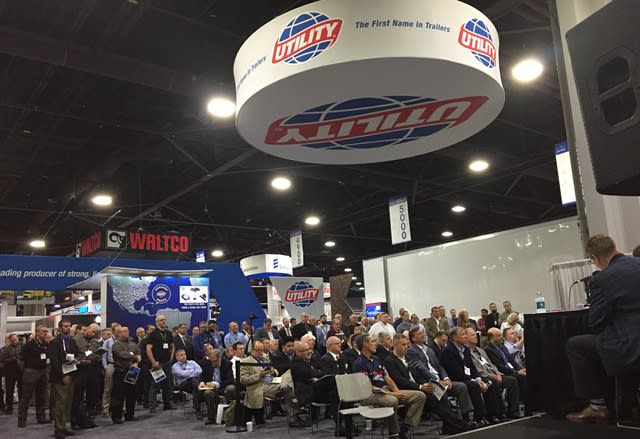
Utility Trailer’s Intelligent Trailer Symposium gathered a panel of high-profile executives to explore the promises and challenges of collecting, sharing, and using trailer-related data.Photo: Deborah Lockridge
When establishing telematics systems, there is also the question of how quickly people need to receive information, said David Kiefer, director of sales, marketing and product management for Carrier Transicold. One warning might require a driver’s immediate attention, but if reefer temperatures begin to fluctuate, it might be better to inform other fleet personnel who have the tools to make adjustments remotely. Drivers no longer have to be part of that equation.
Too much data, after all, can be overwhelming to those sitting behind the wheel. “We have to think in terms of what we do to enable the driver just to drive the truck,” he said.
As advances are made toward different levels of autonomous trucks, it becomes increasingly important to consider the entire vehicle combination, Morrison added. Platooning offers a prime example here. “This is where we need to really understand and qualify the vehicles that are coming together, and this is where data sensing and data transmission becomes quite important,” he said. As the lead vehicle in a tightly spaced platoon applies the brakes, the following vehicles almost instantaneously have to know what’s happening and trigger brakes of their own.
The ever-increasing streams of data might demand a new electrical connector between tractors and trailers, suggested Rob Phillips, president and chief operating officer of Phillips Industries. Equipment used to support the latest round of emissions standards will present the need for additional circuits, he said. “The J560 we’re using right now is very much overloaded.”
It could call for something like the 15-pin connectors used in Europe. “That’s a better solution – to have two connectors there,” he said, citing the example of installing multiple cameras around a trailer to feed screens in a cab. Each camera requires two wires, with the twisted pairs offering the best signals.
“The reality is, we’ve got potentially a lot of data going back and forth.”
Systems on the trailer itself could generate some of the required power, added Beto Dantas, ConMet’s vice president – marketing, strategy and innovation, referring to his company’s electric hub that generates power by electrifying wheel hubs. Then there’s the matter of how the power is ultimately used, maybe to assist fuel economy. The ultimate application could vary by fleet. “You can actually create something that’s customizable,” he said.
Dantas also called on manufacturers to collaborate more closely when developing different systems, stressing that it would expedite the rollouts of different technologies.
The ultimate goal would be cost-effective systems that talk to each other with a single bill for the airtime, all through a single dashboard, Kiefer said. With many suppliers coming and going in the world of telematics, the interest in systems that are backed by original equipment manufacturers also begins to rise.
“You see a lot of people and a lot of manufacturers offering new and unique things that really add value to fleets,” he said, referring to the opportunities to share the pipeline of data heading back to fleet offices. “The question becomes, how do you integrate that? It’s where the next stage of the value chain begins.”
“Fleets don’t want to have a dozen boxes on the front of their trailer,” Phillips agreed. “The way we can do that is by collaborating.”
This content appears through an editorial sharing agreement with Today's Trucking, an award-winning Canadian trucking publication.
Subscribe to Our Newsletter
More Fleet Management

Sponsored•September 16, 2026
Color Match Smarter: Tools That Restore & Perform
For fleet managers and collision repair professionals keeping heavy-duty trucks on the road, getting the color right the first time isn't just about appearance — it's about efficiency, turnaround time, and bottom-line results. Discover how today's digital color tools are transforming the repair process from guesswork to precision.
Read More →
FMCSA Pauses Biennial-Update Enforcement Amid Motus Transition
Carriers whose updates were due on or after June 1 have more time, while FMCSA works to stabilize its new registration system and warns of phishing sites impersonating its new carrier registration system, Motus.
Read More →
Sponsored•September 14, 2026
2026 Blueprint for Countering Smarter Supply Chain Theft
Cargo theft is no longer just the cost of doing business. It's a multi-billion-dollar criminal enterprise exploiting vulnerabilities across your fleet, drivers, and supply chain.
Read More →


Sponsored•September 1, 2026
How Telematics Improves Visibility, Control, and Performance in Refrigerated Fleets
Explore how telematics help refrigerated fleets improve visibility, uptime, efficiency, compliance, and cargo protection across connected cold chain operations.
Read More →
What the U.S.-Canada Trade War Means for Trucking
Escalating U.S.-Canada tariffs could disrupt cross-border freight, reduce truck volumes, raise costs, and create new uncertainty for carriers on both sides of the border.
Read More →
What Are Trucking’s Top Concerns for 2026?
The American Transportation Research Institute wants to know what's worrying trucking fleet managers, drivers, and other stakeholders in its annual Industry Issues survey.
Read More →
American Trucking Associations Looks for a New Leader
ATA President and CEO Chris Spear abruptly left his job at the association on August 21, at a pivotal time for the trucking industry.
Read More →
Public Wi-Fi Cybersecurity Risks: How Truck Drivers and Fleets Can Protect Their Data
Public Wi-Fi can expose truck drivers and fleets to credential theft, malware, and other cyber threats. Here’s how to reduce the risk on the road.
Read More →
For Nicky Cupp, Fleet Innovation Starts With Frustration
HDT Truck Fleet Innovator Nicky Cupp turns everyday pain points at Fraley & Schilling into opportunities for better technology and smarter processes.
Read More →
Adam Buttgenbach’s Approach to Electric Trucks: Start With Where They Fit
HDT Truck Fleet Innovator Adam Buttgenbach helped PepsiCo build one of North America’s largest EV fleets by focusing on where electric trucks make operational sense.
Read More →