





Related -- Q&A: Old Dominion's David Bates on the Keys to the LTL's Success
Q&A: Old Dominion Freight Line Exec on Scope, Scale, and Growth
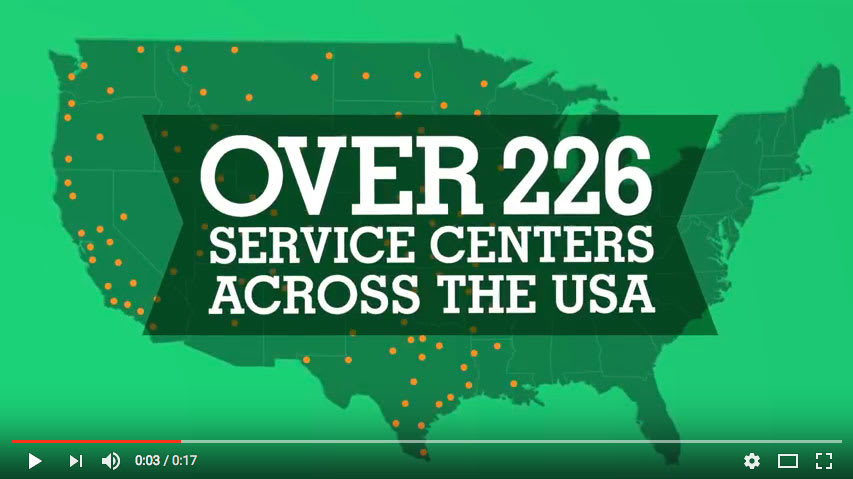
Old Dominion Freight Line recently posted a short animated video highlighting the scope and scale of the less-than-truckload carrier. We spoke with Chip Overbey, senior vice president of strategic planning, to learn more about OD's impressive growth strategy.
March 17, 2017
6 min to read

Chip Overbey.Photo: Old Dominion Freight Line
Old Dominion Freight Line recently posted a short animated video highlighting the scope and scale of the less-than-truckload carrier. We spoke with Chip Overbey, senior vice president of strategic planning, to learn more about OD's impressive growth strategy. (The interview has been lightly edited for length and clarity.)
HDT: The freight climate was soft last year, yet you continued to invest in building, remodeling and expanding service centers. Why is that important?
Overbey: This is nothing new for us. We've been reinvesting in this company and this business for many, many years. Between 2006 and 2015 we’ve invested over $900 million in our service centers network. If you count equipment and technology, since 2012 we’ve invested a billion and a half or more. Even during the recession, we were investing in the business. We believe we have a premium service. Our value proposition is a high-quality service for a fair and equitable price. Even when economic conditions are somewhat off, in a just-in-time, online economy, if it’s not available to sell, there is no sale. So people need their goods, they need them on time, they need them in good condition, and the best way to do that is to have the capacity available to them when they need it.
If you look at [our] service center count from 2005 to the end of 2014 compared against other publicly traded LTLs, their terminal parity is down 27%; ours is up 42%. That means we've got the capacity to move [customers’] goods though our network in a time-sensitive manner, over 99% on time, [with] around 0.3% claims ratio.
With tractors and trailers, against those same carriers, our tractor count is up 30% and trailers the same; the nearest competitor is about half that. At the end of the month or the quarter people looking for trailers and need high quality service, we've got it here. We don't say, ‘We can’t pick you up today.’
Frankly, financially we’ve had the wherewithal to do it. I think our value proposition of high quality at a fair and reasonable price has allowed us to maintain a solid balance sheet. Customers have been very loyal to us, so we can make the reinvestment back into the business.
HDT: How much is driven by the need to adapt to consumer-driven e-commerce?
Overbey: I don’t know that e-commerce itself drives it, other than if you think about the e-commerce model, the idea is to get as close to the consumer as you can. People want to order things and get it next day or the second day. We may not be delivering to that end consumer, but we’re having to help the fulfillment centers turn their inventory. In our world, over 87% move in three day or less and 68% second day or less.
Some of the service centers where we added capacity or spun off [another service center] in a market, like Atlanta where we used to have one and now have three plus one in Athens, gets us closer to those fulfillment centers to provide that quick turnaround. Our trailers are really a warehouse on wheels. Turning it quickly helps drive supply chain costs down and we’re very good at that. We can have conversations with shippers about how their supply chain works and we have a really flexible network that can help them with that.
We may add doors to an existing service center, or we may spin off and, say, instead of adding another 100 doors, maybe we need to put that 100 doors 50 miles up the road closer to that industrial park or that city. We’ve been very successful with organically growing.
HDT: What benefits are there to service center remodels beyond adding doors?
Overbey: It may be a technological upgrade. Sometimes it's hard to put a hard dollar on this, but when employees are coming to a place that’s clean and ergonomically friendly, it can’t help but help your morale. They’re proud of where they work and the tractors they drive in. They’re proud to invite customers to facilities and show it off. And that’s one of the things that separates us from the field. Sometimes when we can bring someone and show them our technology, our resources, and how they can make their businesses better, it’s good for us. You want your places to be warm and friendly and inviting; and your equipment can look that way too. State of the art equipment that is new and efficient and gets the best fuel mileage possible; all those things matter.
HDT: How does scope and scale benefit the company and what are the challenges of growth?
Overbey: One [challenge] is financially being stable enough to do that, and we’ve been blessed. You’ve got to have the financial wherewithal to fund it. Obviously the macro economy hasn't helped.
And always things like finding the right people. We've been blessed to find good quality people in every market who understand our culture. The people drive it. It’s cliched, I know, but they're the most important asset we've got. We don't have high turnover, so we’ve been very blessed with that and it helps overcome some of the economic challenges.
HDT: In an article in the Journal of Commerce recently, Satish Jindel, president of SJ Consulting Group, said, “There is no certainty demand is going to increase. This is not the time to add capacity.” He said if LTL carriers add too much capacity, pricing power could slip away. What do you think about that?
Overbey: There are really three different types of capacity. There’s network capacity, such as service centers, number of doors, and real estate; there’s tractors and trailers, the equipment; and then there’s people.
We try to add capacity where we think we’re going to grow. We have internal models and studies that show when a service center reaches a percentage of capacity, we know historically it’s time to start planning to do something. From a tractor and trailer account, it doesn't make sense to have equipment sitting, so you do have to be very disciplined in what you’re doing.
HDT: Jindel also contended that LTL carriers should try to unlock “unused” capacity in existing terminals before adding doors or buildings, using technology to incur affinity in routing, cross dock operations, etc.
Overbey: That is something that we spend a lot of time [and money] on. In technology alone, since 2012, we spent right at $115 million on technology. How do we use our operational technology, how do we use our databases, how do we use information from customers, to help us plan better, be more effective. We're after the same things as a shipper may be – we want to make sure we’re as efficient and move that freight as quickly a possible with as few resources as possible. That’s what technology helps us do. It also allows you to give information to your customer to help them communicate with their customers.
HDT: Where do you see things heading in the future?
Overbey: The macro economy is always going to be a big part of transportation. It’s going to be interesting to see how that unfolds over the next few quarters and years to come. After recessions, a lot of carriers don't have the ability to invest in equipment… you've got to operate with a reasonable return to invest the money back into the business. Otherwise you end up robbing Peter to pay Paul.
We still only have 8.5 to 9% of the LTL share. depending on whose study. So for us, the downside is we’ve only got that much. The upside is, there’s opportunity there… there’s a lot of growth opportunity. We have a great service that moves across North American borders. It’s going to be interesting to see how the economy changes and what factors come into play in the coming months.
Subscribe to Our Newsletter
More Fleet Management

Kodiak Lines Up Fleets for Driverless Trucking
An agreement for 75 trucks, a new Texas freight lane, and progress on safety validation move Kodiak closer to its planned driverless highway launch.
Read More →
ITS Logistics Settles Religious Harassment Case
The Nevada-based logistics firm agreed to pay more than $396,000 to settle a religious harassment charge involving an employee's Jewish identity.
Read More →
Your Trucks Are Busy. That Doesn’t Mean They’re Winning.
High utilization doesn’t always mean strong margins. Looking beyond the current load can help fleets make better dispatch decisions and get more value from each truck’s time.
Read More →
Why This Trucking Recovery Is Different
Freight demand remains sluggish, but rising costs and tougher enforcement have taken enough capacity out of the market to change the outlook for motor carriers.
Read More →
Platform Science Adds Dispatch and Safety Tools
Four additions to PS Fleet help fleets monitor loads, manage driver coaching, share truck locations and adjust video system settings.
Read More →
PrePass Intelligence Mines Fleet Bypass, Toll and Safety Data
PrePass Intelligence helps fleets measure bypass savings, flag potential toll overcharges, and spot suspicious transactions by combining data from separate systems.
Read More →
Motive Adds AI Agents for Fleet Operations
New tools automate follow-up on fleet data, from maintenance work orders to driver alerts, with two-way voice conversations planned for later this year.
Read More →
Can You Beat Our Trucking Trivia Challenge?
Test your truck knowledge with 19 trivia questions from Heavy Duty Trucking Exchange. Can you keep up with the fleet pros?
Read More →
BeyondTrucks Adds Rules Checks to Dispatch
New Compatibility Engine checks driver qualifications, equipment requirements and fleet policies before loads are dispatched.
Read More →
Diesel Prices Hijack Trucking’s Worry List
ATRI’s annual survey finds cautious optimism about freight, but diesel costs, litigation, and insurance continue to squeeze fleets. Drivers have different priorities on several issues.
Read More →