




California Carrier Builds Own ELD
California carrier Best Yet Express decided to develop its own ELD system, which would go beyond the ELD mandate that kicks in this December and become a true productivity tool.

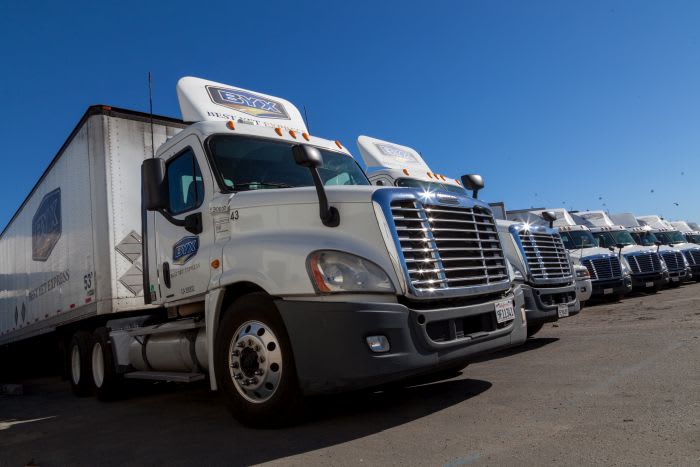
Photos: Best Yet Express

Photos: Best Yet Express
For Southern California carrier Best Yet Express, which operates within a 100-mile radius, log books are only required if drivers have to work more than 12 hours. So if drivers of its 43 trucks unexpectedly had to go beyond that 12-hour period, they had to pull over and fill out their log right away.
“We wanted to make sure our trucks were always moving,” explains Jay Newjahr, CEO of the family-owned, primarily less-than-truckload and warehousing company. “Whether we work one hour or 14 hours, we didn’t want to make our drivers have to fill out those forms.”
None of the commercially available products really fit its needs, so the company decided to develop its own system, which would go beyond the electronic logging device mandate that kicks in this December and become a true productivity tool.
“We said, why does it have to stop at hours of service?” Newjahr says. “We want our HOS to develop in the background and run as the guys are doing their normal everyday shift.”

The project actually grew out of a desire to automate pretrip inspections, Newjahr explains. “I was having problems getting drivers to fill out vehicle reports accurately. So I said, why don't we find a way to do this electronically, and set it up so a driver has to do step one before he does step two,” and so forth. “It started getting very creative after that.”
In addition to electronic pre-trip inspections, Best Yet Express wanted its system to track not just city names, but the actual customer location. It wanted to be able to tell where drivers are, why they’re there, and what they’re doing.
The resulting system is a workflow application drivers can easily pull up on a Samsung 7-inch tablet.
“They used to have to fill out a paper form for [their manifest] and a paper form for hours of service and a paper form for their pretrips,” Newjahr says. Much of the information required on the manifest overlapped what’s required for hours of service. Putting it all into one electronic system streamlined the driver’s day.
The system was recently rolled out to drivers, and currently the company is working on making sure it meets the self-certification standards for ELDs as set up by the FMCSA. The plan eventually is to market the system to other trucking companies.
“Our drivers have been absolutely enthralled by it,” Newjahr says. “They love the no paperwork part, they love the simplicity of it, they love being in compliance.”
More Fleet Management

Color Match Smarter: Tools That Restore & Perform
For fleet managers and collision repair professionals keeping heavy-duty trucks on the road, getting the color right the first time isn't just about appearance — it's about efficiency, turnaround time, and bottom-line results. Discover how today's digital color tools are transforming the repair process from guesswork to precision.
Read More →
FMCSA Pauses Biennial-Update Enforcement Amid Motus Transition
Carriers whose updates were due on or after June 1 have more time, while FMCSA works to stabilize its new registration system and warns of phishing sites impersonating its new carrier registration system, Motus.
Read More →
2026 Blueprint for Countering Smarter Supply Chain Theft
Cargo theft is no longer just the cost of doing business. It's a multi-billion-dollar criminal enterprise exploiting vulnerabilities across your fleet, drivers, and supply chain.
Read More →


How Telematics Improves Visibility, Control, and Performance in Refrigerated Fleets
Explore how telematics help refrigerated fleets improve visibility, uptime, efficiency, compliance, and cargo protection across connected cold chain operations.
Read More →
What the U.S.-Canada Trade War Means for Trucking
Escalating U.S.-Canada tariffs could disrupt cross-border freight, reduce truck volumes, raise costs, and create new uncertainty for carriers on both sides of the border.
Read More →
What Are Trucking’s Top Concerns for 2026?
The American Transportation Research Institute wants to know what's worrying trucking fleet managers, drivers, and other stakeholders in its annual Industry Issues survey.
Read More →
American Trucking Associations Looks for a New Leader
ATA President and CEO Chris Spear abruptly left his job at the association on August 21, at a pivotal time for the trucking industry.
Read More →
Public Wi-Fi Cybersecurity Risks: How Truck Drivers and Fleets Can Protect Their Data
Public Wi-Fi can expose truck drivers and fleets to credential theft, malware, and other cyber threats. Here’s how to reduce the risk on the road.
Read More →
For Nicky Cupp, Fleet Innovation Starts With Frustration
HDT Truck Fleet Innovator Nicky Cupp turns everyday pain points at Fraley & Schilling into opportunities for better technology and smarter processes.
Read More →
Adam Buttgenbach’s Approach to Electric Trucks: Start With Where They Fit
HDT Truck Fleet Innovator Adam Buttgenbach helped PepsiCo build one of North America’s largest EV fleets by focusing on where electric trucks make operational sense.
Read More →