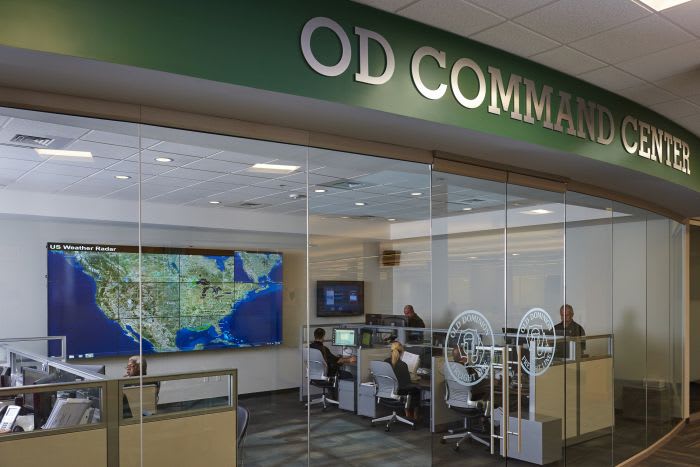
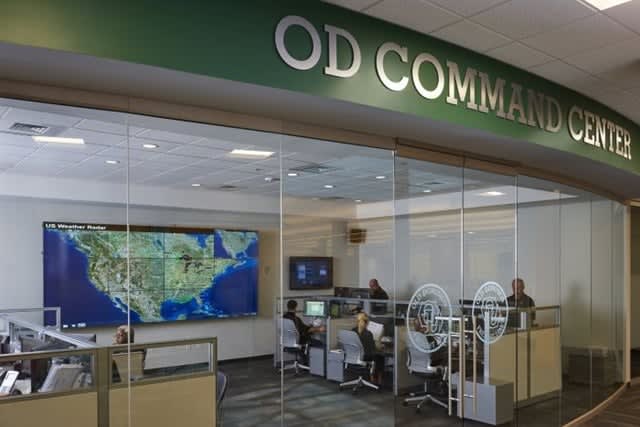
Data from PeopleNet units on trucks plus external information, like weather reports, generate graphics on the big wall map. Dispatchers can see it all from their nearby work stations.Photo via Old Dominion Freight Line
3 min to read
Data from PeopleNet units on trucks plus external information, like weather reports, generate graphics on the big wall map. Dispatchers can see it all from their nearby work stations.Photo via Old Dominion Freight Line
When you have some 7,000 trucks on the road at any one time, things like winter storms that close Interstate highways have a ripple effect across the network like cancelled flights at Chicago’s O’Hare airport. And the amount of data available on those trucks via telematics is a gold mine waiting to be tapped.
Ad Loading...
That’s why the less-than-truckload carrier Old Dominion Freight Line got its IT staff to work with PeopleNet to develop better ways to analyze and use all that data. The centerpiece of their efforts is visible as the “command center” at its Thomasville, North Carolina, headquarters.
At any time of day or night, the five dispatchers in the center can glance up at a wall of TVs and get a birds-eye view of the entire network, including any weather delays, accidents or breakdowns, and hard braking/stop incidents.
Ad Loading...
“We look at ourselves as the conductor and all 230 service centers out in the field as the orchestra,” says Hugh Morris, vice president of transportation. “Anybody here in the corporate office that is sharing information out in the field can walk by, look inside our big glass bubble, and in 30 seconds know just about anything and everything going on in the entire network.”
The data flows into the system from PeopleNet units on the vehicles, as well as external information such as weather data from the National Oceanic and Atmospheric Administration.
“PeopleNet is an external partner that is working with our internal IT department, and they’re actually working together to help make this reporting more dynamic,” he says.
WIth the two-way flow of communications though the PeopleNet units, Morris says, a dispatcher can use his or her mouse to click on a point in the network and broadcast messages to trucks in a certain geographic area. For example, if a tornado is reported, dispatchers can warn trucks in its path.
In addition to the real-time data displayed on the screen, ODFL uses the data that comes in to analyze and improve other operational efficiencies. For instance, rpm, overspeed and idling time are measured and used to help educate drivers on how to drive for better fuel economy. Fuel mileage per truck is used to determine if some trucks are more fuel efficient in different areas of the country. Real-world data from trucks helps the company develop the most efficient routes based on time of day or night. The amount of shipments and tonnage flowing through service centers determines when a service center may need to be expanded or a new one added.
Ad Loading...
ODFL had been using PeopleNet for several years, Morris says. “We had access to all of that information; it’s just that we did not have a visual that we could display to the network that was easy for them to see and understand vs. reading it on the paper, and interpreting what was said vs. what was meant.”
Fleet Snapshot
Who: Old Dominion Freight Line
Where: Thomasville, North Carolina
Fleet: Over 7,000 tractors and some 20,000 trailers
Operations: Less-than-truckload non-union carrier providing super-regional and national service
Fun Fact: Earl and Lillian Congdon founded ODFL with a single truck running between Richmond and Norfolk, Virginia.
Challenge: Displaying and using vast amounts of data
For fleet managers and collision repair professionals keeping heavy-duty trucks on the road, getting the color right the first time isn't just about appearance — it's about efficiency, turnaround time, and bottom-line results. Discover how today's digital color tools are transforming the repair process from guesswork to precision.
Carriers whose updates were due on or after June 1 have more time, while FMCSA works to stabilize its new registration system and warns of phishing sites impersonating its new carrier registration system, Motus.
Cargo theft is no longer just the cost of doing business. It's a multi-billion-dollar criminal enterprise exploiting vulnerabilities across your fleet, drivers, and supply chain.
Explore how telematics help refrigerated fleets improve visibility, uptime, efficiency, compliance, and cargo protection across connected cold chain operations.
Escalating U.S.-Canada tariffs could disrupt cross-border freight, reduce truck volumes, raise costs, and create new uncertainty for carriers on both sides of the border.
The American Transportation Research Institute wants to know what's worrying trucking fleet managers, drivers, and other stakeholders in its annual Industry Issues survey.
HDT Truck Fleet Innovator Adam Buttgenbach helped PepsiCo build one of North America’s largest EV fleets by focusing on where electric trucks make operational sense.