




3 Trends in the Spot Freight Market
As FTR and Truckstop.com apply "big data" analysis to spot market pricing, Noel Perry, FTR transportation economist, offers some insights into the volatility of spot pricing and how spot prices correlate with contract pricing.
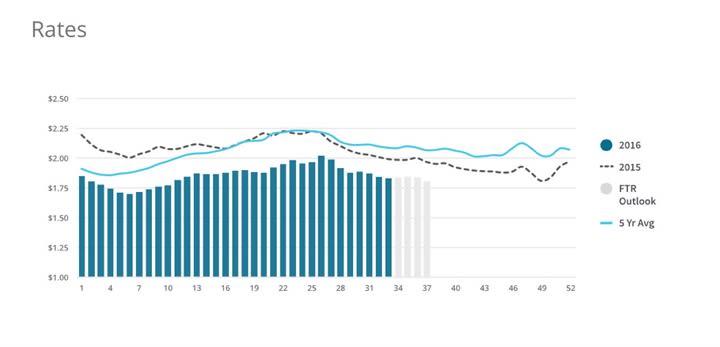
Graph courtesy FTR and Truckstop.com
Graph courtesy FTR and Truckstop.com
As FTR and Truckstop.com apply "big data" analysis to spot market pricing, Noel Perry, FTR transportation economist, offers some insights into the volatility of spot pricing and how spot prices correlate with contract pricing.
1. Spot prices have been rising more than contract prices.
The data being analyzed starts in the first quarter of 2008, just before the big downturn. Since the bottom of that recession, contract prices have averaged a 1% quarter over quarter growth (annualized). Even with the big decline last year, spot prices have averaged 2%. This is consistent with the big move of random freight from the edges of contracts into the spot market, Perry notes. Volume has built, and so have rates.
"I expect this trend to peak in 2019 with the coming crisis in regulatory drag," Perry says. "After that is unclear."
2. Spot prices are way more volatile.
This is no surprise, Perry says. The spot market is defined as the home of swings in random demand. The capacity pressure indices calculated by Truckstop.com and DAT both swing widely in almost lockstep. It follows that price changes swing widely.
The standard deviation of spot rate changes since the bottom of the last recession is five times larger than that of contract rates. "In case you have forgotten your college stat definitions, that means spot rate growth varies five times more than contract rate growth," he says.
3. Both spot and contract pricing lag changes in capacity utilization.
With spot prices, the lags between market events and price response are short, perhaps up to a quarter, Perry says. The response is not instantaneous because truckers and shippers take time to realize that a change is required. There are also some small delays in the statistics. As big data (and forecasting tools) emerge, this lag should be shortened because market decision makers will know that something is happening sooner, he notes.
Contract rates have a much more noticeable lag. They tend to peak two quarters after spot rates move. In part, this is due to the nature of data collection and the schedule for contract renewals. In part, it is the lag in capacity migration between the two segments.
Both customers and carriers work to keep market conditions stable in this segment," Perry explains. Changes, increasingly come from outside forces overwhelming those efforts. Driver supply is one good example of such outside forces. If spot rates rise at some point, drivers serving that market (and carriers) will earn enough to justify leaving dependable contract situations. But rates have to climb and stay high for a while before drivers will take that risk.
"We know from history that strong changes in rate levels tend to last longer than one would expect," Perry said. "Both carriers and shippers get used to market conditions and tend to sustain them for a while after market conditions change. This is human nature.”
He pointed out two recent instances of this. First, the six-month capacity crisis of early 2004 funded a two-year burst in rates. More recently, the 2014 spot rate acceleration lasted until mid-2015 despite the fact that its first accelerant, bad winter weather, subsided by June of 2014, and the second accelerant, hours of service changes, were suspended in December 2014.
More Fleet Management

How Telematics Improves Visibility, Control, and Performance in Refrigerated Fleets
Explore how telematics help refrigerated fleets improve visibility, uptime, efficiency, compliance, and cargo protection across connected cold chain operations.
Read More →
What the U.S.-Canada Trade War Means for Trucking
Escalating U.S.-Canada tariffs could disrupt cross-border freight, reduce truck volumes, raise costs, and create new uncertainty for carriers on both sides of the border.
Read More →
What Are Trucking’s Top Concerns for 2026?
The American Transportation Research Institute wants to know what's worrying trucking fleet managers, drivers, and other stakeholders in its annual Industry Issues survey.
Read More →

American Trucking Associations Looks for a New Leader
ATA President and CEO Chris Spear abruptly left his job at the association on August 21, at a pivotal time for the trucking industry.
Read More →
Public Wi-Fi Cybersecurity Risks: How Truck Drivers and Fleets Can Protect Their Data
Public Wi-Fi can expose truck drivers and fleets to credential theft, malware, and other cyber threats. Here’s how to reduce the risk on the road.
Read More →
For Nicky Cupp, Fleet Innovation Starts With Frustration
HDT Truck Fleet Innovator Nicky Cupp turns everyday pain points at Fraley & Schilling into opportunities for better technology and smarter processes.
Read More →
Adam Buttgenbach’s Approach to Electric Trucks: Start With Where They Fit
HDT Truck Fleet Innovator Adam Buttgenbach helped PepsiCo build one of North America’s largest EV fleets by focusing on where electric trucks make operational sense.
Read More →
Deen Albert: Let Automation Do the Math, People Make the Decisions
HDT Truck Fleet Innovator Deen Albert makes sure people are still at the heart of operations at Grand Island Express, even while adopting artificial intelligence tools. AI-assisted dispatch helped boost revenue 25% with the same number of trucks.
Read More →
Trimble’s New AI Agent Takes Aim at Fleet Back-Office Busywork
Arc Agent works across Trimble TMS products to automate repetitive tasks such as freight orders, maintenance, invoices, fuel costs and more.
Read More →
How HDT’s 2026 Truck Fleet Innovators Are Rethinking Fleet Operations
Meet five trucking leaders who are challenging assumptions, solving operational problems, and putting innovative ideas to work.
Read More →