





Related:
Renschler Takes Over VW Trucks, Creating Speculation on Acquisitions
Former Daimler Trucks head Andreas Renschler started work this week as head of rival Volkswagen's trucks business, once again creating speculation that VW may look to North American shores as it works toward goals of expanding its global footprint.
February 5, 2015
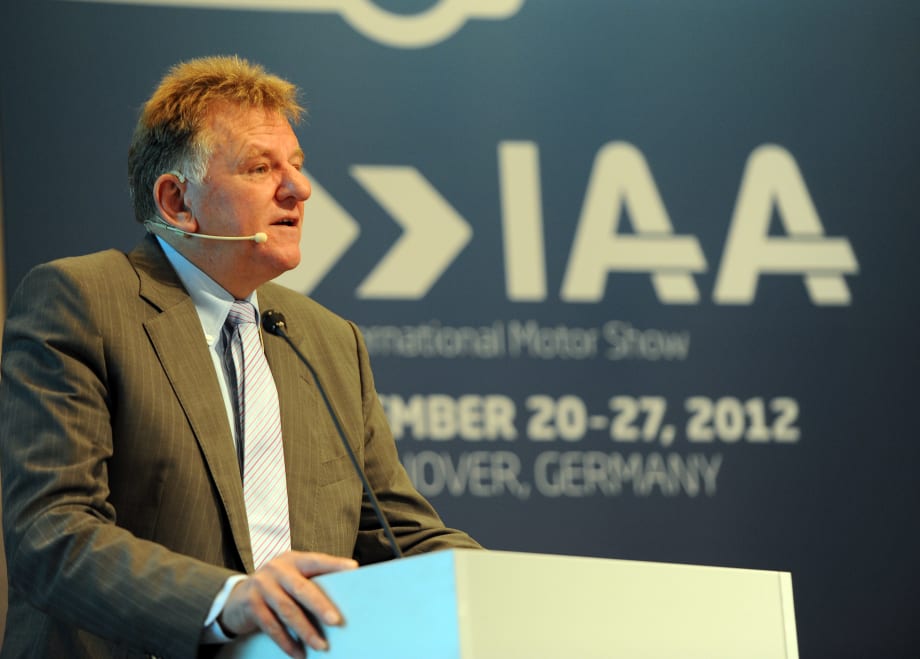
Andreas Renschler speaks at a 2012 event. Photo by Sven-Erik Lindstrand.
2 min to read
Andreas Renschler speaks at a 2012 event.Photo by Sven-Erik Lindstrand.
Former Daimler Trucks head Andreas Renschler started work this week as head of rival Volkswagen's trucks business, once again creating speculation that VW may look to North American shores as it works toward goals of expanding its global footprint.
Renschler will be working to integrate VW's different trucks businesses, according to published reports, which include Swedish truck maker Scania and German MAN as well as its own VW-branded light commercial vehicles.
Reuters reported recently that Volkswagen might spin off the trucks business and establish a separate headquarters for it in Frankfurt, Germany, citing a German management magazine.
Bernd Osterloh, head of VW's "works council," or labor council, told reporters in a briefing last week that Renschler will need to examine whether acquisitions are necessary, according to a report in the Detroit News.
“Focusing on Europe and Brazil won’t be enough if the goal is to be a global player,” Osterloh said, according to the paper. “We’ll have to talk about the U.S. market and about China as well.” However, speculation that Volkswagen may buy Paccar isn’t realistic at the moment, he said.
Renschler, the former head of Daimler Trucks, left the company a year ago, less than a year after he was promoted by parent Daimler AG to oversee production and purchasing of Mercedes Benz cars and vans.
Volkswagen announced soon afterward that Renschler wouldl be taking over responsibility for commercial vehicles at the company after his non-compete agreement was over, taking over for Leif Östling, who will continue to work with the commercial vehicles supervisory bodies in the Volkswagen Group.
Wolfgang Bernhard, who had been the head of operations with Mercedes-Benz Cars since 2010, replaced Renschler as the head of Daimler Trucks.
More Equipment

How Volvo Updated Its D13 for EPA 2027 [Watch]
Volvo’s updated D13 promises lower emissions without sacrificing performance or fuel economy. Take a closer look at what changed inside the engine in this HDT Spotlight video.
Read More →
Michelin Tire Improves Efficiency and Durability for Regional Fleets
The Michelin X Multi Energy D2 is a regional haul drive tire engineered to help fleets improve fuel efficiency, durability and traction in demanding stop-and-go operations.
Read More →
ZF Expands Commercial Vehicle Push in North America
ZF is expanding its North American commercial-vehicle presence with new transmission applications, electrification, trailer technology and autonomous-driving systems.
Read More →
Tesla Wants a Self-Driving Semi. Are Cameras Enough?
Could Tesla’s camera-only autonomous driving technology work on an 80,000-pound Semi? In this commentary, HDT's Deborah Lockridge takes a look at Tesla, Cybercab, and how autonomous trucks see the road.
Read More →
Kodiak: Driverless Long-Haul Truck Launch on Track for 2026
Kodiak AI says its driverless long-haul safety case is 93% complete and it remains on track to begin commercial operations by year-end 2026.
Read More →
What DOT’s Automated Vehicle Strategy Means for Trucking
The U.S. Department of Transportation issued a new automated-vehicle strategy that outlines plans for driverless-truck regulations, cross-state freight corridors, and federal safety standards.
Read More →
East Coast Port Launches $45M Electric Truck Push
The Port Authority of New York and New Jersey announced millions in incentives for zero-emission drayage trucks, yard tractors, and new charging hubs near the port.
Read More →
PlusAI Going Public to Fund Autonomous Truck Launch
A SPAC deal could provide PlusAI with up to $300 million as it works toward a 2027 commercial launch of factory-built autonomous trucks.
Read More →
NHTSA Moves to Rewrite Truck Fuel-Economy Rules
The National Highway Traffic Safety Administration says it lacks authority to regulate medium- and heavy-duty truck engines separately from complete vehicles, but the existing standards have not yet been eliminated.
Read More →
Detroit Opens Orders for EPA 2027 Engines
Detroit isn’t starting from scratch to meet EPA 2027 diesel emissions standards. Its Gen 6 DD13 and DD15 engines keep much of today’s platform while updating the fuel and aftertreatment systems.
Read More →