




Careful Trailer Spec'ing Yields Higher Payloads
Lighter-weight equipment is a quest for Jim Burg, president and CEO of James Burg Trucking Co. in Warren, Mich.

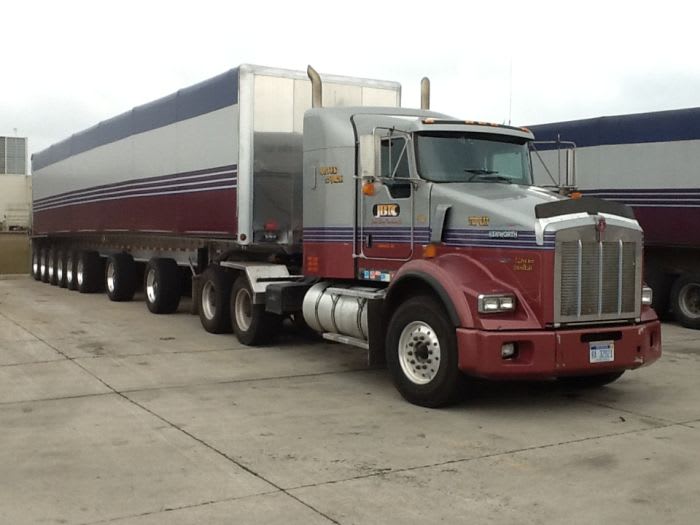
A 53-foot trailer allows use of two 9-foot spreads, between axles 1-2 and 2-3, adding another 5,000 pounds of legal gross weight.
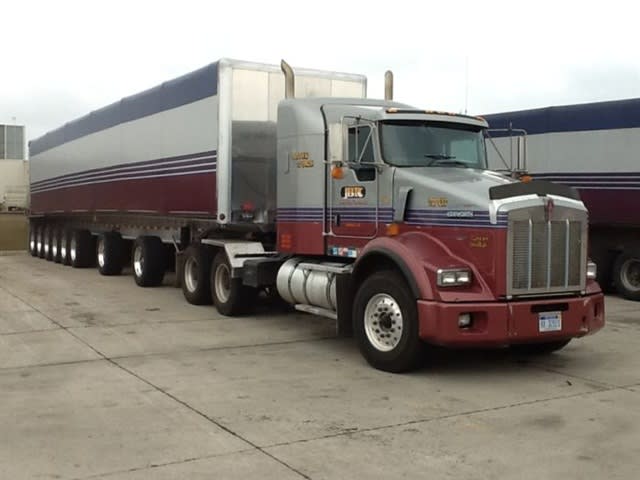
A 53-foot trailer allows use of two 9-foot spreads, between axles 1-2 and 2-3, adding another 5,000 pounds of legal gross weight.
Lighter-weight equipment is a quest for Jim Burg, president and CEO of James Burg Trucking Co. in Warren, Mich. He hauls steel and construction supplies on multi-axle flatbeds in 11-axle combinations that gross up to 164,000 pounds. Lower tare weight often yields more payload.
He started out working with East Manufacturing in 1990, saving 10,000 pounds by going to aluminum rather than steel B-trains.
But what he really wanted were single trailers. They’re a simpler piece of equipment, don’t require drivers to have a doubles endorsement on their licenses, are easier to navigate into shipping and receiving docks, and can be rear-loaded, while doubles are sometimes limited to side loading.
“By 2000, they could extrude [main] beams long enough for 50-foot trailers, and strong enough to handle side stress from the axles during turns,” Burg explains. “Even lane changes were a concern to the engineers. So we went to single 50-footers on 8 axles, or 11 axles with a tractor. It came in 5,000 pounds lighter than a set of doubles, and we could haul the same amount of product on a single 50 as a B-train.” The payload: 117,000 pounds.
Proper axle spacing is also important. Closely spaced trailer axles are limited to 13,000 pounds each in Michigan, but a distance of 9 feet between two axles allows each to gross 18,000 pounds. The 50-footer has one such spread, which gains 5,000 pounds of legal gross.
But if the trailer could be 53 feet long, two 9-foot spreads could be accommodated and another 5,000 pounds carried. So Burg worked with the state’s DOT and state police to get them on board. Police noted that with more cargo carried on each trip, fewer trips would be needed and fewer trucks would be on the road — a safer situation. Officials asked the legislature to legalize 53-foot multi-axle trailers, and it did, giving Burg a payload of up to 122,000 pounds.
“We try to match it to a customer who can gain advantage of that – two coils [of steel] instead of one, or three instead of two, or an extra skid of sheet or coiled steel, or any type of product.”
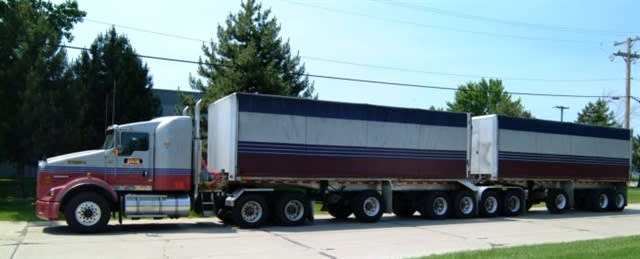
Going from steel B-train doubles to East aluminum doubles saved 10,000 pounds. Wide-base single tires and aluminum wheel help.
With opportunity, however, comes responsibility, Burg notes. “You have to be sure weight is distributed properly. We run Michelin X-One [wide-base] singles and Meritor disc brakes. And lift axles are steerable, so they can stay down in turns and there’s less fatigue on the trailer beams” and less scuffing of tire tread and pavement.
“Discs are safer and less troublesome — there are no freeze-ups in winter. And because of the rotor-caliper mechanism, there’s no way a wheel can depart the vehicle if a bearing burns and fails. The caliper holds the rotor and wheel in place. We learned that by experience, and that is worth the price of admission.”
More Equipment

How Volvo Updated Its D13 for EPA 2027 [Watch]
Volvo’s updated D13 promises lower emissions without sacrificing performance or fuel economy. Take a closer look at what changed inside the engine in this HDT Spotlight video.
Read More →
Michelin Tire Improves Efficiency and Durability for Regional Fleets
The Michelin X Multi Energy D2 is a regional haul drive tire engineered to help fleets improve fuel efficiency, durability and traction in demanding stop-and-go operations.
Read More →
ZF Expands Commercial Vehicle Push in North America
ZF is expanding its North American commercial-vehicle presence with new transmission applications, electrification, trailer technology and autonomous-driving systems.
Read More →
Tesla Wants a Self-Driving Semi. Are Cameras Enough?
Could Tesla’s camera-only autonomous driving technology work on an 80,000-pound Semi? In this commentary, HDT's Deborah Lockridge takes a look at Tesla, Cybercab, and how autonomous trucks see the road.
Read More →
Kodiak: Driverless Long-Haul Truck Launch on Track for 2026
Kodiak AI says its driverless long-haul safety case is 93% complete and it remains on track to begin commercial operations by year-end 2026.
Read More →
What DOT’s Automated Vehicle Strategy Means for Trucking
The U.S. Department of Transportation issued a new automated-vehicle strategy that outlines plans for driverless-truck regulations, cross-state freight corridors, and federal safety standards.
Read More →
East Coast Port Launches $45M Electric Truck Push
The Port Authority of New York and New Jersey announced millions in incentives for zero-emission drayage trucks, yard tractors, and new charging hubs near the port.
Read More →
PlusAI Going Public to Fund Autonomous Truck Launch
A SPAC deal could provide PlusAI with up to $300 million as it works toward a 2027 commercial launch of factory-built autonomous trucks.
Read More →
NHTSA Moves to Rewrite Truck Fuel-Economy Rules
The National Highway Traffic Safety Administration says it lacks authority to regulate medium- and heavy-duty truck engines separately from complete vehicles, but the existing standards have not yet been eliminated.
Read More →
Detroit Opens Orders for EPA 2027 Engines
Detroit isn’t starting from scratch to meet EPA 2027 diesel emissions standards. Its Gen 6 DD13 and DD15 engines keep much of today’s platform while updating the fuel and aftertreatment systems.
Read More →