




FTR: Tight Capacity, Rate Increases Projected to Continue
Truckload capacity will remain tight and rates high, but both may moderate somewhat as market forces come into play, according to FTR analysts. The ELD mandate is still a wild card, with the economy and tax reform playing a part as well.

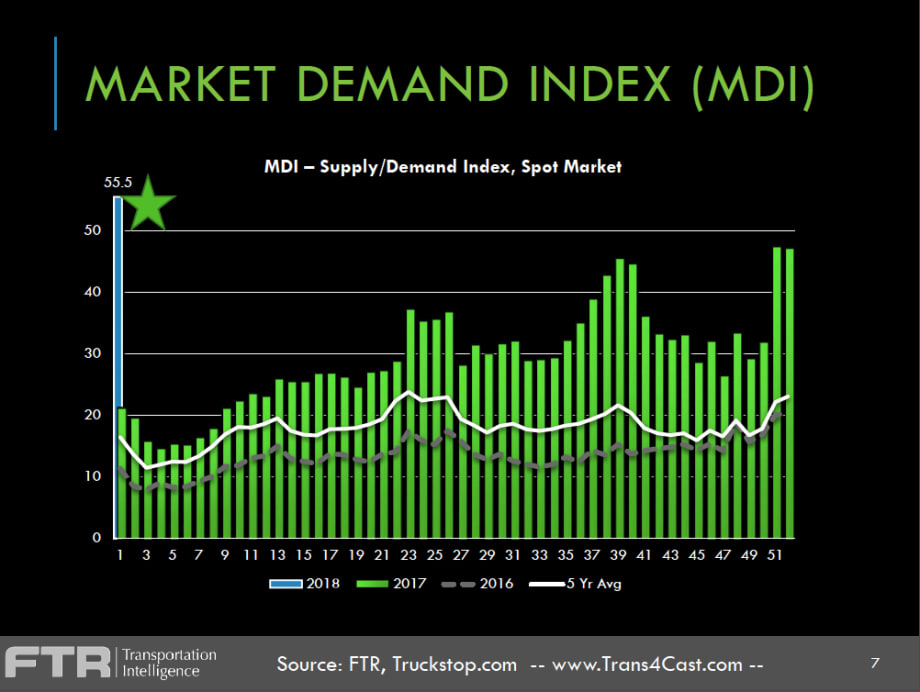
Truckstop.com's Market Demand Index hit a record high the first week of 2018.
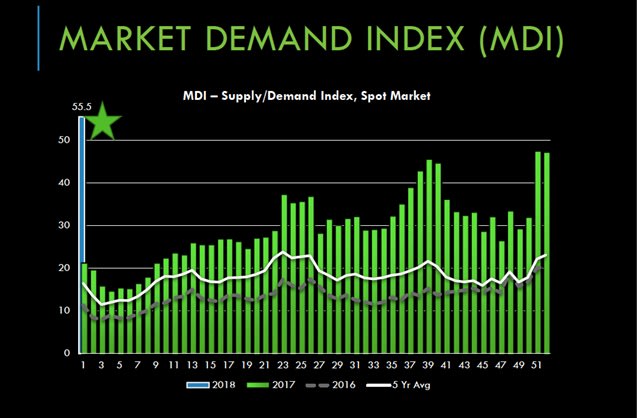
Truckstop.com's Market Demand Index hit a record high the first week of 2018.
Truckload capacity will remain tight and rates high, but both may moderate somewhat as market forces come into play, according to FTR analysts. The ELD mandate is still a wild card, with the economy and tax reform playing a part as well.
FTR cited Truckstop.com's Market Demand Index, which measures how many available trucks there are vs. how many loads on the spot market. That index "really accelerated" once we got past the first quarter of 2017 after a somewhat depressed 2016, explained FTR Chief Operating Officer Jonathan Starks in a recent webinar.
A spike occurred after Hurricanes Harvey and Irma, and again right at the end of the year. In the first week of 2018, it hit record levels. In fact, Starks said, “We hit record levels in four of the last 15 weeks of this index.”
Rates showed a similar pattern, coming down a bit in the first week of the year but still “very elevated,” Starks said. Although they are expected to come down some, FTR still sees a very strong spot freight market going forward.
“I think there’s perhaps no more striking indicator of what’s happening in trucking than what’s happening in rates," noted Avery Vise, FTR's new vice president of trucking research. "The spot market began to turn about a year ago and has soared since." As is typical, he added contract rates becan to move higher as well, albeit on a delayed basis.
"A robust spot market will continue to translate into higher contract rates as carriers and shippers adjust to a new normal," Vise said. FTR projects that through 2018, spot market rates will continue to grow, but not as fast as during 2017. Likewise, contract rates should accelerate through 2018 before tapering off.
Vise emphasized that while the graph depicted appeared to show rates dropping, the data shown is year over year comparisions, "Much of the deleration you see in this chart is just stronger prior year figures," he said. The remender is an expectation of "modest capacity gains and carrier hesitation to press too hard on rates for too long… markets typically cannot sustain pricing gains indefinitely."
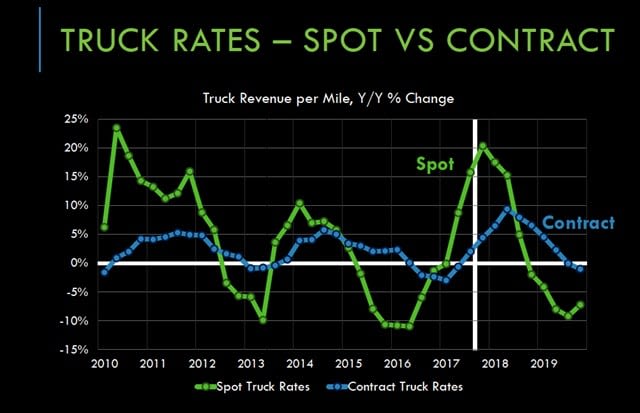
While rates are expected to remain robust, market forces will tend to bring them back down in comparison to 2017.
Vise also noted that when you look at loadings in the over-the-road market, “we think that will moderate somewhat going forward,” particularly when looking at the year-over-year comparisons.
“There will be some adjustments as shippers move to alternative shipping methods,” he said.
In-use Truck Capacity
Looking at market tightness, in the form of a graph on active truck capacity, Vise said that “we are almost at full active truck capacity. This is a calculated figure that very rarely hits this 100% level; it is almost by definition not sustainable, because market forces take over.”
For instance, he said, fleets have been ordering more trucks, and putting major bonuses and pay raises in place in order to draw more drivers.
“Right now it’s the driver, not necessarily the capital equipment, that is the biggest constraint in this active capacity. But both of those can be addressed with investments,” and that is already happening.
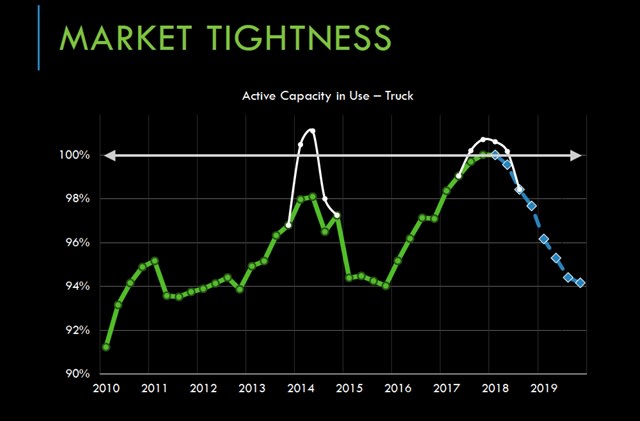
The market will only remain at such high capacity levels for a limited time. The white peaks represent estimated imacts from weather events -- polar vortices and hurricanes.
Starks said that the nation's economic growth is a factor here. "We're at a very high level throughout 2018," he said of the FTR projections. "Then when you add in the impact of a strong economy, it could remain at or above 100% utilization for the majority of 2018, and that would change operating conditions for a significant period of time. The question is, are we able to build in some excess capaity, or are we expected to stay extremely tight throughout the majority of the year?"
FTR’s Trucking Conditions Index projects overall trucking conditions improving through 2018. The strong market does bring with it cost pressures in the form of higher driver wages and equipment acquisitions, Vise noted, but diesel prices appear to be fairly stable, and the new federal tax law should more than offset the rising costs, at least in the near term. “We’re already in a pro-carrier environment, and we think this will continue for a while,” he said.
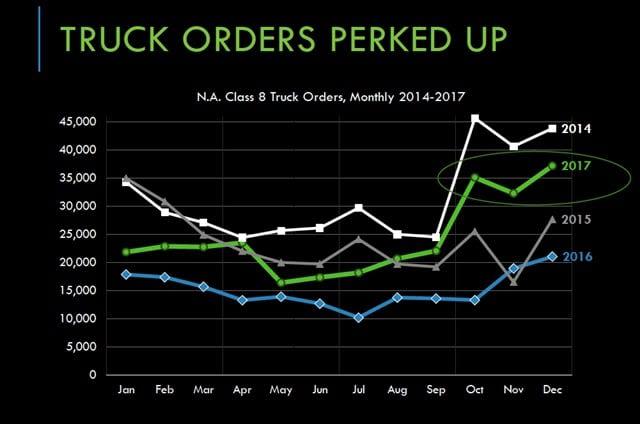
Fleets already are buying more trucks. Assuming they can get drivers, it should ease the capacity crunch.
Effects of the ELD mandate
It’s tough to tell what effect the electronic logging devide mandate will have on capacity at this point, Vise pointed out, because of the soft enforcement period until April 1 as well as a temporary waiver for agricultural haulers.
“The effects of ELDs on the market will show up in reduced miles for carriers that have not strictly complied with hours of service rules in the past, and to a degree will show up in drivers exiting the market,” Vise said.
While anecdotal evidences points to some owner-operators and small fleets saying they will get out of the business, “presumably most of those thinking about doing so would hold out until April, when enforcement begins for out of service violations and affects CSA scores.”
Corrected 1/18/2018 to reflect that Truckstop.com is the source for the Market Demand Index.
More Drivers

From One Generation to the Next: How Mentorship Builds Safer Truck Drivers
After three decades in trucking, Harold Perry shares what he's learned about driver safety, mentorship, and helping the next generation build confidence behind the wheel.
Read More →
Truck Drivers Need More Than Another Alert
Fleets have more visibility into truck health, safety events, and driver activity than ever. The next challenge is turning all that information into useful guidance for the person who has to decide what to do next.
Read More →
FMCSA Removes 110 Truck Driver Training Schools from Certified ELDT List
Federal regulators also are targeting more than 160 additional training providers and launching a nationwide audit of third-party CDL skills testers as part of a broader crackdown on trucking fraud.
Read More →
Hours of Service Pilot Programs: FMCSA Readies for 2027 Rollout
Two pilot programs could eventually reshape hours-of-service rules, giving truck drivers options to pause their 14-hour clock or use longer split sleeper rest periods.
Read More →
Medical Cards, English Proficiency Reshape Roadcheck Violations
Medical-card violations jumped to the top of the driver out-of-service list during CVSA’s 2026 International Roadcheck, while English-language proficiency violations appeared among the leading violations for the first time.
Read More →
Driver Trust Can Make or Break the Success of Fleet Safety Technology
New Teletrac Navman research suggests that onboarding, transparency about driver data, and positive feedback can play a significant role in how commercial drivers respond to safety and coaching technology.
Read More →
EEOC Sues KLLM Over Alleged Sex Discrimination in Driver Training
KLLM is facing a federal sex-discrimination lawsuit over policies the EEOC alleges put female truck driver trainees at a disadvantage.
Read More →
FMCSA Moves to Codify English Language Requirements for Commercial Drivers
By changing regulations on English-language proficiency requirements for commercial drivers, rather than relying on a guidance memo, the FMCSA said future administrations won't be able to walk back the Trump administration's stricter enforcement with just a memo.
Read More →
Drivers Put Western Star Trucks to the Test at Star Nation Experience
Watch to get an inside look at the Western Star trucks, technology, and community behind the Star Nation Experience 2026!
Read More →
Trump Administration Looks to Put More Veterans Behind the Wheel
The Freedom Haulers program pulls together existing and expanded programs at several federal agencies to recruit veterans to drive commercial heavy-duty trucks and cut the red tape for them to get a CDL, training, and employment.
Read More →