




FHWA Tests Three-Truck Platoon on Virginia Interstate
The latest series of platoon tests will evaluate Cooperative Adaptive Cruise Control technology, which adds vehicle-to-vehicle communications to the adaptive cruise control capability now available in new vehicles and allows trucks to operate more smoothly as a unit, reducing and controlling the gaps between trucks.

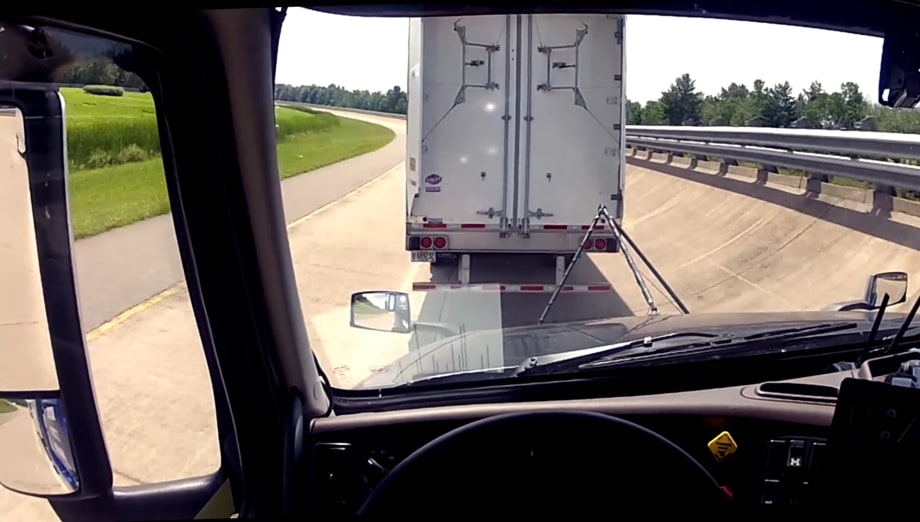
The Federal Highway Adminstration has begun testing three-truck platoons on Interstate 66 in Virginia, in addition to track testing like this. Photo: FHWA
The Federal Highway Administration is overseeing a series of runs testing three-truck platoons on a stretch of I-66 near Centreville, Virginia.
The agency oversaw a successful series of two-truck platoons in Texas last summer.
Both tests are part of a four-year research project to test the effectiveness of state-of-the-art driving and communications technologies.
Truck platooning uses vehicle-to-vehicle communications technology to allow trucks to follow each other more closely – at about one second apart – and travel in a more coordinated fashion. According to a report from the North American Council for Freight Efficiency last year, trucks traveling in a platoon convoy can take advantage of increased aerodynamic efficiencies and see fuel economy increases of from 4% to 7% depending on operational conditions.
FHWA said the Virginia tests taking place now are using partially automated trucks that handle acceleration, deceleration and braking, with professional drivers behind the wheel actively steering the trucks and able to step in if necessary. It emphasized that the advanced technology that makes platooning possible is meant to supplement, not replace, the nation’s commercial motor vehicle operators.
While various aspects of truck platooning have been studied for years, FHWA’s Exploratory Advance Research program has taken testing to new levels with the addition of Cooperative Adaptive Cruise Control technology. CACC adds vehicle-to-vehicle communications to the adaptive cruise control capability already available in new vehicles. This connectivity allows trucks to operate more smoothly as a unit, reducing and controlling the gaps between vehicles.
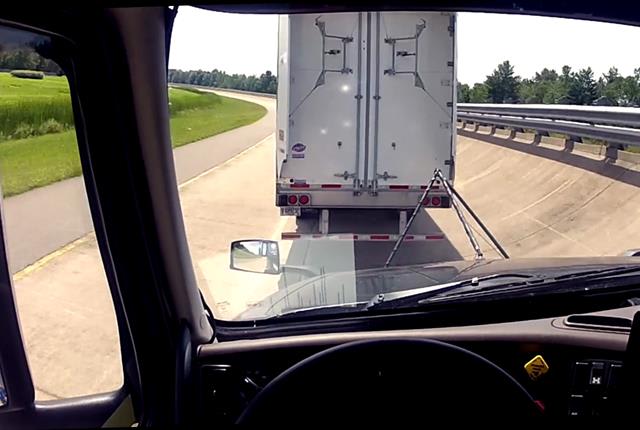
The Federal Highway Adminstration has begun testing three-truck platoons on Interstate 66 in Virginia, in addition to track testing like this. Photo: FHWA
“The future of innovative new technology to help our drivers navigate the road more safely is so full of promise; it’s a future where vehicles increasingly help drivers avoid crashes,” said U.S. Transportation Secretary Elaine L. Chao. “As technology advances, safety is a primary concern of the department, but the benefits of these driving technologies extend beyond safety, including productivity and efficiency on our roads.”
Stepping Stones to Automation
The demonstrations came just days after Secretary Chao and the National Highway Traffic Safety Administration announced new guidelines for Automated Driving Systems, called A Vision for Safety. This guidance is the newest version, replacing previous operating guidance, and offers a more flexible approach to advancing the innovation of automated vehicle safety technologies. The Department of Transportation is focused on collecting and sharing the best ideas and approaches to developing and testing automated vehicle technologies and to ensure that no requirements or regulatory hurdles exist or are introduced that could delay these vehicle safety advances.
“These new technologies have the ability to increase capacity on our highways and make freight transportation more efficient,” said Acting Federal Highway Administrator Brandye Hendrickson. “With innovations like these, we can get more out of the highway system we already have, relieve traffic congestion and reduce costs to the freight industry.”
More Drivers

From One Generation to the Next: How Mentorship Builds Safer Truck Drivers
After three decades in trucking, Harold Perry shares what he's learned about driver safety, mentorship, and helping the next generation build confidence behind the wheel.
Read More →
Truck Drivers Need More Than Another Alert
Fleets have more visibility into truck health, safety events, and driver activity than ever. The next challenge is turning all that information into useful guidance for the person who has to decide what to do next.
Read More →
FMCSA Removes 110 Truck Driver Training Schools from Certified ELDT List
Federal regulators also are targeting more than 160 additional training providers and launching a nationwide audit of third-party CDL skills testers as part of a broader crackdown on trucking fraud.
Read More →
Hours of Service Pilot Programs: FMCSA Readies for 2027 Rollout
Two pilot programs could eventually reshape hours-of-service rules, giving truck drivers options to pause their 14-hour clock or use longer split sleeper rest periods.
Read More →
Medical Cards, English Proficiency Reshape Roadcheck Violations
Medical-card violations jumped to the top of the driver out-of-service list during CVSA’s 2026 International Roadcheck, while English-language proficiency violations appeared among the leading violations for the first time.
Read More →
Driver Trust Can Make or Break the Success of Fleet Safety Technology
New Teletrac Navman research suggests that onboarding, transparency about driver data, and positive feedback can play a significant role in how commercial drivers respond to safety and coaching technology.
Read More →
EEOC Sues KLLM Over Alleged Sex Discrimination in Driver Training
KLLM is facing a federal sex-discrimination lawsuit over policies the EEOC alleges put female truck driver trainees at a disadvantage.
Read More →
FMCSA Moves to Codify English Language Requirements for Commercial Drivers
By changing regulations on English-language proficiency requirements for commercial drivers, rather than relying on a guidance memo, the FMCSA said future administrations won't be able to walk back the Trump administration's stricter enforcement with just a memo.
Read More →
Drivers Put Western Star Trucks to the Test at Star Nation Experience
Watch to get an inside look at the Western Star trucks, technology, and community behind the Star Nation Experience 2026!
Read More →
Trump Administration Looks to Put More Veterans Behind the Wheel
The Freedom Haulers program pulls together existing and expanded programs at several federal agencies to recruit veterans to drive commercial heavy-duty trucks and cut the red tape for them to get a CDL, training, and employment.
Read More →