




Related: Scania Tests Truck Platooning Technology in Singapore
UK Announces Series of Truck Platoon Tests
The British government has awarded funding that will enable a series of truck platoon tests on public roadways in the United Kingdom beginning next year.
by Staff
August 28, 2017
The British government has awarded a grant of €8.1 million to test truck platooning on public roadways. Photo: Scania
2 min to read
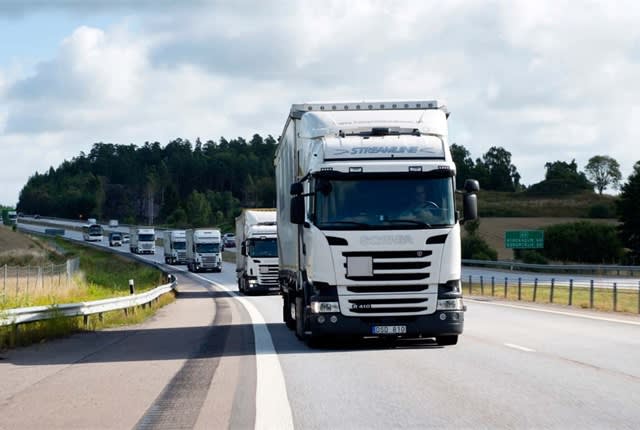
The British government has awarded a grant of €8.1 million to test truck platooning on public roadways. Photo: Scania
The government of the United Kingdom announced on August 25th that it will grant €8.1 million (approximately $9.7 million) in funding for a series of truck platooning trials on public roads next year.
The Transport Research Laboratory will carry out the trials, with funding provided by the Department for Transport and Highways England. The decision follows a government-funded feasibility study that recommended a trial to examine the benefits and viability of platooning.
According to Jim O’Sullivan, Highways England's chief executive, the platooning trials will focus on three-truck convoys with the goal of demonstrating how greater automation of vehicles – in this instance, heavy commercial vehicles – can deliver improvements in safety, better journeys for road users, and reductions in vehicle emissions.
The tests will be carried out in three phases, with the first focusing on the potential for platooning on Great Britain's major roads. Initial test track-based research will help decide details such as distance between vehicles and on which roads the tests could take place. Each phase of testing will only begin after there is “robust” evidence it can be carried out safety, O’Sullivan added.
The British government anticipates that the initial three test phases will be complete by the end of next year.
Rob Wallis, chief executive of The Transport Research Laboratory, said in a statement, “The UK has an unprecedented opportunity to lead the world in [testing] connected vehicle platoons in a real-world environment. TRL and its consortium of leading international partners, have the practical and technical knowledge gained from previous projects to understand what is required to put a connected vehicle platoon on to UK roads safely.”
More Drivers

From One Generation to the Next: How Mentorship Builds Safer Truck Drivers
After three decades in trucking, Harold Perry shares what he's learned about driver safety, mentorship, and helping the next generation build confidence behind the wheel.
Read More →
Truck Drivers Need More Than Another Alert
Fleets have more visibility into truck health, safety events, and driver activity than ever. The next challenge is turning all that information into useful guidance for the person who has to decide what to do next.
Read More →
FMCSA Removes 110 Truck Driver Training Schools from Certified ELDT List
Federal regulators also are targeting more than 160 additional training providers and launching a nationwide audit of third-party CDL skills testers as part of a broader crackdown on trucking fraud.
Read More →
Hours of Service Pilot Programs: FMCSA Readies for 2027 Rollout
Two pilot programs could eventually reshape hours-of-service rules, giving truck drivers options to pause their 14-hour clock or use longer split sleeper rest periods.
Read More →
Medical Cards, English Proficiency Reshape Roadcheck Violations
Medical-card violations jumped to the top of the driver out-of-service list during CVSA’s 2026 International Roadcheck, while English-language proficiency violations appeared among the leading violations for the first time.
Read More →
Driver Trust Can Make or Break the Success of Fleet Safety Technology
New Teletrac Navman research suggests that onboarding, transparency about driver data, and positive feedback can play a significant role in how commercial drivers respond to safety and coaching technology.
Read More →
EEOC Sues KLLM Over Alleged Sex Discrimination in Driver Training
KLLM is facing a federal sex-discrimination lawsuit over policies the EEOC alleges put female truck driver trainees at a disadvantage.
Read More →
FMCSA Moves to Codify English Language Requirements for Commercial Drivers
By changing regulations on English-language proficiency requirements for commercial drivers, rather than relying on a guidance memo, the FMCSA said future administrations won't be able to walk back the Trump administration's stricter enforcement with just a memo.
Read More →
Drivers Put Western Star Trucks to the Test at Star Nation Experience
Watch to get an inside look at the Western Star trucks, technology, and community behind the Star Nation Experience 2026!
Read More →
Trump Administration Looks to Put More Veterans Behind the Wheel
The Freedom Haulers program pulls together existing and expanded programs at several federal agencies to recruit veterans to drive commercial heavy-duty trucks and cut the red tape for them to get a CDL, training, and employment.
Read More →