




Getting Smart in the Warehouse
The surge in e-commerce orders is recasting the role warehousing plays in the supply chain. Part six of our Trucking in the 21st Century series.

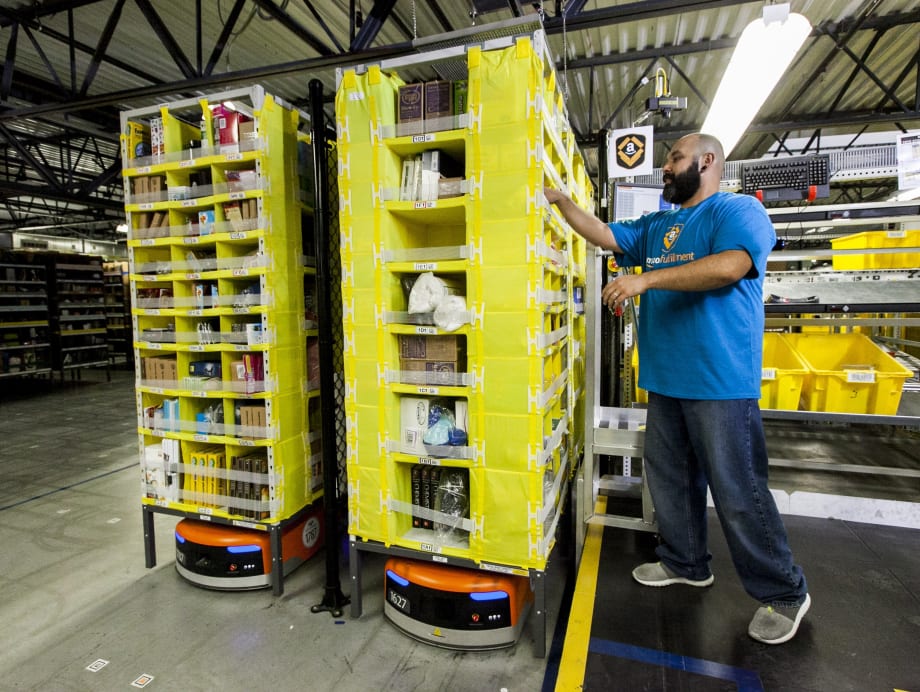
Amazon has been using these small orange warehouse robots for several years to make picking much faster, increasing their number every year. Photo: Amazon
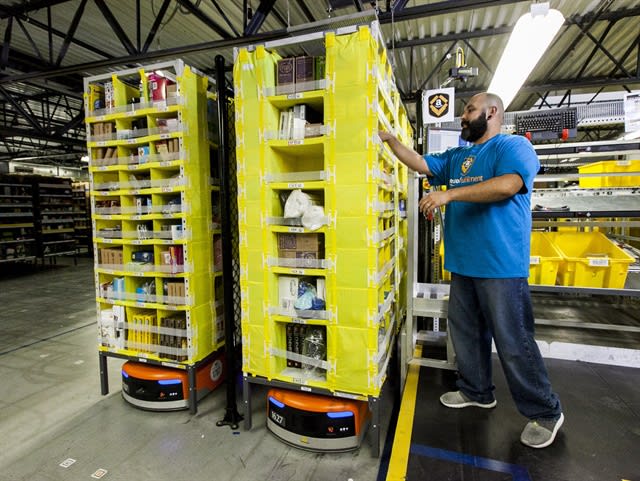
Amazon has been using these small orange warehouse robots for several years to make picking much faster, increasing their number every year.Photo: Amazon
Peek inside the nearest warehouse and you may witness its metamorphosis from a largely static way station along the traditional supply chain into a “smart” staging area that is just one part of a digitally connected supply chain. It’s part of a chain that fulfills shipments from all sorts of places holding goods, including regional warehouses, urban distribution centers, brick-and-mortar stores, and even right off assembly lines.
That’s the vision of 21st century warehousing that's starting to emerge. Today to some degree, such as at Amazon, and increasingly tomorrow for all goods providers, a smart warehouse can be defined as one that deploys automation (and even robotics) alongside advanced warehousing management systems driven by big data to speed the movement and ultimate delivery of goods.
The latest State of Logistics Report, issued last month by the Council of Supply Chain Management Professionals and Penske Logistics, predicts that we’re “moving toward a fully digital, connected, and flexible supply chain optimized for e-commerce and last-mile, last-minute delivery. The next-generation supply chain will enhance fulfillment capabilities and drive efficiencies through technologies ranging from big data and predictive analytics to artificial intelligence and robotics.”
The report, authored by consultancy A.T. Kearney, also holds that steadily rising package volumes are driving the trend toward more regional distribution centers, which will serve as “linchpins of advanced networks as retailers offering same-day delivery move goods closer to densely populated areas. Parcel carriers will follow suit with their own region-focused delivery networks.” Of course, those new distribution patterns will spawn – and already are spawning – new trucking routes, with volumes rebalanced between local and regional DCs. What’s more, carriers will strive and in some cases struggle to build the local route densities necessary to provide last-mile services profitably.
As for companies offering warehousing, they are “under pressure to move goods faster as consumers demand same-day delivery and omnichannel ordering explodes.” To stay on top of their link in the chain, warehouse operators are boosting productivity with such technologies as pick-to-light (light-directed), voice-directed, and automated picking systems. Also expect to see self-guided robots come into play. In addition, advances in warehouse management systems are increasing productivity. “New mobile apps allow managers to monitor distribution center floor activity, benchmark performance with analytics, and optimize labor costs in real time,” notes the report.
But what the CSCMP report makes abundantly clear is none of this is happening — or should be happening — in a vacuum. “Warehouse operators maximize the benefits of technology when they use it end to end,” the authors stress. “Sophisticated warehousing software and cloud-based services reach beyond the warehouse, gathering upstream order information and downstream transportation data. Players throughout the supply chain benefit as seamless connectivity creates a fully integrated system capable of responding quickly to constantly changing customer needs.”
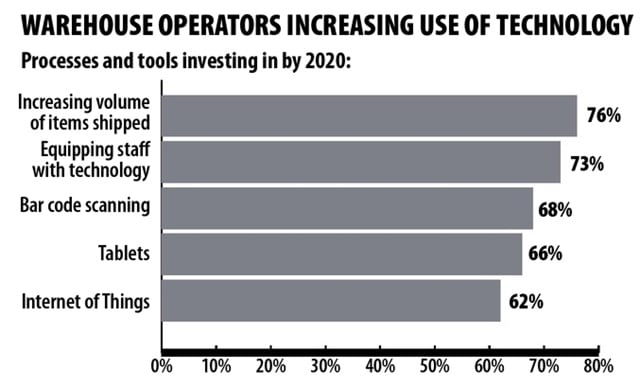
Source: Zebra Technologies’ Warehouse Vision Study of 1,378 respondents from 12 countries
From robots to wearables
Need more convincing that warehouses will get smarter and the overall supply chain more connected in the years just ahead? A recent Warehouse Vision Study conducted by Zebra Technologies, a provider of real-time visibility services, finds that seven in 10 warehousing decision-makers plan to increase their use of technology to put in place smart warehouse systems by 2020.
Zebra says its research shows that consumer expectations will drive increased investment in IT and operational functions in warehouses over the next few years as companies continue to adjust to delivering directly to consumers.
More than 40% of the 1,378 respondents from 12 countries cited shorter delivery times as a key driver for warehouse investments. Also reflecting increased consumer demand, 76% of the respondents expect both the number of warehouse locations and the volume of items shipped out of warehouses to rise.
The respondents also indicated that by 2020 they plan to invest in processes and tools such as increasing the volume of items shipped, equipping staff with technology, bar code scanning, tablets, and Internet of Things (see graph on next page).
There are already over 40 tech startup companies that will help drive smart warehousing operations, according to research firm CB Insights. Their solutions fall into several categories, including these, which pretty much cover all aspects of warehousing:
Warehouse and inventory management software. Provided as software-as-a-service (SaaS) platforms, generally cloud-based, for warehouse management and inventory tracking functions.
Indoor asset tracking. Solutions involving software, bar code readers, and RFID tags that focus on improving the tracking of goods and equipment in warehouses.
Worker wearables. These include augmented-reality “smart” glasses to aid warehouse workers and devices that attach to workers’ belts to analyze movements and help prevent injuries.
Robots. Automated and remotely controlled robots, including vision-guided vehicles for companies such as Walgreens and USPS.
Indoor asset tracking. Solutions involving software, bar code readers, and RFID tags that focus on improving the tracking of goods and equipment in warehouses.
Outsourced warehousing & fulfillment. Handle fulfillment processes for e-commerce companies that may not have their own warehouse space, managing both the warehousing of goods and order shipments.
On-demand warehouse space. Online marketplaces connect retailers that need warehouse space with warehouses that have extra capacity.
That’s a lot of technology to absorb. And on top of that, it’s all meant to be connected within the warehouse as well as to the overall supply chain. Nonetheless, Royce Digital Systems, an IT solutions provider, envisions the smart warehouse as an orderly and speedy place where orders are received automatically and pickup lists are sent to “robot carts” that pick the correct products and deliver them to workers for packing. Meanwhile, wireless solutions and sensors across the warehouse track the robot carts and verify that product is headed to the shipping dock and onto a truck.
Opportunities for logistics providers
The demand for a smarter, connected supply chain is providing growth for logistics providers. Harvey Rickles, UPS marketing director, Global Logistics & Distribution, says the rise in shipping driven by e-commerce and omnichannel marketing is “creating opportunities in the warehousing business, because people have realized it’s not easy to do this type of fulfillment. As they come to understand these challenges, they start thinking, ‘Maybe this is something we should leave to the guys who do this every day.’”
He points to the impact that recent changes in cycle time from order receipt to delivery have had. “Five years ago, it was fairly standard for people to get an e-commerce order delivered in five days. Now, they’re looking at two-day, three-day, next-day or even same-day [delivery]. That forces our customers to look at solutions requiring more locations. Instead of one warehouse, if I want to reach 80 or 90% of customers in two days, what kind of solution do I need? I don’t want to pay expedited transportation charges. So, that leads them to think about putting inventory in three or more locations so they can hit those targets within a normal ground shipment. But that’s impacted their inventory; they have to carry more inventory to hit the same service levels in terms of not being out of stock.”
Solving the problem of there being more inventory in more locations requires “doing smarter things with inventory,” he says, “figuring out where inventory is within a network of facilities and then deciding the best place to draw the product from for shipping.” Thanks to omnichannel distribution, the needed goods might be in a retail store instead of a warehouse. “We’re even seeing retail stores using the same smart-fulfillment systems so they can serve as another warehouse.”
Shippers also are looking for later cutoffs for shipping each day, which is especially important given that half of their orders may be via mobile devices. “That means orders are coming in all the time, around the clock and throughout the day; the demand part is becoming really unpredictable. Add that to faster cycle times and late cutoffs, and it’s quite a challenge for fulfillment operations.”
Rickles says having to get the most out of warehousing operations is why automation is “not just conveyors and sorters anymore.” He says the technology mix will run the gamut from voice-activated picking and wearing Google Glasses to leveraging robotics. “We’ve got teams looking at all of this to determine what makes economic sense to improve speed and efficiency for specific customers.
“When you think of e-commerce, they are little orders so it’s much more picking and packing.” And now there are “relatively low-cost robots that help assist workers doing picking and packing by moving goods to where they can assemble them [for shipping]. That eliminates a lot of walking. These robots can sense people as they move about; they are very much like the autonomous vehicles being developed for trucking.”
Rickles says all the effort being poured into making warehouses smarter requires a more collaborative planning process with customers. It’s more complex to move goods this way, so that requires better decision-making technology, too. He notes that by leveraging big data to discern trends faster, shippers are “getting smarter about inventory — for example, they may put slow-moving items in fewer warehouses.”
Ashfaque Chowdhury, president, supply chain - Americas and Asia Pacific for XPO Logistics, says changes in warehousing are being driven by e-commerce continuing to grow faster than general retail. “More and more consumers are buying through e-commerce. Fulfilling those orders is becoming more scientific because there is so much more of it.”
Chowdhury regards big data as a key driver of smart warehousing. “Mining big data for predictive analysis helps streamline the supply chain. And there’s also a lot of new automation making warehouses more sophisticated and productive for e-commerce.”
He points out that many retailers “build [inventory] infrastructure around their stores and may receive containers of goods from abroad and simply cross-deck that freight out to their stores. But with e-commerce, they also have to ship to individual customers.
“The order of magnitude for handling e-commerce orders is significantly higher than fulfilling retail. We’ll look at customers’ demand patterns, even to the point of relocating distribution centers. And we’re looking at the size of each product to determine how best to ship it.”
Chowdhury says all this impacts the technology and the people inside the distribution centers, but it also affects the trucking operations that provide the shipping. In this new world of smart fulfillment, he says, “truckers may have to be more flexible and prepared to handle more varied freight flows. Handling e-commerce means dealing with more peaks and valleys” than when hauling strictly retail or manufacturing freight.
The whole kit and caboodle of what smart warehousing promises to deliver extends well beyond the walls of any one facility or any fleet of trucks. That is to say, even the smartest warehouse is but one component of the emerging “fluid, connected digital supply chain,” as the authors of the CSCMP report put it.
More Fleet Management

Nominations Open for HDT Emerging Leaders
Heavy Duty Trucking is looking for accomplished trucking fleet professionals under 40 who are making an impact and helping lead the industry forward.
Read More →
Why Private Fleets Are Taking More Freight
Private fleets are putting their own trucks on demanding customers and high-cost lanes as companies seek greater control over service, costs, and capacity.
Read More →
Color Match Smarter: Tools That Restore & Perform
For fleet managers and collision repair professionals keeping heavy-duty trucks on the road, getting the color right the first time isn't just about appearance — it's about efficiency, turnaround time, and bottom-line results. Discover how today's digital color tools are transforming the repair process from guesswork to precision.
Read More →


FMCSA Pauses Biennial-Update Enforcement Amid Motus Transition
Carriers whose updates were due on or after June 1 have more time, while FMCSA works to stabilize its new registration system and warns of phishing sites impersonating its new carrier registration system, Motus.
Read More →
2026 Blueprint for Countering Smarter Supply Chain Theft
Cargo theft is no longer just the cost of doing business. It's a multi-billion-dollar criminal enterprise exploiting vulnerabilities across your fleet, drivers, and supply chain.
Read More →
How Telematics Improves Visibility, Control, and Performance in Refrigerated Fleets
Explore how telematics help refrigerated fleets improve visibility, uptime, efficiency, compliance, and cargo protection across connected cold chain operations.
Read More →
What the U.S.-Canada Trade War Means for Trucking
Escalating U.S.-Canada tariffs could disrupt cross-border freight, reduce truck volumes, raise costs, and create new uncertainty for carriers on both sides of the border.
Read More →
What Are Trucking’s Top Concerns for 2026?
The American Transportation Research Institute wants to know what's worrying trucking fleet managers, drivers, and other stakeholders in its annual Industry Issues survey.
Read More →
American Trucking Associations Looks for a New Leader
ATA President and CEO Chris Spear abruptly left his job at the association on August 21, at a pivotal time for the trucking industry.
Read More →
Public Wi-Fi Cybersecurity Risks: How Truck Drivers and Fleets Can Protect Their Data
Public Wi-Fi can expose truck drivers and fleets to credential theft, malware, and other cyber threats. Here’s how to reduce the risk on the road.
Read More →