




HDT Truck Fleet Innovator Joe Cowan Building a Dream at Cowan Systems
Early on, Joe Cowan had his sights set on football. He had a chance to play for the Baltimore Colts, but could not forget another dream he'd had since he was a boy.

Joe Cowan, President - Cowan Systems LLC, Baltimore, Maryland

Joe Cowan, President - Cowan Systems LLC, Baltimore, Maryland
Early on, Joe Cowan had his sights set on football. He had a chance to play for the Baltimore Colts, but could not forget another dream he'd had since he was a boy.
“When you're a kid, you're so proud of what your father created,” he says. His father, W.T. Cowan, had founded and built a less-than-truckload business that served the Mid-Atlantic out of Baltimore.
“I always dreamed of running the business, making it much better, leaving it to my children and their children.”
Cowan went to work for the company and began the decades-long process of building a successful business in an intensely competitive industry.
It was a tumultuous time. Not long after he started, the industry was deregulated. He was running the company's public warehouse operation, and within that entity started a small irregular route truckload business — the kernel from which his current company, Cowan Systems, was grown.
Over the next decade or so, Cowan says he “learned every way how not to do it.”
He was competing against carriers that would become the giants of the truckload business, companies like J.B. Hunt that ran with lower costs and charged lower rates.
“We basically just survived all those years, until we formulated a strategy to be more of a dedicated fleet carrier with an irregular route fleet that supports the dedicated fleet.”
In the business model that emerged, starting with the launching of Cowan Systems in 1994, two-thirds of the business is asset-based with company-owned tractors and trailers. The rest is divided between two non-asset operations, one offering brokerage and logistics services, and the other an owner-operator business moving marine containers in and out of some 20 ports around the country.
Cowan Systems is now running about 1,700 Navistar or Peterbilt tractors and 4,000 Wabash trailers. The intermodal operation has about 600 owner-operators. All together, with revenues of about $280 billion in 2011, Cowan Systems is one of the 100 largest for-hire carriers in the country.
Advantages of Running Dedicated and Irregular-Route Trucking
Having an irregular-route operation that uses the same type of company-owned equipment as the dedicated operation gives Cowan the capacity to handle surges in the dedicated business.
That's one advantage. Another is the company's weight-loss program. By cutting weight from the tractor and trailer and increasing payload, Cowan saw an opportunity to provide his dedicated customers added value.
Of course, cutting weight was not a new idea. But Cowan was able to do it in a way that meant something special to his customers in the beverage business, where he is heavily concentrated.
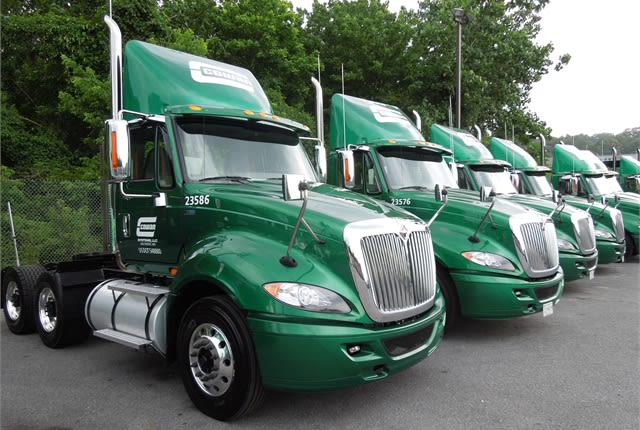
By a variety of changes such as wide-base singles, lighter engines, smaller fuel tanks and lightweight flooring, he has been able to shed 5,000 pounds per combination, which means he can haul 50,000 pounds while competitors are in the 44,000-pound range.
Lightweighting the Cowan Fleet
The true value, though, came from converting the entire fleet, including the irregular-route operation, to this equipment. Cowan could do that in fairly short order because he turns over his tractors every three years, his trailers every six.
It means that the surge capacity in his irregular-route operating has the same configuration, so it can blend right in to his dedicated operations.
At first it was not an easy sell. Customers had to get used to the idea of changing their loading practices, and his equipment suppliers had to look for better ways to take off the weight and spare the extra cost.
Lighter flooring in trailers is a good example. Aluminum works, but the commodity price fluctuates from year to year, an uncertainty that was hard to manage. So Cowan worked with Wabash to develop a composite floor that is as light as aluminum.
Advantages to Drivers
Another advantage is based on an observation Cowan made early on when he saw truckload carriers putting drivers on the road for a month at a time.
“I think it's extremely difficult for a guy to have a balanced life, raise a family and be responsive when he's out on the road,” he says.
The company's average length of haul is around 200 miles. Drivers in the dedicated fleet are home at night, and over-the-road drivers are home every weekend.
Cowan says the weekend turnaround is an expensive proposition but allows for a reasonable life. It's one factor in a driver turnover rate around 30% in an industry where more than 100% is not uncommon.
That 30% includes the drivers the company has to let go because they don't meet performance requirements. “Our drivers have to deliver 98% to 99% on time. If that doesn't happen we have to make changes.”
Another element in the equation is asset management, where Cowan Systems excels, says John Arscott, president of The Pete Store.
“In my 20 years as a truck dealer, I have never seen a truck fleet manage their equipment so efficiently,” Arscott says. “Very few trucks are ever sitting idle, waiting to be repaired or waiting for drivers.”
Being Selective About Freight
The company also is picky about the freight it will take on. “We probably turn down as much freight as we haul,” Cowan says.
A big reason for that is making the freight driver-friendly. Cowan wants to be sensitive to where the driver has to go and the treatment he'll get on the receiving end of the trip.
There's also a geographical component. “Predictability is big,” Cowan says. “If drivers get to go to the same place every time, it makes the job easier.”
Looking ahead, he's convinced his biggest challenge will be to find drivers who are safe and qualified. The average age of the company's drivers is 54.
“These guys are going to retire in the next seven to 10 years. Who is going to replace them? That's what worries me. Our whole industry desperately needs drivers.”
But there's one personnel issue he's not worried about. It has to do with that dream of building a company that will last for his children and grandchildren.
“I have two daughters,” he says. “I am really one of the luckiest guys you'll ever talk to because I have two sons-in-law who are executives in our firm. Plus, I've got one of the best management teams in the country. We're a financial success and not by accident, I can tell you that.”
More Fleet Management

Geotab Links Fleet Card to Vehicle Data
The new card combines fuel discounts with telematics-based purchase controls. Geotab’s analysis also points to potential savings from choosing lower-priced fuel stops.
Read More →
How MFA Helps Protect Trucking Fleets
Multi-factor authentication adds protection when passwords are stolen. Here’s how it works and where fleets should start.
Read More →
How Better Freight Data Helps Trucking Teams Get Ahead of Disruption
Trucking and logistics teams have plenty of data. The problem is getting the right information in front of the right people soon enough to act. Better-connected data can help teams spot trouble earlier and make smarter decisions before small problems become big ones.
Read More →

Trimble: Taking Artificial Intelligence in Trucking Beyond Faster Tasks
At Insight 2026, Trimble executives argued that fleets may need to redesign workflows to get more from AI as it introduced new products and enhancements. AI’s value will depend on how fleets combine automation with their people's knowledge.
Read More →
Build a bulletproof fleet: Uniting ELDs and dash cams for total compliance
An ELD can prove compliance, but it cannot always prove what happened on the road. Discover how uniting accurate ELD data with AI-powered dash cam video can help your fleet strengthen compliance, defend against liability, protect drivers and reduce operational costs.
Read More →
Nominations Open for HDT Emerging Leaders
Heavy Duty Trucking is looking for accomplished trucking fleet professionals under 40 who are making an impact and helping lead the industry forward.
Read More →
Why Private Fleets Are Taking More Freight
Private fleets are putting their own trucks on demanding customers and high-cost lanes as companies seek greater control over service, costs, and capacity.
Read More →
Color Match Smarter: Tools That Restore & Perform
For fleet managers and collision repair professionals keeping heavy-duty trucks on the road, getting the color right the first time isn't just about appearance — it's about efficiency, turnaround time, and bottom-line results. Discover how today's digital color tools are transforming the repair process from guesswork to precision.
Read More →
FMCSA Pauses Biennial-Update Enforcement Amid Motus Transition
Carriers whose updates were due on or after June 1 have more time, while FMCSA works to stabilize its new registration system and warns of phishing sites impersonating its new carrier registration system, Motus.
Read More →
2026 Blueprint for Countering Smarter Supply Chain Theft
Cargo theft is no longer just the cost of doing business. It's a multi-billion-dollar criminal enterprise exploiting vulnerabilities across your fleet, drivers, and supply chain.
Read More →