A gauge of the level of freight moved by the nation’s for-hire transportation industry capped off 2017 by posting another new all-time monthly high, according to the Transportation Department.
Evan Lockridge・Former Business Contributing Editor
February 14, 2018
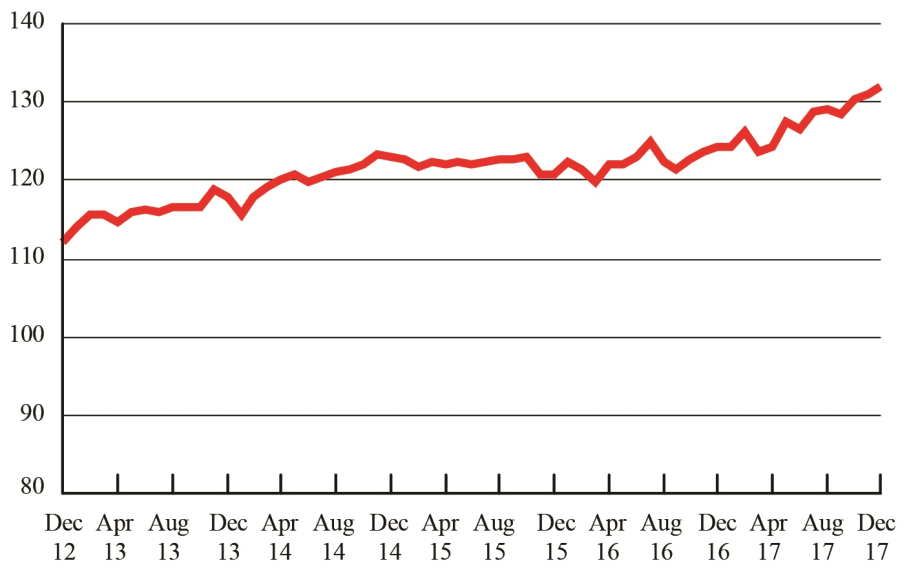
Freight Transportation Services Index, December 2012 - December 2017.Credit: U.S. DOT
2 min to read
Freight Transportation Services Index, December 2012 - December 2017. Credit: U.S. DOT
A gauge of the level of freight moved by the nation’s for-hire transportation industry capped off 2017 by posting another new all-time monthly high, according to the Transportation Department.
Its Freight Transportation Services Index (TSI), increased 0.7% than the previous highest level reached in November, with a reading of 132. This marked reaching an all-time high for the third consecutive month.
Ad Loading...
For the year, the index was 6.1% higher in December 2017 than a year earlier, the largest annual gain since 2010.
The November index was revised to 131.1 from 130.8 in last month’s release. Monthly numbers for January through October were revised down slightly.
The Freight TSI measures the month-to-month changes in for-hire freight shipments by mode of transportation in tons and ton-miles, which are combined into one index. The index measures the output of the for-hire freight from trucking, rail, inland waterways, pipelines and air freight.
Ad Loading...
The December increase in the Freight TSI was broad-based, according to the department, with increases in rail carloads, rail intermodal, trucking, and water, while pipeline and air freight declined.
The overall gain took place against a background of mostly positive results for other economic indicators. The Federal Reserve Board’s Industrial Production index rose by 0.9% in December, with significant increases in mining and utilities and a small increase in all manufacturing. Employment rose, personal incomes grew, and the Institute for Supply Management’s manufacturing index rose to a level 59.7, indicating accelerating growth. In contrast, housing starts fell by 8.2%.
The 2.8% increase in the Freight TSI in the fourth quarter was consistent with the 2.6% growth in gross domestic product (GDP) during the same months. GDP growth had been 3.2% in the third quarter and 3.1% in the second quarter, when the Freight TSI also grew. GDP growth was slower in the first quarter of 2017, when the Freight TSI declined.
The Freight TSI’s new all-time high, was the seventh record-high level in 2017. The December 2017 index was 5.7% higher than the pre-2017 high of 124.9 in July 2016 and 6.1% higher than the December 2016 level of 124.4.
In nine out of 12 months in 2017, the Freight TSI exceeded the record high for all months prior to 2017.
Ad Loading...
Over the last nine months of 2017, the index rose 6.8% with three quarterly increases. The increase of 2.8% in the fourth quarter was the largest quarterly increase since 2.9% in the first quarter of 2013.
The three consecutive quarters of growth were the longest sequence of quarterly increases since the string of nine quarterly increases from the fourth quarter of 2012 through the fourth quarter of 2014.
When the unexpected happens, how you react to, and deal with operational blind spots is critical. Here’s how to keep you recovery on track, when nothing is normal.
As fleets adopt artificial intelligence for routing, maintenance, and load matching, new security risks are emerging. Learn where the vulnerabilities are and how to put the right controls in place.
CargoNet reports fewer supply chain crime events to start 2026. But losses hold steady as organized crime shifts tactics toward impersonation schemes and high-value goods.
Heavy Duty Trucking is searching for forward-looking leaders at trucking fleets as nominations for HDT’s Truck Fleet Innovators 2026. Deadline is May 15.
Cargo theft rings plant operatives as drivers inside legitimate, fully vetted carriers, then execute coordinated thefts that look like a traditional straight theft from the outside.
The American Transportation Research Institute will examine driver coaching, regulatory impacts — including the "Beyond Compliance" concept —and weather disruptions that shape trucking operations.
Fleet Advantage's Brian Antonellis says it's time for fleets to get back to the fundamentals of good maintenance practices. And that includes replacing older, inefficient equipment.