




Trump on Infrastructure Draws More Trucking Questions than Applause
Reaction by highway stakeholder groups to President Trump’s State of the Union remarks on investing in infrastructure seem to be informed as much by earlier information on his spending proposal as by anything he said in his Jan. 30 address to Congress.

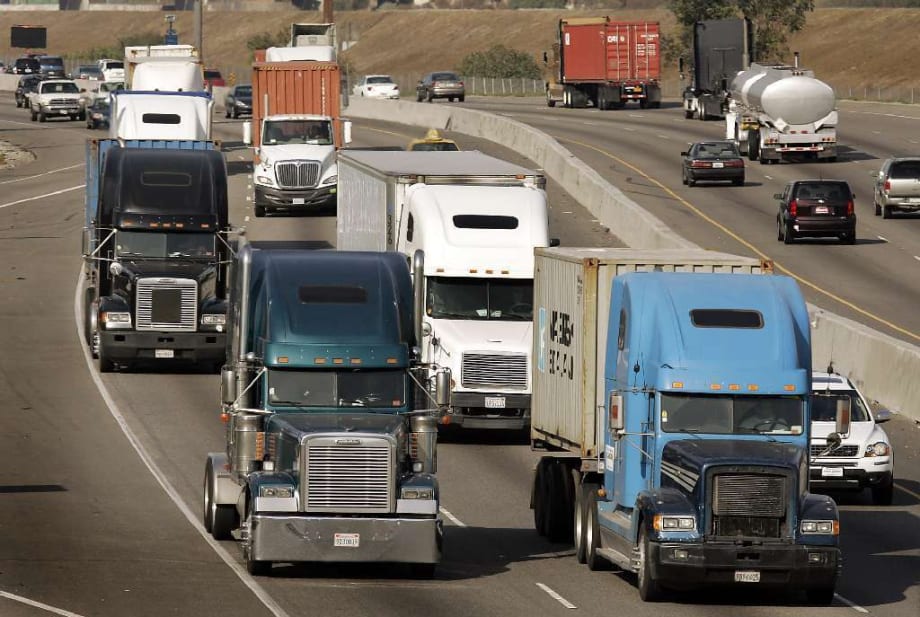
Heavy truck traffic on a California highway. Photo: U.S. Department of Transportation
Heavy truck traffic on a California highway. Photo: U.S. Department of Transportation
Reaction by highway stakeholder groups to President Trump’s State of the Union remarks on investing in infrastructure seem to be informed as much by earlier information on his spending proposal as by anything he said in his Jan. 30 address to Congress.
In his SOTU speech, the president called for Congress to pass a bipartisan bill that “generates" at least $1.5 trillion to invest in infrastructure improvements — but he made no mention of how to pay for that princely sum.
But based on what the Trump Administration has previously stated, as well as a recently leaked draft document, the president’s approach to financing infrastructure improvements remains fixed on priming the pump with $200 billion in cash and tax credits to stoke spending on infrastructure projects by state and local governments as well as by private investors.
It should be noted that the leaked draft document contained one specific point that did not go over at all with several stakeholder groups: that states be allowed “flexibility to toll on interstates and reinvest toll revenues in infrastructure” and to “reconcile the grandfathered restrictions on use of highway toll revenues with current law.”
Tolls a No-go for Many
Albeit to different degrees, the American Trucking Associations, the Alliance for Toll-Free Interstates and NATSO, which represents truck-stop operators, all declared their opposition to reversing the current federal ban on tolling existing interstates and to expanding tolling in general.
At least one lobbying group, though, said it is “encouraged by the president’s call to cut burdensome regulations and laws that prevent states from accessing all available funding options to meet their local needs.” Patrick Jones, executive director and CEO of the International Bridge, Tunnel and Turnpike Association, said in a statement on the SOTU address that the current federal restriction on tolling interstates is "one such barrier to increased higwhay investment. Some of the highest-capacity, Interstate-quality highways in America would never have been built without tolling."
By contrast, both ATA and the powerhouse U.S. Chamber of Commerce have lobbied not only against expanding toiling, but also strongly in favor of raising the federal fuel tax – and indexing it for inflation going forward — to pay for work on highways and bridges. The chamber plan proposes a 5-cent increase over five years. “Increasing the fee by a total of 25 cents, indexed for inflation and improving fuel economy, would raise $394 billion over the next 10 years,” according to the lobby’s president and CEO, Tom Donohue (a former head of ATA).
In a statement on Trump’s address, ATA President and CEO Chris Spear called for Congress to produce with the administration “an infrastructure package that raises real revenue to meet the enormity of this challenge. Roads are not a partisan issue – they’re driven on by Republicans and Democrats alike. As both sides of Capitol Hill know, modernizing our infrastructure will require a substantial investment – actual, real revenue. America cannot be rebuilt with funding gimmicks and finance schemes.”
Spear added that ATA is “looking forward to working with Congress and the administration and educating the public on why a fuel user fee is the most cost-effective and conservative answer to fixing our deteriorating roads and bridges.” He noted that the trucking lobby has put forward its own proposal, the Build America Fund, which he called “efficient, conservative and viable, and will generate $340 billion of real money in the first 10 years.”
Fuel Tax Seen as More Popular than Tolls
The Owner-Operator Independent Drivers Association said it welcomed Trump’s call for $1.5 trillion in infrastructure investment, but said that on the other hand, “professional truckers are concerned by the administration’s reliance on private investment to achieve this level of funding.”
OOIDA stated that the issue of federal funding of highways has been affected by “negative attitudes toward raising taxes.”
The association said that it regards fuel taxes, both diesel and gasoline, as the most efficient way to raise funds, as opposed to looking to private-public partnerships, the sale or lease of existing roads, or efforts to convert roads into tolled roads.
“If elected officials think a fuel tax increase would be unpopular, wait until Americans encounter more and higher tolling,” said OOIDA Acting President Todd Spencer. “An investment of $1.5 trillion in infrastructure will help dramatically improve our roads, while spurring economic growth. But increased tolling is not the way to pay for it.
“Instead,” he added, “the White House and Congress should find the courage to increase federal fuel taxes, which are a significantly more reliable and efficient source of revenue than tolling.”
Bud Wright, executive director of the American Association of State Highway and Transportation Officials, said the group was pleased Trump had highlighted the need for additional federal investment in infrastructure. "AASHTO has, for years, called for a long-term strategy to shore up the Highway Trust Fund in order to maintain federal investment in surface transportation. We are looking forward to seeing the president’s infrastructure plan and working closely with the administration and Congress to advance a robust, long-term infrastructure bill that supports needed reforms, such as streamlining project delivery in ways that also protect our natural resources.”
A Call for Putting Focus on Freight
Other reaction to the speech included the contention of the Coalition for America’s Gateways and Trade Corridors that the Trump administration and Congress should increase direct federal investment with an emphasis on multimodal freight infrastructure. “For years, federal freight infrastructure investment has lagged while our population and national economy grow," said CAGTC President Leslie Blakey. "This financial burden cannot be shouldered by states, localities and the private sector alone, and we welcome President Trump’s commitment to driving an investment plan at the federal level.
“Existing programs are oversubscribed," Blakey added. "The freight-focused INFRA program, for example, saw $13 of requests for every $1 available in its first round. We encourage the administration to commit significant resources above current funding levels and dedicate a minimum of $2 billion annually to freight projects.”
More Fleet Management

How MFA Helps Protect Trucking Fleets
Multi-factor authentication adds protection when passwords are stolen. Here’s how it works and where fleets should start.
Read More →
How Better Freight Data Helps Trucking Teams Get Ahead of Disruption
Trucking and logistics teams have plenty of data. The problem is getting the right information in front of the right people soon enough to act. Better-connected data can help teams spot trouble earlier and make smarter decisions before small problems become big ones.
Read More →
Trimble: Taking Artificial Intelligence in Trucking Beyond Faster Tasks
At Insight 2026, Trimble executives argued that fleets may need to redesign workflows to get more from AI as it introduced new products and enhancements. AI’s value will depend on how fleets combine automation with their people's knowledge.
Read More →

Build a bulletproof fleet: Uniting ELDs and dash cams for total compliance
An ELD can prove compliance, but it cannot always prove what happened on the road. Discover how uniting accurate ELD data with AI-powered dash cam video can help your fleet strengthen compliance, defend against liability, protect drivers and reduce operational costs.
Read More →
Nominations Open for HDT Emerging Leaders
Heavy Duty Trucking is looking for accomplished trucking fleet professionals under 40 who are making an impact and helping lead the industry forward.
Read More →
Why Private Fleets Are Taking More Freight
Private fleets are putting their own trucks on demanding customers and high-cost lanes as companies seek greater control over service, costs, and capacity.
Read More →
Color Match Smarter: Tools That Restore & Perform
For fleet managers and collision repair professionals keeping heavy-duty trucks on the road, getting the color right the first time isn't just about appearance — it's about efficiency, turnaround time, and bottom-line results. Discover how today's digital color tools are transforming the repair process from guesswork to precision.
Read More →
FMCSA Pauses Biennial-Update Enforcement Amid Motus Transition
Carriers whose updates were due on or after June 1 have more time, while FMCSA works to stabilize its new registration system and warns of phishing sites impersonating its new carrier registration system, Motus.
Read More →
2026 Blueprint for Countering Smarter Supply Chain Theft
Cargo theft is no longer just the cost of doing business. It's a multi-billion-dollar criminal enterprise exploiting vulnerabilities across your fleet, drivers, and supply chain.
Read More →
What the U.S.-Canada Trade War Means for Trucking
Escalating U.S.-Canada tariffs could disrupt cross-border freight, reduce truck volumes, raise costs, and create new uncertainty for carriers on both sides of the border.
Read More →