




Spot Truckload Rates Jump in Wake of Hurricanes
The number of loads on the spot truckload freight market fell 3% during the week ending Sept. 9, which included the Labor Day holiday and supply chain disruptions caused by two hurricanes, according to freight matching provider DAT Solutions and its load boards.

The number of loads on the spot truckload freight market fell 3% during the week ending Sept. 9, which included the Labor Day holiday and supply chain disruptions caused by two hurricanes, according to freight matching provider DAT Solutions and its load boards.
Truckload capacity also tightened with truck posts down 15% compared to the previous week. A 20% reduction is typical for a holiday week. Van and flatbed load-to-truck ratios increased as a result:
Van ratio: 6.6 to 1, up 17%
Flatbed ratio: 34.4 to 1, up 29%
Reefer ratio: 11.3 to 1, down 2%
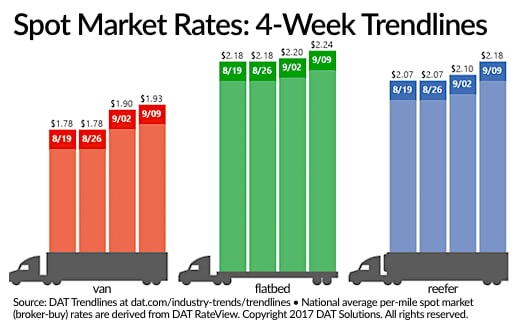
Diesel prices continued to climb, rising 4 cents to $2.80 gallon as a national average. Higher fuel prices put pressure on national average spot rates compared to the previous week. All rates include fuel surcharges while average rates at their highest levels in at least the last four weeks.
Vans: $1.93 per mile, up 3 cents
Flatbeds: $2.24 per mile, up 4 cents
Reefers: $2.18 per mile, up 8 cents
Nationally, van load posts declined 3% and truck posts lost 17%. Houston freight levels bounced back to 88% of where they were before Hurricane Harvey, a remarkable achievement considering that the rebound happened during a four-day holiday week, according to DAT.
Reefer load posts declined 10% and truck posts fell 8% compared to the previous week. Outbound reefer rates in Atlanta rose 6 cents to an average of $2.46 per mile as freight hubs in the Southeast helped to re-stock markets in Arkansas, Louisiana, and Oklahoma that are usually served out of Houston. In Dallas, demand for reefer trucks led to a 19 cents increase to an average of $2.26 per mile outbound.
Flatbed load posts increased 4% nationally due in part to the need to move relief supplies and heavy equipment in Houston and Louisiana. Available capacity fell 20%, in line with expectations given the holiday week and the unusual pressures on the supply chain.
How Hurricanes Harvey and Irma Affected Freight Flows
Hurricane Harvey and Irma forced supply chain managers to make quick decisions about how to route their freight.
After Harvey, some shippers began to supply markets ordinarily served by Houston from regional hubs in the Southeast, including Atlanta, Charlotte, and Memphis. With Irma headed toward Florida, those same distribution centers re-focused and moved freight south instead of west. Meanwhile, the Midwest had to supply the Northeast to compensate for the freight that would otherwise arrive from Atlanta. And the Midwestern warehouses were called on to supply Colorado, which is often served by Houston.
For more details, read Emergency Freight: What Harvey Tells Us About Irma on the DAT blog.
More Fleet Management

Color Match Smarter: Tools That Restore & Perform
For fleet managers and collision repair professionals keeping heavy-duty trucks on the road, getting the color right the first time isn't just about appearance — it's about efficiency, turnaround time, and bottom-line results. Discover how today's digital color tools are transforming the repair process from guesswork to precision.
Read More →
FMCSA Pauses Biennial-Update Enforcement Amid Motus Transition
Carriers whose updates were due on or after June 1 have more time, while FMCSA works to stabilize its new registration system and warns of phishing sites impersonating its new carrier registration system, Motus.
Read More →
2026 Blueprint for Countering Smarter Supply Chain Theft
Cargo theft is no longer just the cost of doing business. It's a multi-billion-dollar criminal enterprise exploiting vulnerabilities across your fleet, drivers, and supply chain.
Read More →


How Telematics Improves Visibility, Control, and Performance in Refrigerated Fleets
Explore how telematics help refrigerated fleets improve visibility, uptime, efficiency, compliance, and cargo protection across connected cold chain operations.
Read More →
What the U.S.-Canada Trade War Means for Trucking
Escalating U.S.-Canada tariffs could disrupt cross-border freight, reduce truck volumes, raise costs, and create new uncertainty for carriers on both sides of the border.
Read More →
What Are Trucking’s Top Concerns for 2026?
The American Transportation Research Institute wants to know what's worrying trucking fleet managers, drivers, and other stakeholders in its annual Industry Issues survey.
Read More →
American Trucking Associations Looks for a New Leader
ATA President and CEO Chris Spear abruptly left his job at the association on August 21, at a pivotal time for the trucking industry.
Read More →
Public Wi-Fi Cybersecurity Risks: How Truck Drivers and Fleets Can Protect Their Data
Public Wi-Fi can expose truck drivers and fleets to credential theft, malware, and other cyber threats. Here’s how to reduce the risk on the road.
Read More →
For Nicky Cupp, Fleet Innovation Starts With Frustration
HDT Truck Fleet Innovator Nicky Cupp turns everyday pain points at Fraley & Schilling into opportunities for better technology and smarter processes.
Read More →
Adam Buttgenbach’s Approach to Electric Trucks: Start With Where They Fit
HDT Truck Fleet Innovator Adam Buttgenbach helped PepsiCo build one of North America’s largest EV fleets by focusing on where electric trucks make operational sense.
Read More →