




Meritor to Start Testing Electric Drivetrain Next Year
Meritor announced at the North American Commercial Vehicle Show that it is developing a platform of electric drive axles and suspensions as well as supporting systems “to position Meritor as a leader in electric solutions for the commercial vehicle market.”

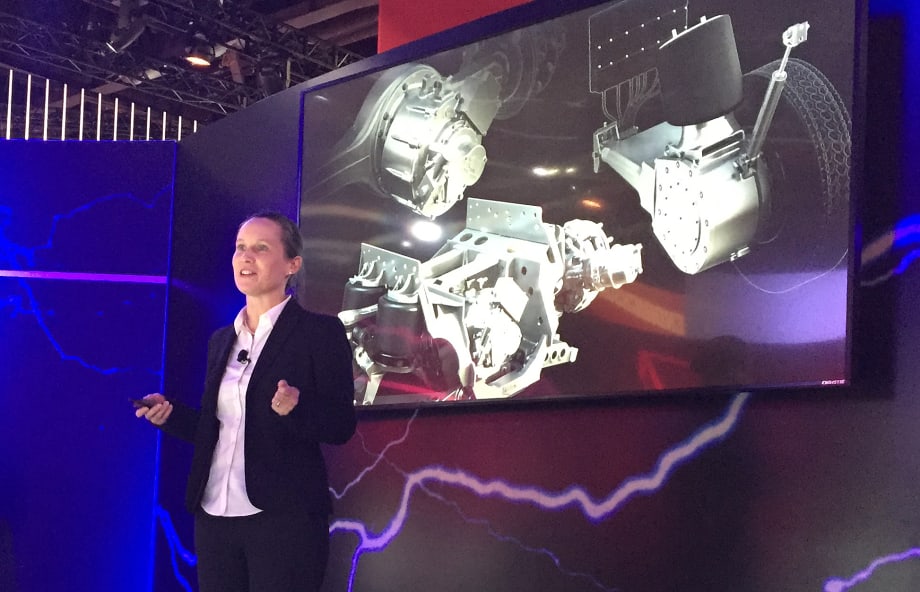
Meritor's Cheri Lantz explains that the e-carrier is an electric motor designed into a differential carrier. Photo: Deborah Lockridge
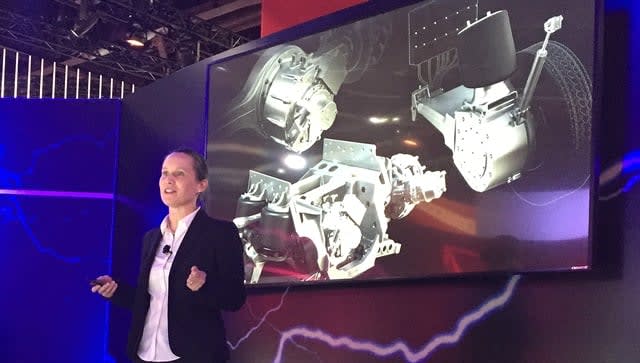
Meritor's Cheri Lantz explains that the e-carrier is an electric motor designed into a differential carrier.Photo: Deborah Lockridge
ATLANTA – As Meritor works to stay ahead in an industry facing the most rapid change CEO Jay Craig says he’s ever seen, the company announced it’s developing a new portfolio of electric drivetrains.
Meritor announced at the North American Commercial Vehicle Show that it is developing a platform of electric drive axles and suspensions as well as supporting systems “to position Meritor as a leader in electric solutions for the commercial vehicle market.”
It also announced an improved air disc brake and a new low-cost aftermarket brand.
“You’re seeing part of the Renaissance of Meritor,” Craig said. About a year into its three-year M2019 plan focusing on revenue growth, the company continues to press forward with its goal to roll out at least 20 new products during that three-year time frame.
“We're also committed to electrification,” Craig said. “We’ve had a lot of interest from OEs on how we can start to work with them to launch demonstrator and production vehicles as well. We have a product for every category of the commercial vehicle market,” he said, including trucks, buses, and delivery vans. “We offer the complete portfolio and our plan is to continue to be the drivetrains leader – no matter where the industry evolves.”
The electric drivetrains address several trends in the industry, said Cheri Lantz, vice president and chief strategy officer: the increasing quest for efficiency, global emissions regulations, and the advancement of electrification as technology improves and battery costs come down.
Essentially, Meritor is focusing on integrating an electric motor into the differential carrier. The flexible e-carrier design will be the foundation for various drivetrain configurations, including full electric, hybrid, single or tandem axles with various options based on application. Designed for city-delivery, medium-duty and transit bus, as well as off-road and severe-duty applications, the electrified, lightweight carrier offers several benefits over remote-mounted electric motor configurations.
Meritor designed the e-carrier as a drop-in replacement of a conventional mechanical carrier that does not disrupt axle or suspension packaging. Because the electric motor is integrated into the axle, space is freed up for batteries and other electrical components, offering easier packaging and installation and a safer, more protected location inside the frame rails to mount the batteries. The design also eliminates cost and weight associated with a driveline and mounting a remote motor with brackets.
The following near-term electrified product solutions are under development by Meritor:
• Integrated two-speed electric carrier platform capable of delivering 150-200 kilowatts of continuous power for mounting on existing axle platforms, fitting a wide variety of applications on rigid and independent suspensions
• 13Xe rigid axle, capable of 200 kilowatts of continuous power and featuring customizable gearing to cover linehaul, school bus, refuse, pickup and delivery, utility and other applications
• Electric-driving independent suspension for applications such as military, emergency, off-highway and construction vehicles that will benefit from increased performance as well as better ride comfort and handling
• Electric eCorner module for low-floor applications such as medium-duty Class 4 and 5 pickup and delivery vehicles and transit buses.
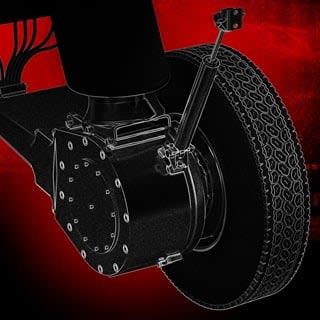
The Electric eCorner module is designed for low-floor applications such as medium-duty Class 4 and 5 pickup and delivery vehicles and transit buses.
Meritor says it’s taking an integrated approach to electrification, so it will also offer braking systems optimized for e-axles. The Next Generation Quadraulic brake and Next Generation Air Disc Brake have been designed for use on hybrid or electric vehicles with regenerative braking.
“Both take advantage of the lighter duty cycle in an electric vehicle,” explained Lantz. “You have regenerative braking so you don't use the brakes as much, so we have been able to reduce wearable content and save cost and weight on the braking systems.”
The components will be part of a demonstration vehicle to be built in 2018, with production beginning as early as 2019.
More Fuel Smarts

How GP Transco Builds Fuel Savings a Fraction at a Time
Aerodynamic specs, solar panels, and driver incentives help GP Transco turn small efficiency gains into savings it can reinvest in its people.
Read More →
Trucking’s Diesel Squeeze Isn’t Letting Up
With diesel topping $6 a gallon nationally, ATA's Bob Costello explains why fleets should prepare for continued pressure at the pump.
Read More →
FlowBelow Redesigns Trailer AeroSlider to Cut Fuel Use
The lighter trailer aerodynamic system installs in less than 45 minutes, according to the company, with potential payback in under a year depending on fuel prices and trailer mileage.
Read More →
Why Diesel Price Relief Efforts May Fall Short
Diesel prices have eased from September’s record high, but doubts about additional Russian supply and limits on dyed-diesel tax relief mean trucking fleets still face expensive fuel. And prices could go higher.
Read More →
Why Small Fuel Savings Matter in Trucking
Can better fuel economy help pay for driver raises? In this podcast, GP Transco explains how small efficiency gains create room to reinvest in its people.
Read More →
How GP Transco Cuts Trucking Fuel Costs, a Tenth of a Gallon at a Time
What’s another tenth of a mile per gallon worth? GP Transco shares how equipment upgrades and driver coaching turn small gains into meaningful fuel savings.
Read More →
Electric Yard Tractors Move Beyond Pilots
Operating-cost savings have overtaken sustainability goals as the leading reason surveyed fleets are adopting battery-electric terminal tractors, according to new NACFE research.
Read More →
Geotab Links Fleet Card to Vehicle Data
The new card combines fuel discounts with telematics-based purchase controls. Geotab’s analysis also points to potential savings from choosing lower-priced fuel stops.
Read More →
Fleet Economics Shape Electric Truck Outlook
ACT Research expects costs, charging infrastructure, and technology improvements to drive zero-emission commercial vehicle adoption as federal regulations and incentives retreat.
Read More →
Wex Adds Cardless Fuel Payments for Over-the-Road Customers
A new fuel card feature for Wex customers offers convenience and security.
Read More →