





Related: Navistar OnCommand to Offer Parts Failure Prediction Feature
Digital Supply Chain Offers Greater Potential Than Electric, Autonomous Trucks
Amidst a show where major topics of conversation included electrification of commercial vehicles and the path to autonomous trucks, one industry exec said the digital supply chain will be the next big breakthrough in trucking productivity.
September 27, 2017

Persio Lisboa talks to suppliers about the need to be leaders in technology to improve trucking productivity.
4 min to read

Persio Lisboa talks to suppliers about the need to be leaders in technology to improve trucking productivity.
ATLANTA – Amidst a show where major topics of conversation included electrification of commercial vehicles and the path to autonomous trucks, one industry exec said the digital supply chain will be the next big breakthrough in trucking productivity.
Speaking to an audience of suppliers at the Heavy Duty Manufacturers Association Breakfast and Briefing at the inaugural North American Commercial Vehicle Show, Persio Lisboa, executive vice president and COO of Navistar International, predicted that data and analytics will drive advances in trucking industry productivity while imposing increasingly stringent design requirements for truck and component reliability.
The supply chain is changing rapidly, he noted, thanks in large part to the growth of e-commerce. “Customers’ expectation are totally different today than they were five years ago; 48 hour delivery is starting to sound like a terribly long time.”
However, he said, this incredibly fast and efficient delivery system has a very inefficient back end. For every truckload of products that hit the front door of a customer, there are four other equivalent loads taking place to manage returns, transfers between PDCs, etc., he said – “an efficient system maintained by an inefficient supply chain.”
And who is paying for those inefficiencies? It’s not the end consumer, he said, and it’s not Amazon. Which means those in the supply chain are likely footing the bill.
Those inefficiencies are hardly news to fleets. As one customer told Navistar, “We don’t need more drivers, we need more time driving." Large carriers typically report that drivers are only actually driving about 6.5 hours out of their 11 hours of available driving time. The rest is wasted on things like waiting to load and unload.
“The only answer that makes any sense is we need to find a way how to get our supply chains delivering a breakthrough in productivity.”
A digital supply chain, he said, could provide that breakthrough.
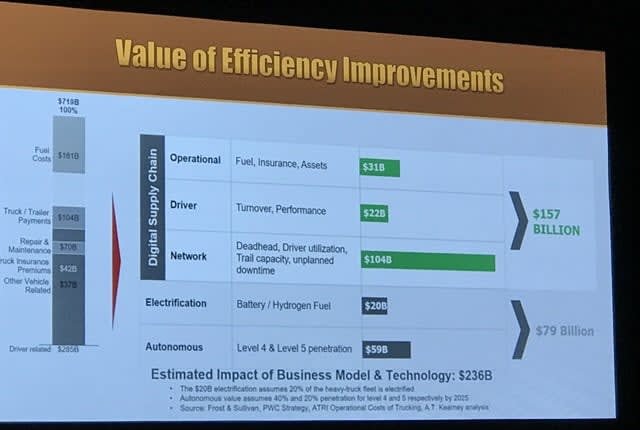
A digital supply chain, Lisboa said, could mean nore than electrification or autonomous tech.
By 2025, Lisboa said, electrification and automation are projected to provide some $79 billion in savings. In contrast, he said, a digital supply chain could save $157 billion, with operational improvements, reduction in driver turnover and improvement in driver performance, but most importantly, in the network, optimizing driver utilization, cutting deadhead miles, eliminating unplanned downtime, and optimizing trailer capacity.
"When we add together the impact of these three megatrends – electric, autonomous and digital supply chain – the industry has the opportunity, over the next few years alone, to capture a 30 percent improvement in efficiency, and consequently lower operating costs," Lisboa said.
“We don’t think that can happen without a network of connected vehicles,” he said. “We believe that's the backbone of the digital supply chain.”
One challenge there, though, is that close to 70% of trucks on the road today don't even have a telematics device, he said.
The world of connected vehicles offers greatly increased availability of data, which can enable digital load matching, as well as a much more accurate level of prognostics for truck maintenance issues.
As an example, he cited Navistar's use of data from its OnCommand Connection remote diagnostics system to provide detailed guidance on maintenance and truck specifications to all customers, even those purchasing just a single truck.
Analysis of big data from connected vehicles can tell truck makers almost precisely what to expect from a certain component or group of components, and can even point toward specific vehicles in the population that may be exposed to a certain issue, with a high degree of confidence.
"The companies who supply the network of connected vehicles and take advantage of the big data generated by them, will be one step ahead of the others," Lisboa said.
Lisboa warned the suppliers in the audience that if they don’t get out in front, they may be left behind, much as companies such as Blockbuster and Kodak were by the digital revolution.
“It can happen to all of us,” he said, noting that Bill Gates in 1994 said, "It's important that [internet] expectations aren't cranked too high. The total number of users is still very small."
“My first advice to all of us is to really get paranoid about the fact that disruption is going to happen.”
More Fleet Management

Sponsored•September 1, 2026
How Telematics Improves Visibility, Control, and Performance in Refrigerated Fleets
Explore how telematics help refrigerated fleets improve visibility, uptime, efficiency, compliance, and cargo protection across connected cold chain operations.
Read More →
What the U.S.-Canada Trade War Means for Trucking
Escalating U.S.-Canada tariffs could disrupt cross-border freight, reduce truck volumes, raise costs, and create new uncertainty for carriers on both sides of the border.
Read More →
What Are Trucking’s Top Concerns for 2026?
The American Transportation Research Institute wants to know what's worrying trucking fleet managers, drivers, and other stakeholders in its annual Industry Issues survey.
Read More →

American Trucking Associations Looks for a New Leader
ATA President and CEO Chris Spear abruptly left his job at the association on August 21, at a pivotal time for the trucking industry.
Read More →
Public Wi-Fi Cybersecurity Risks: How Truck Drivers and Fleets Can Protect Their Data
Public Wi-Fi can expose truck drivers and fleets to credential theft, malware, and other cyber threats. Here’s how to reduce the risk on the road.
Read More →
For Nicky Cupp, Fleet Innovation Starts With Frustration
HDT Truck Fleet Innovator Nicky Cupp turns everyday pain points at Fraley & Schilling into opportunities for better technology and smarter processes.
Read More →
Adam Buttgenbach’s Approach to Electric Trucks: Start With Where They Fit
HDT Truck Fleet Innovator Adam Buttgenbach helped PepsiCo build one of North America’s largest EV fleets by focusing on where electric trucks make operational sense.
Read More →
Deen Albert: Let Automation Do the Math, People Make the Decisions
HDT Truck Fleet Innovator Deen Albert makes sure people are still at the heart of operations at Grand Island Express, even while adopting artificial intelligence tools. AI-assisted dispatch helped boost revenue 25% with the same number of trucks.
Read More →
Trimble’s New AI Agent Takes Aim at Fleet Back-Office Busywork
Arc Agent works across Trimble TMS products to automate repetitive tasks such as freight orders, maintenance, invoices, fuel costs and more.
Read More →
How HDT’s 2026 Truck Fleet Innovators Are Rethinking Fleet Operations
Meet five trucking leaders who are challenging assumptions, solving operational problems, and putting innovative ideas to work.
Read More →