




ZF Brings Reax Electronic Steering System to Heavy Truck Market
ZF's new Reax electronic steering system reads sensors from a wide array of vehicle systems and provides drivers with augmented control automatically tailored to specific driving situations.
August 20, 2017

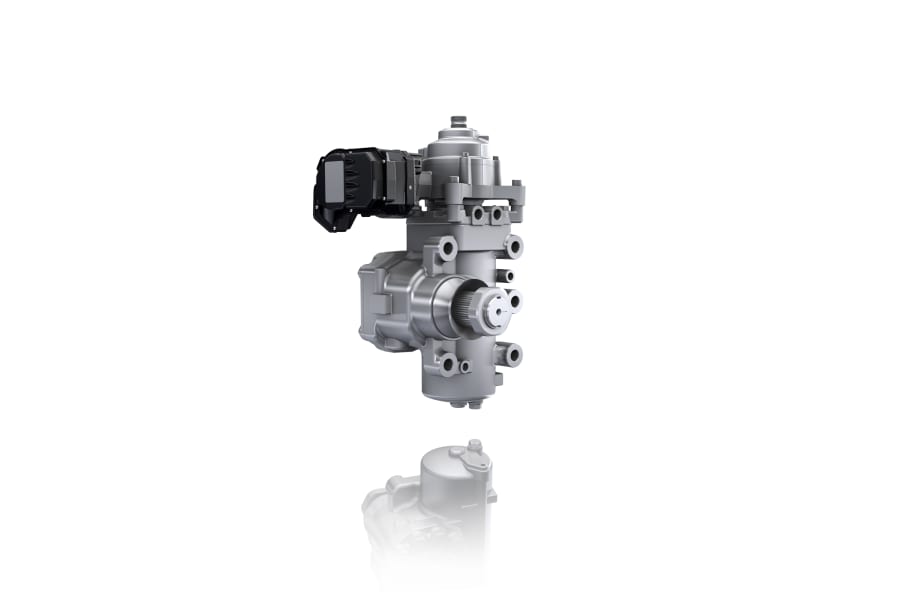
ZF's ReAx steering system mounts to a truck steering column and provides steering assistance based on real-time driver needs. Photo: ZF Group
4 min to read
ZF's ReAx steering system mounts to a truck steering column and provides steering assistance based on real-time driver needs. Photo: ZF Group
ZF is bringing its Reax electronic steering system to the North American commercial vehicle market. The company demonstrated the system at a press conference at its Commercial Vehicle Technology Center in Lafayette, Indiana, last week.
ZF first introduced the product into the recreational vehicle market in 2006 and the global coach and bus market a couple of years later. Since then, ZF engineers have continuously upgraded Reax as other new vehicle technologies have come on line. Today, the system can fully integrate with a host of advanced vehicle systems, including camera, radar, lidar and other advanced safety system and adaptive cruise control enablers, as well as emerging autonomous vehicle control systems.
In fact, in its current form, Reax is a Level 2 autonomous vehicle control system designed to assist drivers, boost safety and vehicle control while reducing stress and fatigue.
Here’s how it works: Reax features an array of sensors that continuously monitor any incoming telemetry related to how the truck is being steered at both highway speeds and in low-speed maneuvering situations.
The easiest way to grasp the Reax concept is to think of the system as an electronic steering control system that boosts a truck’s hydraulic steering pump output. But there’s so much more to the system than that. According to Mark Cartwright, global product marketing planning manager for ZF, Reax is a steering-proportional control, which means that it adjusts how it augments power steering pump output based on actual driver needs. In low-speed situations, Reax lightens up steering resistance to help drivers quickly act and react when maneuvering, backing or docking. At highway speeds, the system tightens up steering resistance to give a driver better feel and precision control in holding a lane.
But that’s just the beginning: The system is, as its name suggested, also reactive. This means that it can read specific situational demands and make adjustments accordingly. In low-speed maneuvers, it automatically returns the steering wheel to top dead center if the driver removes his or her hand from the wheel. This, Cartwright said, takes all the guesswork out of getting the wheels straight when backing or docking.
But at highway speeds, Reax responds to help drivers deal with crosswinds or crowns in the road that can force them to hold constant pressure on the wheel in order to keep the truck in its lane. In those instances, Reax notes the wheel input and force being exerted on the wheel by the driver and automatically compensates for the difference within a minute or so. In other words, it compensates for the external forces trying to push the truck off its desired steering track and holds the correct course for the driver automatically. This, Cartwright explained, reduces driver fatigue while increasing overall safety for the driver.
Reax works in other ways as well. If the truck is fitted with a lane departure warning system, it can help eliminate drift in the lane by reading telemetry off the safety system cameras and other systems. If ReAx senses drift toward one lane marking or the other, it can gently nudge the truck back to its correct position in the center of the lane.
Additionally, at highway cruise speeds, when little or no hydraulic system output is needed to handle limited steering wheel movements, ReAx can take over steering control augmentation and allow the steering pump hydraulic pressure to drop to zero flow. This reduces parasitic drag on the engine, Cartwright says, and can add an additional 1.5% boost in vehicle fuel economy when cruising at highway speeds.
Hands-on Impressions
ZF engineers had a cone course set up behind its Commercial Vehicle Technology Center in order to allow wheel time to see how the Reax system worked in low-speed situations. (Highway drives were not available at the press event.)
Driving a Peterbilt Model 579 tractor, I was able to whip the truck through repeated laps on a Figure-8 course using only my index finger to turn the wheel as needed. Another course had me taking a Volvo VHD dump truck over a series of aggressive speed bumps. AF engineers could turn Reax on and off on command, in order to give a sense of how the system can pick up on impact forces from potholes and instantaneously counteract those forces before they get to the steering wheel or the driver. As promised, running over the speed bumps with the system engaged dampened those impact forces so thoroughly, I could take my hand completely off the steering going over the speed bumps while it tracked straight and true.
ZF is currently meeting with various truck OEMs and fleets to demonstrate Reax technology and its benefits and hopes to have the system available as either optional or standard equipment in the near future.
More Drivers

Truck Drivers Need More Than Another Alert
Fleets have more visibility into truck health, safety events, and driver activity than ever. The next challenge is turning all that information into useful guidance for the person who has to decide what to do next.
Read More →
FMCSA Removes 110 Truck Driver Training Schools from Certified ELDT List
Federal regulators also are targeting more than 160 additional training providers and launching a nationwide audit of third-party CDL skills testers as part of a broader crackdown on trucking fraud.
Read More →
Hours of Service Pilot Programs: FMCSA Readies for 2027 Rollout
Two pilot programs could eventually reshape hours-of-service rules, giving truck drivers options to pause their 14-hour clock or use longer split sleeper rest periods.
Read More →
Medical Cards, English Proficiency Reshape Roadcheck Violations
Medical-card violations jumped to the top of the driver out-of-service list during CVSA’s 2026 International Roadcheck, while English-language proficiency violations appeared among the leading violations for the first time.
Read More →
Driver Trust Can Make or Break the Success of Fleet Safety Technology
New Teletrac Navman research suggests that onboarding, transparency about driver data, and positive feedback can play a significant role in how commercial drivers respond to safety and coaching technology.
Read More →
EEOC Sues KLLM Over Alleged Sex Discrimination in Driver Training
KLLM is facing a federal sex-discrimination lawsuit over policies the EEOC alleges put female truck driver trainees at a disadvantage.
Read More →
FMCSA Moves to Codify English Language Requirements for Commercial Drivers
By changing regulations on English-language proficiency requirements for commercial drivers, rather than relying on a guidance memo, the FMCSA said future administrations won't be able to walk back the Trump administration's stricter enforcement with just a memo.
Read More →
Drivers Put Western Star Trucks to the Test at Star Nation Experience
Watch to get an inside look at the Western Star trucks, technology, and community behind the Star Nation Experience 2026!
Read More →
Trump Administration Looks to Put More Veterans Behind the Wheel
The Freedom Haulers program pulls together existing and expanded programs at several federal agencies to recruit veterans to drive commercial heavy-duty trucks and cut the red tape for them to get a CDL, training, and employment.
Read More →
Putting Mack’s Command Steer to the Test
A test drive of Mack’s Command Steer active steering system evaluates how it can make truck driving easier and less tiring.
Read More →