





Related: Will Electric Trucks Charge Ahead?
Will Future Tech Have a Domino Effect on Fleets?
Transportation analyst Rick Mihelic says electric powertrains and autonomous vehicles will only be the beginning of the changes fleets will have to deal with in the near-term future.
August 31, 2017
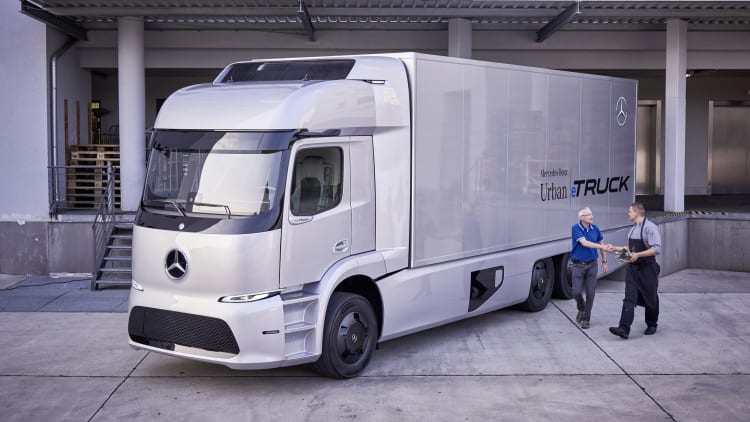
Although the use of electric trucks will likely rise in the coming years, diesel will remain the fuel of choice for fleets, said analyst Rick Mihelic. Photo: Mercedes Benz
5 min to read
Although the use of electric trucks will likely rise in the coming years, diesel will remain the fuel of choice for fleets, said analyst Rick Mihelic. Photo: Mercedes Benz
Great changes are heading toward trucking. And while it’s only natural to focus on headline-making technologies such as electric vehicles or autonomous driving technology, the tidal wave of changes coming at the industry create a ripple effect that will change aspects of the trucking industry that few have considered to this point.
That was the cautionary note struck by Rick Mihelic, transportation industry analyst and president of Mihelic Vehicle Consulting, at a webinar hosted by the Stifel Transportation Equipment Equity Research Group.
Mihelic noted that while there are many experts and pundits making predictions concerning the future of trucking today, these forecasts are extremely tricky to get right with the benefit of hindsight. However, he said it is important to remember that while many new technologies are initially supported by incentives, tax breaks, and grants to offset developmental costs, ultimately these technologies must win out in the marketplace and generate a positive return on investment and prove capable of offsetting both developmental and operating costs in order to be successful.
Taking that analysis a step further, Mihelic said it’s possible today to zero in on specific aspects of the trucking industry to see where emerging technologies might be able to cut costs or improve efficiencies in the future. These areas include:
Reducing driver costs
Increasing the payload an individual vehicle can carry
Increasing the amount of freight miles per unit per year
Increasing pricing
Reducing other operating costs
Mihelic said that while other forms of transporting material goods, such as shipping, rail and airlines, have evolved and modified over the decades since their establishment, trucking alone remains locked by regulations and legislation in methods and configurations that would be familiar to someone 80 years ago.
Moreover, other countries around the world have allowed their trucking industries to grow and evolve, Mihelic noted, pointing to use of two- and even three-trailer combinations in Europe and in counties such as Mexico, Australia and Canada. (He did point out that some U.S. states, such as Oregon, do likewise.)
Platooning, Mihelic said, could be a first step in using autonomous technology to extend the capabilities of the current driver-controlled, 53-foot tractor-trailer combination to improve fleet efficiencies. And, he said as the technology matures and evolves, it could eventually lead to fully autonomous trucks in trailing platoon positions, as well as the expansion of associated technologies or practices such as dedicated freight lanes, automated road trains, drone-controlled trucks, or remote-controlled trucks.
Mihelic also said these trendlines strongly suggest a change in the way vehicles are spec’d, which will have a dramatic impact on resale values and the secondary truck market overall. As the technology and demands of the evolving freight market change, trucks will become much more specialized for specific hauling applications than they are today. As a result, flexibility of these vehicles in second or third lives will be drastically reduced, as will the pool of potential buyers for these used trucks.
Additionally, Mihelic said, the evolutionary curve of trucks – particularly in regard to electronics and computing systems-- will mimic that of cellular phones and their eventual evolution into smart phones over the last decade, with little or no backwards-compatibility between older and newer model trucks.
The differences between these older and newer trucks, Mihelic predicts, will be so stark that older trucks may not be allowed on the roads at all, or even if they are, running them will put operators at such a distinct competitive advantage that it won’t make any business sense to do so.
Going Electric
Mihelic was quick to stress that he believes diesel will remain the predominant fuel in trucking for many years to come. However, he also said that electric trucks will find a useful niche for fleets – even in some regional or limited long-haul applications.
Although the current battery technology does not yet allow for runs of more than 200 or 300 miles on a single change, Mihelic suggested that changes in vehicle configurations and route adjustments could easily overcome these shortcomings.
If, as Mihelic proposes, battery packs are moved from the tractor unit to the trailer, perhaps mounted underneath most of a 53-foot trailer, an electric tractor-trailer could engage in a daily drop-and-hook route of 600 miles or more. It would drive 300 miles to a warehouse, where a trailer with a cargo and a spent battery pack would be exchanged for a new trailer with new cargo and a freshly charged battery. The truck will then continue on to a second warehouse facility, repeat the trailer/battery exchange, and then begin its journey back to either a starting facility or a final, end-of-day facility to complete the round trip the following day.
Additionally, Mihelic said these warehouse/charging facilities could be powered by roof-mounted solar panels, which he said studies have shown could conservatively provide enough electricity to power 60 to 80 all-electric tractors each running a 100-mile route a day.
Another compelling possibility, Mihelic said, was that idle trailers with battery packs could be plugged into the warehouse grid to either help charge trucks or trailers or put power back into the electric grid, creating an opportunity for fleets to use idle equipment to earn additional revenue.
Looking ahead, Mihelic picked out 10 key “talking points” that he said will likely become realities for fleets in the near future:
Increased use of electric vehicles
Greater freight capacities hauled by single motive units
Vehicles becoming increasingly optimized for first-use life
Shorter service lives for first-life trucks
Lower residual values for first-life trucks
Increased automation with driverless trucks a possibility
Significant "domino effects" as new technology comes on line
Increased technical complexity of trucks and vehicle systems
Increased skill sets for drivers, technicians and fleet managers
As for when these changes will start to occur, Mihelic noted there is a standard 15-year S-curve that charts technological-adoption rates. Assuming that holds true for trucking, then Mehelic said that many of the changes he is forecasting could be reality for fleets as early as 2033.
More Drivers

From One Generation to the Next: How Mentorship Builds Safer Truck Drivers
After three decades in trucking, Harold Perry shares what he's learned about driver safety, mentorship, and helping the next generation build confidence behind the wheel.
Read More →
Truck Drivers Need More Than Another Alert
Fleets have more visibility into truck health, safety events, and driver activity than ever. The next challenge is turning all that information into useful guidance for the person who has to decide what to do next.
Read More →
FMCSA Removes 110 Truck Driver Training Schools from Certified ELDT List
Federal regulators also are targeting more than 160 additional training providers and launching a nationwide audit of third-party CDL skills testers as part of a broader crackdown on trucking fraud.
Read More →
Hours of Service Pilot Programs: FMCSA Readies for 2027 Rollout
Two pilot programs could eventually reshape hours-of-service rules, giving truck drivers options to pause their 14-hour clock or use longer split sleeper rest periods.
Read More →
Medical Cards, English Proficiency Reshape Roadcheck Violations
Medical-card violations jumped to the top of the driver out-of-service list during CVSA’s 2026 International Roadcheck, while English-language proficiency violations appeared among the leading violations for the first time.
Read More →
Driver Trust Can Make or Break the Success of Fleet Safety Technology
New Teletrac Navman research suggests that onboarding, transparency about driver data, and positive feedback can play a significant role in how commercial drivers respond to safety and coaching technology.
Read More →
EEOC Sues KLLM Over Alleged Sex Discrimination in Driver Training
KLLM is facing a federal sex-discrimination lawsuit over policies the EEOC alleges put female truck driver trainees at a disadvantage.
Read More →
FMCSA Moves to Codify English Language Requirements for Commercial Drivers
By changing regulations on English-language proficiency requirements for commercial drivers, rather than relying on a guidance memo, the FMCSA said future administrations won't be able to walk back the Trump administration's stricter enforcement with just a memo.
Read More →
Drivers Put Western Star Trucks to the Test at Star Nation Experience
Watch to get an inside look at the Western Star trucks, technology, and community behind the Star Nation Experience 2026!
Read More →
Trump Administration Looks to Put More Veterans Behind the Wheel
The Freedom Haulers program pulls together existing and expanded programs at several federal agencies to recruit veterans to drive commercial heavy-duty trucks and cut the red tape for them to get a CDL, training, and employment.
Read More →