




NACFE Updates 6x2 Confidence Report
NACFE offers an updated 6x2 Confidence Raport that reflects the lessons learned over the past 14 years. It also address advancing technology and how such improvements make 6x2 a more viable consideration than previous generations of the technology.
July 11, 2017

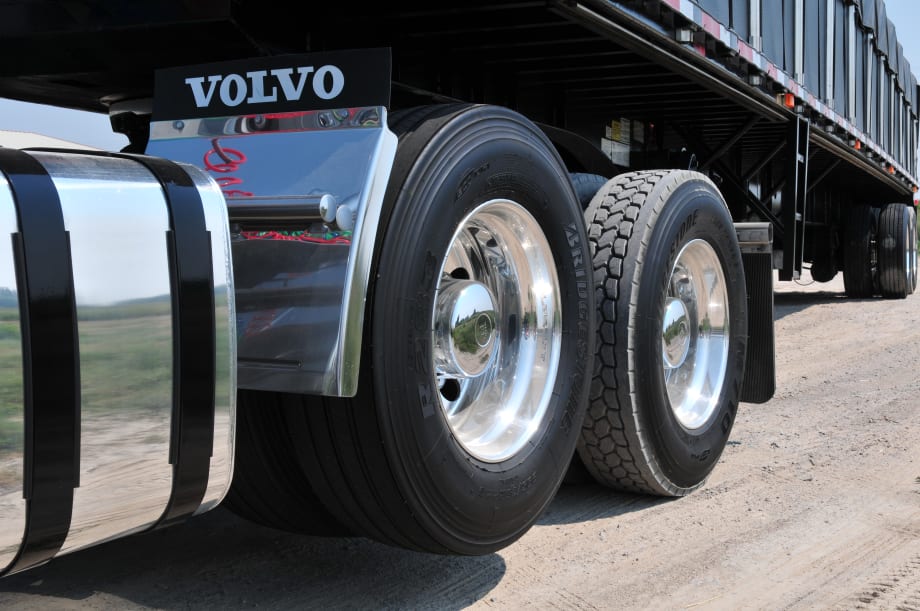
Third generation 6x2 systems feature liftable pusher axles, which are said to improve ROI by allowing for axle-up light-weight operation. Photo by Jim Park
6 min to read
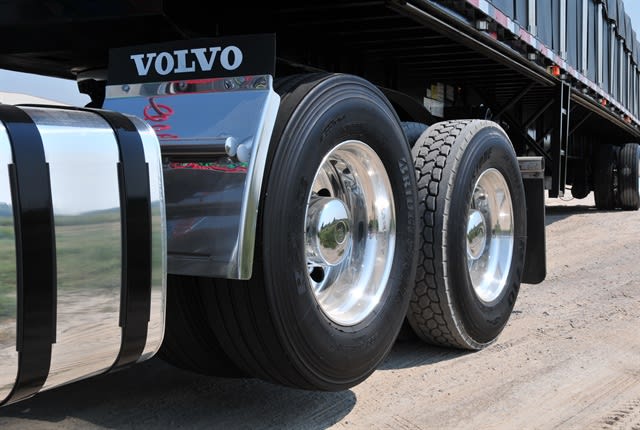
Third generation 6x2 systems feature liftable pusher axles, which are said to improve ROI by allowing for axle-up light-weight operation. Photo by Jim Park
The latest Confidence Report from the North American Council for Freight Efficiency shows that 6x2 drivetrains are still viable options for fleets looking for fuel and weight savings, but uptake on the technology is lower than what was predicted. This latest report shows 6x2 technology is evolving as product refinements emerge and fleets continue to work around some of the configuration's perceived challenges.
NACFE and Carbon War Room this week issued an update to the Confidence Report on 6x2 axles, originally published in January 2014. This is the first time NACFE has convened a new team of experts to re-investigate a technology on which it has already issued a Confidence Report.
“While we found that the fuel savings benefits as well as the challenges from the original report are largely still true, new product refinements are coming to the market that are aimed at addressing some of the concerns fleets had about 6x2 axles,” said Yunsu Park, NACFE study team manager. “For instance, fleets dedicated to 6x2s are improving tire wear by changing the tire models they use and [electronically] limiting [engine] torque when launching the truck. Also, driver training has proven to be a significant part of a successful 6x2 implementation.”
The study team identified three generations of 6x2 products, but focused special attention on Generation III products, which contain liftable pusher axles, automatic axle-load biasing and traction control.
Generation I: 6x2 with tag axle, no load-shifting technology, manual differential locks. This version offered a 2–3% fuel savings along with weight savings of 300–400 pounds compared to a 6x4. Reported issues included accelerated tire wear and reduced traction under certain conditions, which together resulted in poor driver perception.
Generation II: 6x2 with tag axle, manual or automated load-shifting, traction control, engine parameters adjusted to reduce low-speed clutch engagement and engine brake torque. Load shifting and traction control were found to mitigate traction issues, while limiting engine torque was found to improve tire wear significantly.
Generation III: 6x2 with liftable pusher axle, automatic load-sensing/load-shifting (axle-load biasing), traction control, engine parameters to limit low speed/brake torque. The most significant change was a switch from tag to pusher axles, which enabled lightly loaded trucks to operate with the pusher axle raised. This offered tire wear and fuel economy benefits as well as better traction when empty or lightly loaded compared to a Gen II configuration. It's a very attractive option for fleets expecting to carry less than 60,000 pounds at least 30% of the time, offering additional 2% fuel savings potential, improved traction and less tire wear. Heavier front axles, suspensions, tires, and other equipment may help optimize this configuration.
Among the lessons learned by early adopters of Gen I systems are that tire wear is higher when compared to equivalent 6x4 vehicles, with some fleets experiencing a 50–70% reduction in tire life on their drive tires. Fleets that have adopted best practices have cut this penalty significantly, decreasing the reduction in life to 20% on the driven axle.
Additionally, driver perception, particularly as it relates to safety and traction of 6x2-equipped vehicles, has not improved. Many drivers have not actually experienced or been trained on this configuration and often only hear feedback from a negative and sometimes vocal minority.
However, fleets that have implemented a complete Generation II system have found tire wear and traction issues can be managed at a much reduced level and are able to benefit from the fuel savings. Unfortunately for some fleets, the damage in driver perception was done before a full Generation II system could be implemented.
Despite those hurdles, fleets are seeing successes with 6x2.
"Fleets that are dedicated to 6x2 are making them work and have improved their tire wear and traction concerns pretty significantly," explained Mike Roeth, executive director of NACFE and operation lead of Trucking Efficiency. "We have found that switching to 6x2 is not a simple implementation. It takes a systems approach and some effort from an engineering and spec'ing standpoint as well as a higher degree of driver training.
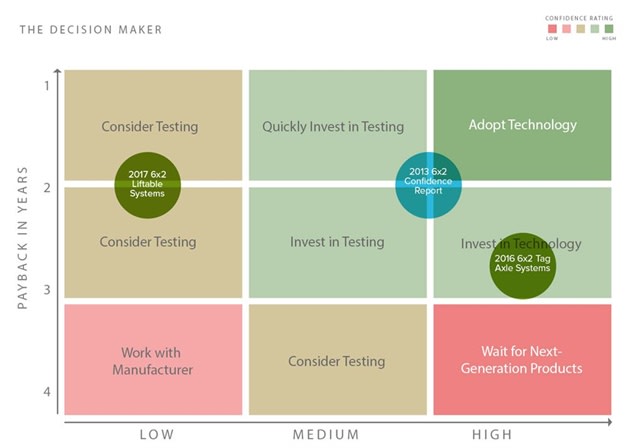
NACFE's Confidence Matrix shows there is still considerable interest in 6x2 but fewer fleets are following through on the investment.
"We have also found that fleets not wanting to jump through all those hoops are migrating back to 6x4s," Roeth added. "And all the while, 6x4 are improving in terms of weight and efficiency, so that's just adding to the tightening in the baseline comparison between 6x2 and 6x4."
CONCLUSIONS AND RECOMMENDATIONS
The Confidence Report update concludes that while 6x2 systems offer an undeniable fuel consumption improvement, they are still not widely viewed as a net positive by the majority of the line-haul industry. The 2003 6x2 study concluded that adoption of 6x2 axles would double every year. This has not happened, in large part because the challenges and consequences of switching to 6x2 were greater than the original study team anticipated. In addition, lower diesel prices have stretched out the payback period.
Many early implementations suffered from very high tire wear combined with poor residual values that more than offset the fuel consumption gains.
However, new 6x2 axles, in particular liftables, are entering the market. They may reduce some of the challenges related to 6x2s but there is limited feedback from fleets at this time.
Drive tire wear on 6x2s will not achieve parity with 6x4s. However, measures can be taken to reduce the accelerated wear. Selecting a retread trailer tire for the free-rolling axle may result in the lowest cost option for fleets.
Fleets should take a system-wide approach and implement the full Generation II package including load-shifting technology, traction control, and engine parameters to limit torque in low gear, at clutch engagement, and under engine braking.
Good and consistent driver communication and training is critical with this technology. Drivers should understand the overall benefit of 6x2s, how the systems work, and when a manual intervention is beneficial.
Traditional 6x4 systems are improving, reducing the potential efficiency gains of a 6x2 system albeit at a greater cost.
Residual values for 6x2s remain a problem due to the reputation of Generation I systems. Fleets that have persisted and implemented Generation II 6x2s do not report a problem with residual values, although these are typically smaller fleets and would not turn over a large number of trucks at once.
Fleets should gain knowledge of 6x2 tag axle systems and test not only the technology but also their internal processes for managing engine parameters and driver communication and training.
Fleets that are below 60,000 lbs. GCWR at least 30% of the time should consider testing a liftable 6x2 axle system.
The new report concludes that 6x2s still play a key role in improving freight efficiency, but the benefits are not as obvious as they previously were. However, manufacturers are continuing to work on improving their offerings, and fleets that have invested in 6x2s continue to do so.
“Those fleets dedicated to 6x2s and exploiting the various opportunities are finding they return their investment,” Roeth concludes.
And just to reaffirm that there is indeed lots of life in the 6x2 concept, Hendrickson says it will unveil a "forward-liftable axle" 6x2 suspension system with an as yet un-named OE partner at the North American Comercial Show in Atlanta this September. That, along with Volvo's Adaptive Loading technology, will bring to two the number of 6x2 suspensions using a forward-liftable or pusher axle, giving fleets the opportunity to lift the axle while empty or lightly loaded.
An executive summary of the report is available, along with the full report. NACFE is now charging a fee of $100 for the full report. More information about the updated 6X2 Confidence Report is available at truckingefficiency.org.
7/11/17: Updated to include information supplied by Hendrickson.
7/12/17: Updated to correct the date of the original Confidence Report.
More Fuel Smarts

Sponsored•September 9, 2026
How Fuel Delivery Shapes Engine Performance
Fuel delivery depends on more than what happens at the injector. For fleet, maintenance and technical professionals, looking at the full path from pump to injector can provide useful context for understanding engine performance.
Read More →
East Coast Port Launches $45M Electric Truck Push
The Port Authority of New York and New Jersey announced millions in incentives for zero-emission drayage trucks, yard tractors, and new charging hubs near the port.
Read More →
California Bill Could Shed Light on Electric Truck Prices
Why do battery-electric Class 8 trucks remain so expensive? A California bill headed to Gov. Gavin Newsom would give fleets and state agencies more visibility into what manufacturers charge.
Read More →

Detroit Opens Orders for EPA 2027 Engines
Detroit isn’t starting from scratch to meet EPA 2027 diesel emissions standards. Its Gen 6 DD13 and DD15 engines keep much of today’s platform while updating the fuel and aftertreatment systems.
Read More →
Zero-Emission Truck Corridor Planned for West Coast
California, Oregon, Washington, British Columbia and Baja California are coordinating plans for truck charging and hydrogen fueling from Canada to Mexico.
Read More →
A Closer Look at Kenworth’s Electric T880E Vocational Truck [Video]
Learn more about Kenworth's T880E battery-electric vocational truck at the Paccar Technical Center, including its range, applications, upfitting considerations, and PTO options, in this HDT Spotlight video.
Read More →
Kenworth T880E Brings EV Power to Vocational Trucks
A closer look at the Kenworth T880E’s range, charging, powertrain and upfit options — and where fleets are showing the most interest.
Read More →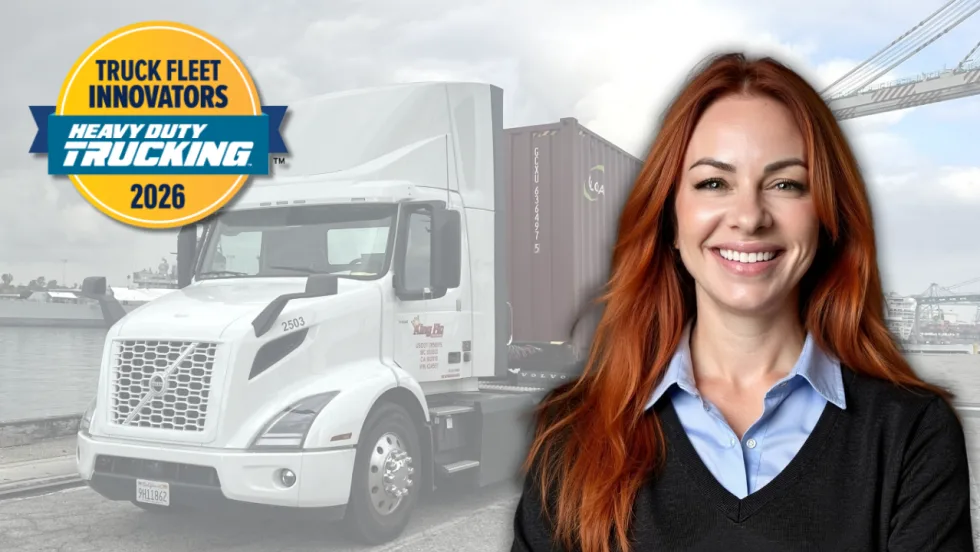
Jennie Abarca Is Proving Electric Trucks Can Do the Job
HDT Truck Fleet Innovator Jennie Abarca is building confidence in fleet electrification one load at a time while openly sharing the challenges she encounters along the way as a small-fleet owner.
Read More →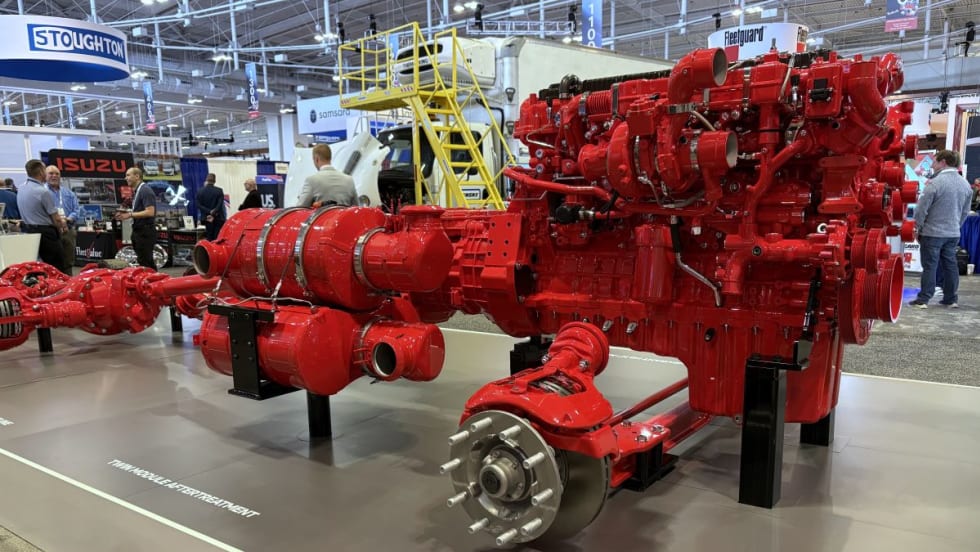
Cummins Adjusts 2027 Engine Rollout After EPA Proposal
The engine maker will gradually introduce its new Model Year 2027 diesel engines while continuing to offer current models during the transition, citing the EPA's proposed emissions rule changes.
Read More →
EPA Proposal Could Ease 2027 Truck Costs and Buying Uncertainty
The proposal doesn't change the tougher NOx standard, but it would revise key implementation requirements that manufacturers say have driven up costs and complicated fleet purchasing decisions.
Read More →