




Trucking Applauds Proposed TWIC Driver-Credential Reform Measure
A bipartisan measure that aims to make the federal Transportation Worker Identification Credential program more effective by ensuring “a risk-based security model for surface transportation facilities” was reintroduced in the Senate on March 30.

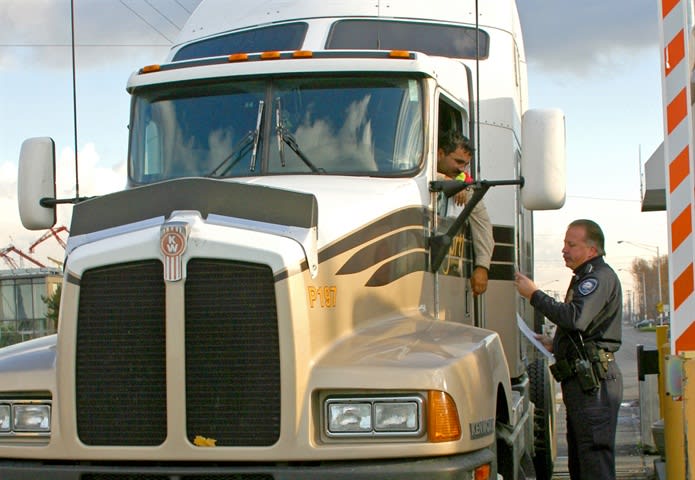
TWIC check at Port of Tacoma. Photo: Port of Tacoma
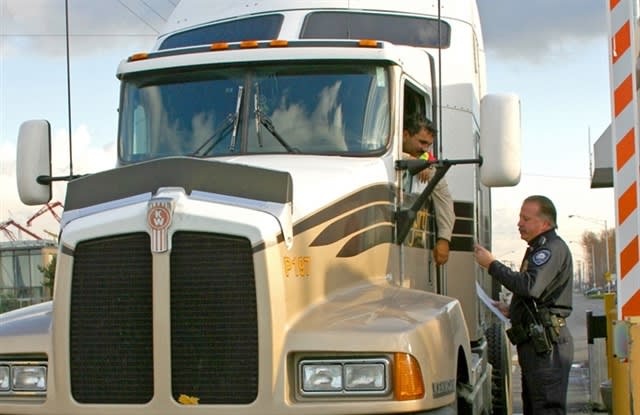
TWIC check at Port of Tacoma.Photo: Port of Tacoma
A bipartisan measure that aims to make the federal Transportation Worker Identification Credential program more effective by ensuring “a risk-based security model for surface transportation facilities” was reintroduced in the Senate on March 30.
The Surface Transportation and Maritime Security Act (S.763) was reintroduced jointly by Sen. John Thune (R-SD), chairman of the Senate Committee on Science, Commerce, and Transportation, and Sens. Bill Nelson (D-FL), Deb Fischer (R-NE), and Cory Booker (D-NJ).
According to the quartet of senators, the legislation is substantially similar to a bill introduced late in the last Congress. It would address deficiencies in the Transportation Security Administration’s efforts to protect rail, transit, highway, and maritime passenger and freight transportation.
Thune said in a statement that the bill would “address concerns, raised by independent government watchdog agencies, that TSA is not adequately positioned to identify security risks across different modes of transportation or effectively support federal, state, local and private providers of transportation security.”
He also noted that TSA has previously stated in testimony to Congress that it spends only 3% of its budget on surface transportation security.
Per Thune, highlights of the bill include provisions that would:
Enhance Risk-Based Security Planning
Require the TSA Administrator to conduct a risk analysis and implement a risk-based security model for surface transportation facilities
Mandate risk-based budgeting for surface transportation security focusing resources on current threats with annual reviews of program effectiveness
Increase Canine Explosive-Detection Teams
Authorize as many as 70 additional canine teams to work in surface transportation security as soon as possible
Require a review of the number, location, and utilization of canine teams in surface transportation security to ensure effective use
Following this review and the implementation of recommendations, TSA may then raise the total number of canine teams to 200 or higher as identified in TSA’s risk-based analysis
Increase Transparency
Establish a Surface Transportation Advisory Committee to provide stakeholders and the public with the opportunity to coordinate with the agency and comment on policy and pending regulations
Require that TSA budget submissions clearly indicate which resources will be used for surface transportation security and which will be dedicated to aviation
Direct TSA to regularly update Congress on the status of long overdue surface transportation rulemakings
“To keep Americans safe, Congress must continually focus attention on areas of neglect and potential weakness to keep them from becoming targets for terrorism,” said Thune. “The Senate Commerce Committee will soon vote on these important reforms for the TSA.”
The American Trucking Associations applauded the reintroduction of the bill. “As it stands now, professional truck drivers are still subject to a number of duplicative background checks and other hurdles in order to move America’s most hazardous freight and access sensitive areas of the supply chain,” said ATA President and CEO Chris Spear.
“We appreciate the efforts of Senators Thune, Nelson, Fischer and Booker for recognizing that while some scrutiny is necessary, we should look to make the process simpler and less redundant for drivers and we thank them for including these necessary reforms to the TWIC program in this important legislation,” he continued. “This bill is a good first step toward improving the credentialing process and we look forward to working with the Committee as it moves forward.”
Pointing out that he had testified before the committee last year on the credentialing process, Spear said trucking “appreciates that the members of the Committee heard those concerns, took them seriously and have introduced legislation aimed at addressing them.”
ATA noted that the measure is also supported by other trucking lobbies, including the National Tank Truck Carriers and the Owner-Operator Independent Drivers Association.
NTTC President Dan Furth said the group thanked the senators “for their efforts to reduce the burden of these overlapping background checks on our drivers while still working to keep our supply chain secure.”
“No group is more concerned with transportation security than the truckers moving the cargo,” added OOIDA Executive Vice President Todd Spencer. “For too long, these hard working men and women have been frustrated with the bureaucracy and costs of duplicative and redundant background checks. They deserve a better system. While there is much more that needs to be accomplished, the Surface Transportation and Maritime Security Act is a significant step in the right direction.”
More Fleet Management

How MFA Helps Protect Trucking Fleets
Multi-factor authentication adds protection when passwords are stolen. Here’s how it works and where fleets should start.
Read More →
How Better Freight Data Helps Trucking Teams Get Ahead of Disruption
Trucking and logistics teams have plenty of data. The problem is getting the right information in front of the right people soon enough to act. Better-connected data can help teams spot trouble earlier and make smarter decisions before small problems become big ones.
Read More →
Trimble: Taking Artificial Intelligence in Trucking Beyond Faster Tasks
At Insight 2026, Trimble executives argued that fleets may need to redesign workflows to get more from AI as it introduced new products and enhancements. AI’s value will depend on how fleets combine automation with their people's knowledge.
Read More →

Build a bulletproof fleet: Uniting ELDs and dash cams for total compliance
An ELD can prove compliance, but it cannot always prove what happened on the road. Discover how uniting accurate ELD data with AI-powered dash cam video can help your fleet strengthen compliance, defend against liability, protect drivers and reduce operational costs.
Read More →
Nominations Open for HDT Emerging Leaders
Heavy Duty Trucking is looking for accomplished trucking fleet professionals under 40 who are making an impact and helping lead the industry forward.
Read More →
Why Private Fleets Are Taking More Freight
Private fleets are putting their own trucks on demanding customers and high-cost lanes as companies seek greater control over service, costs, and capacity.
Read More →
Color Match Smarter: Tools That Restore & Perform
For fleet managers and collision repair professionals keeping heavy-duty trucks on the road, getting the color right the first time isn't just about appearance — it's about efficiency, turnaround time, and bottom-line results. Discover how today's digital color tools are transforming the repair process from guesswork to precision.
Read More →
FMCSA Pauses Biennial-Update Enforcement Amid Motus Transition
Carriers whose updates were due on or after June 1 have more time, while FMCSA works to stabilize its new registration system and warns of phishing sites impersonating its new carrier registration system, Motus.
Read More →
2026 Blueprint for Countering Smarter Supply Chain Theft
Cargo theft is no longer just the cost of doing business. It's a multi-billion-dollar criminal enterprise exploiting vulnerabilities across your fleet, drivers, and supply chain.
Read More →
What the U.S.-Canada Trade War Means for Trucking
Escalating U.S.-Canada tariffs could disrupt cross-border freight, reduce truck volumes, raise costs, and create new uncertainty for carriers on both sides of the border.
Read More →