





Related: Five Years to Autonomous?
Startup Firm Unveils Prototype Autonomous Truck
Yet another startup tech firm has rolled into the autonomous truck arena. San Mateo, Calif.-based Embark publicly revealed its prototype self-driving truck on Feb. 24.
February 24, 2017
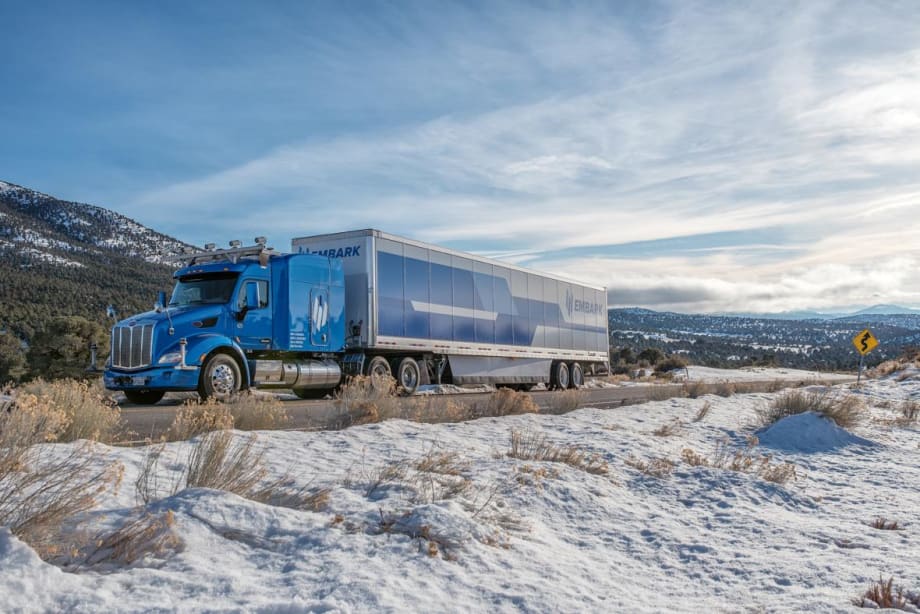
Prototype autonomous truck in Nevada desert. Photo: Embark
3 min to read
Prototype autonomous truck in Nevada desert.Photo: Embark
Yet another startup tech firm has rolled into the autonomous truck arena. San Mateo, Calif.-based Embark publicly revealed its prototype self-driving truck on Feb. 24.
The company, which gained approval from the State of Nevada earlier this year to begin testing its truck on public roads, said its self-driving technology enables a truck “to drive from exit to exit on the freeway without any human input.”
Embark said its tractor-trailer setup uses a combination of radars, cameras and Lidar (light detection and ranging) depth sensors “to perceive the world around it.” The data points captured are processed via a form of Artificial Intelligence known as Deep Neural Nets (DNNs) that “allow the truck to learn from its own experience— much like humans learn from practice.”
“Analyzing terabyte upon terabyte of real-world data, Embark’s DNNs have learned how to see through glare, fog and darkness on their own,” said Alex Rodrigues, CEO and co-founder of Embark. “We’ve programmed them with a set of rules to help safely navigate most situations, how to safely learn from the unexpected, and how to apply that experience to new situations going forward.”
Embark’s truck is built specifically for “long, simple stretches of freeway driving between cities, rather than all aspects of driving.”
Like other autonomous truck designs, including the Freightliner Inspiration truck and the Otto (owned by Uber) truck, Embark's computerized truck is meant to be handed off to a human driver once it heads off the highway, who will then navigate local streets to the destination. “A human driver will still touch every load, but with Embark they’re able to move more loads per day, handing off hundreds of miles of freeway driving to their robot partners,” is how the company put it.
Rodrigues said he was inspired to launch Embark after blowing a tire on the interstate and waiting four hours for a tow. In that time, he said, “every single 18-wheeler that drove past had a sign on the back 'Drivers Wanted'. It was so clear there was a shortage of drivers.” He added that “Embark's goal is to increase productivity per driver and prevent the shortage from becoming a crisis.”
Rodrigues is no stranger to robotics, having built his first autonomous robot at age 13. According to the company, his robots have won international competitions and one of his autonomous shuttles transported over 1,000 passengers in demonstrations across California.
According to Embark, the company’s robotics team includes “talent from technology leaders including SpaceX, StanfordAI, and Audi's self-driving team. The team is backed by a multi-million dollar investment led by Maven Ventures. Maven’s previous investment in self-driving technology, Cruise Automation, sold to GM for $1B last year.”
In addition to its prototype autonomous truck, Embark noted that it also fields a fleet of five trucks to gather data to help accelerate development. The company added that it plans to quadruple its engineering team within the next year and “aggressively expand its testing fleet to show their technology is ready for the nation’s highways.”
“We are committed to proving beyond a shadow of a doubt that this technology is safe and reliable,” said Rodrigues. “That means performing extensive tests and working with our partners in the government to get it— and the market— ready.”
More Fleet Management
Geotab Links Fleet Card to Vehicle Data
The new card combines fuel discounts with telematics-based purchase controls. Geotab’s analysis also points to potential savings from choosing lower-priced fuel stops.
Read More →
How MFA Helps Protect Trucking Fleets
Multi-factor authentication adds protection when passwords are stolen. Here’s how it works and where fleets should start.
Read More →
How Better Freight Data Helps Trucking Teams Get Ahead of Disruption
Trucking and logistics teams have plenty of data. The problem is getting the right information in front of the right people soon enough to act. Better-connected data can help teams spot trouble earlier and make smarter decisions before small problems become big ones.
Read More →

Trimble: Taking Artificial Intelligence in Trucking Beyond Faster Tasks
At Insight 2026, Trimble executives argued that fleets may need to redesign workflows to get more from AI as it introduced new products and enhancements. AI’s value will depend on how fleets combine automation with their people's knowledge.
Read More →
Sponsored•September 28, 2026
Build a bulletproof fleet: Uniting ELDs and dash cams for total compliance
An ELD can prove compliance, but it cannot always prove what happened on the road. Discover how uniting accurate ELD data with AI-powered dash cam video can help your fleet strengthen compliance, defend against liability, protect drivers and reduce operational costs.
Read More →
Nominations Open for HDT Emerging Leaders
Heavy Duty Trucking is looking for accomplished trucking fleet professionals under 40 who are making an impact and helping lead the industry forward.
Read More →
Why Private Fleets Are Taking More Freight
Private fleets are putting their own trucks on demanding customers and high-cost lanes as companies seek greater control over service, costs, and capacity.
Read More →
Sponsored•September 16, 2026
Color Match Smarter: Tools That Restore & Perform
For fleet managers and collision repair professionals keeping heavy-duty trucks on the road, getting the color right the first time isn't just about appearance — it's about efficiency, turnaround time, and bottom-line results. Discover how today's digital color tools are transforming the repair process from guesswork to precision.
Read More →
FMCSA Pauses Biennial-Update Enforcement Amid Motus Transition
Carriers whose updates were due on or after June 1 have more time, while FMCSA works to stabilize its new registration system and warns of phishing sites impersonating its new carrier registration system, Motus.
Read More →
Sponsored•September 14, 2026
2026 Blueprint for Countering Smarter Supply Chain Theft
Cargo theft is no longer just the cost of doing business. It's a multi-billion-dollar criminal enterprise exploiting vulnerabilities across your fleet, drivers, and supply chain.
Read More →