




Outlook for Freight Activity Seen as Improved
Three measures of freight activity and spending were mixed, according to new figures, but the outlook for their performances has improved, according to Cass Information Systems.

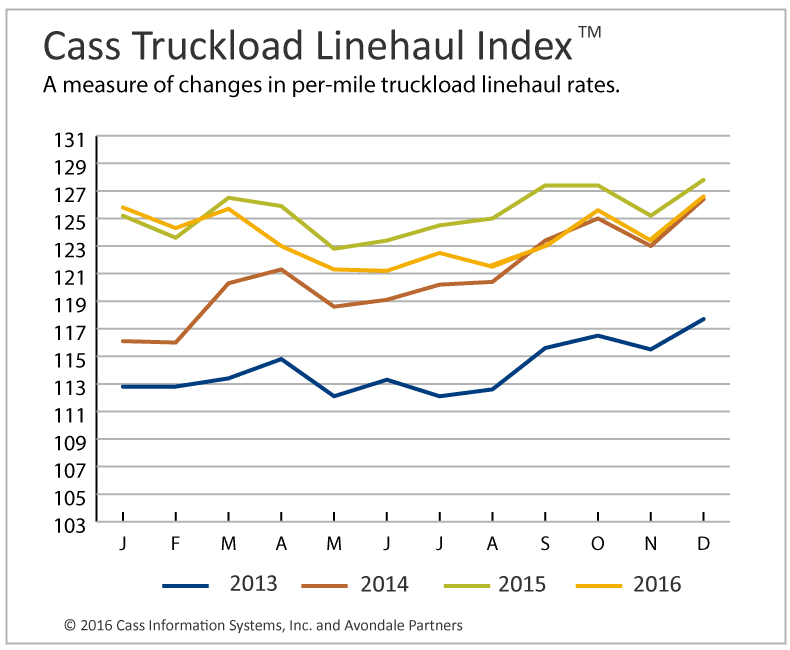
Graphic: Cass Information Systems
Three measures of freight activity and spending were mixed, according to new figures, but the outlook for their performances has improved, according to Cass Information Systems.
The Cass Truckload Linehaul Index, which tracks monthly changes in linehaul rates, fell 0.9% year-over-year in December to a reading of 126.6, marking ten consecutive monthly declines.

Despite this negative trend, analysts at the investment firm Avondale Partners said, "the current strength being reported in spot rates is leading us to believe that our current -3% to 1% truckload pricing forecast may need to be improved or moved to a slightly more positive outlook if the strength in spot rates continues long enough to move contract rates back into positive territory."
One possible reason is that when the December reading is compared to the month before, it improved 2.6%. That marks its biggest month-over-month gain of 2016 and its highest reading since December 2015.
Meantime, the Cass Intermodal Price Index, which tracks changes in total intermodal per-mile costs including fuel, increased 1.5% year-over-year in December to a reading of 129.2. This follows year-over-year hikes of 0.3% and 0.4% in November and October, respectively, and is 2.8% higher in December than the level the month before.

Although diesel fuel prices have recovered from their early 2016 lows, "we do not expect a significant amount of sequential strength from intermodal," said Avondale Partners. “But, the current level of demand and pricing will produce a positive year-over-year comparison for the next nine to 10 months.”
The two indices are based on data from actual freight invoices paid on behalf of freight payment process Cass Information Systems clients.
Both reports came as the December results were released for the Cass Freight Index, which measures monthly levels of shipment activity, in terms of volume and expenditures.
Its measure of shipments showed an increase of 3.5% compared to the same time a year ago but fell 1.2% from November.

The October Cass Freight Shipments Index was up 2.7%, breaking a string of 20 months in negative territory, then November fell back into negative territory, down 0.5%. However, with the December improvement, Donald Broughton, managing director, chief market strategist and senior transportation analyst at Avondale Partners, said this suggests that the October data was not a false positive but instead the beginning of a more positive trend.
"We have seen a wide range of results in the different modes, from continued volume growth in parcel and airfreight driven by e-commerce, to a sequential improvement in truck tonnage to less bad rail and barge volume overall,” he said. “Data is beginning to suggest that the consumer is finally starting to spend a little and that with the recent surge in the price of crude, the industrial economy’s rate of deceleration has eased. If the winter of the overall freight recession we’ve been in for more than a year and a half in the U.S. is not yet over, it is certainly showing promising signs of thawing.”
According to Broughton, the sequential month pattern looked a bit more ominous, but “doesn’t give us great cause for concern.” The reason is what he described as “some degree of normal seasonality at work,” and Avondale is continuing to get daily reports of stronger shipment volume in almost all modes from both hard data sources and industry anecdotes. "It also looks far less troubling when compared to the seasonality in 2013, 2014 and 2015,” he said.
And while the Cass Freight Expenditures Index remained in negative territory, falling 3% in December compared to a year earlier and down 1.1% versus the month before, it also gives Broughton some hope.
“Expenditures, or the total amount spent on freight, were still down, but as was true in October and November, this was less than the rates of contraction in May, June, July and August; down 10.1%, 8.8%, 5.1% and 6.3%, respectively,” he said. “We see this... as a result of the steady increase in the price of fuel over the last six months and the recent rise in the price of crude should only add to this positive bias, but we are also seeing some improvements in the pricing power of truckers and intermodal shippers."
He pointed to numbers from the Cass Truckload Linehaul Index (which does not include fuel) that showed only a 0.9% year-over-year decline in November, far less than the 3.5% drop it posted in September. Also, the Cass Intermodal Price Index (which includes fuel costs) faired even better, marking the third year-over-year increase after 21 consecutive months of decline.
Helping to drive December shipment volume was parcel volume associated with e-commerce continuing “to show outstanding rates of growth, with both FedEx and UPS reporting strong U.S. domestic volumes,” according to Broughton.
He said rail volumes have been part of the weakness, but have become increasingly less bad, and in recent weeks have turned slightly positive. As for trucking overall, volumes are mixed, as tonnage continues to be slightly positive and load volume continues to be slightly negative.
More Fleet Management

New York City's Microhub Project is Delivering Results
Trucking, last-mile delivery companies, and environmental advocates like what they are seeing so far with New York's microhub program.
Read More →
Why Truck Detention Keeps Costing Fleets Time and Money
A 2024 ATRI study found detention affects nearly 40% of truckload stops and costs the industry more than $15 billion annually. Despite the toll on drivers, fleets, and supply chains, the problem remains stubbornly persistent.
Read More →
Time is Running Out to Apply for Exclusive HDT Event
Heavy Duty Trucking Exchange brings fleet managers and suppliers together for the deeper conversations that lead to ideas, partnerships, and solutions. Time is running out to apply for the September event.
Read More →
Amazon Launches Less-Than-Truckload Freight Offering for All Businesses
This launch is the latest addition to Amazon Supply Chain Services, a portfolio of supply chain capabilities from Amazon, including freight, distribution, fulfillment, and parcel shipping.
Read More →
Import Cargo Volume to See Year-Over-Year Gain Again in June, Then Remain Below 2025 Levels Into Fall
After July, the report predicts a weakening in import volume as consumer uncertainty remains high and the impact of increasing inflation takes its toll.
Read More →
AUCTION OF EQUITY INTEREST IN HEAVY HAUL TRUCKING COMPANY!!
Mark your calendar: June 30, 2026 (10:00 a.m. PDT). A 37.5% ownership interest in MagnaTrans, LLC, a California limited liability company doing business as Magna Transportation Group, will be sold in an in-person and online auction to the highest bidder or bidders under Article 9 of the Uniform Commercial Code. The Rancho Cucamonga-based heavy haul and over-dimensional trucking company operates across California, Oregon, and Arizona.
Read More →
Volvo Trucks Adds Unattended Over-the-Air Software Update Capabilities
The latest evolution of Volvo’s over-the-air update technology allows software updates to run while trucks are parked, helping fleets keep vehicles current without disrupting operations.
Read More →
How Waste Connections is Using Data, Telematics, and AI
How do you manage and maintain more than 18,000 connected trucks? Data. Lots of it.
Read More →
Why Fleet Data Matters More Than Ever at Waste Connections [Watch]
Waste Connections' Chuck Palmer explains how telematics, predictive maintenance, safety analytics, and AI help keep vehicles on the road and drivers safe in this episode of HDT Talks Trucking.
Read More →
NMFTA Launches Free, Anonymous Cybersecurity Threat Report Portal
Organizations are encouraged to anonymously report freight fraud, cargo crime, and cyber threats while gaining visibility into incidents reported across the transportation sector.
Read More →