




Volvo’s SuperTruck Exceeds EPA Freight Efficiency Goals
Volvo Trucks North America’s SuperTruck demonstration rig combined advanced aerodynamics, vehicle and powertrain technologies to achieve a freight efficiency improvement of 88%, averaging 12 mpg in road tests.
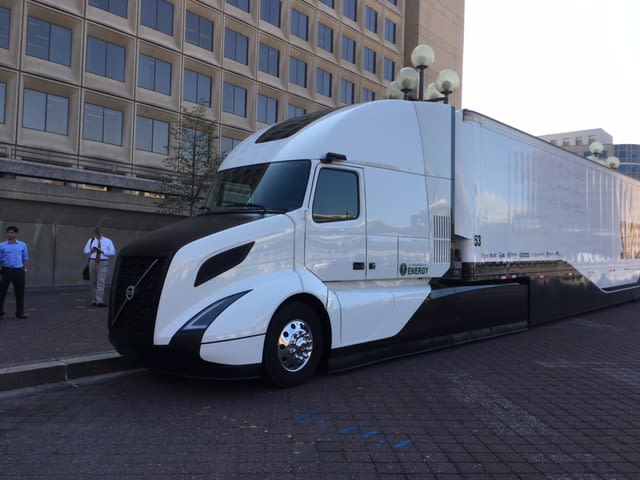
Volvo's SuperTruck is unveiled in Washington, D.C. Photo by Jim Park
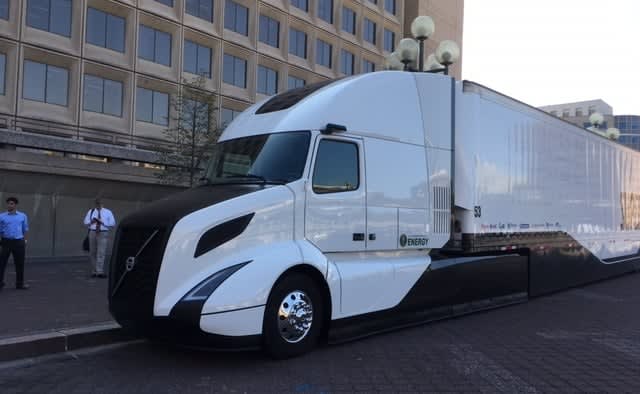
Volvo's SuperTruck is unveiled in Washington, D.C. Photo by Jim Park
Volvo Trucks North America’s SuperTruck demonstration rig combined advanced aerodynamics, vehicle and powertrain technologies to achieve a freight efficiency improvement of 88%, exceeding the 50% improvement goal set by the U.S. Department of Energy SuperTruck program compared to a base model 2009 Volvo VN.
From the top-of-cab solar panels powering its battery and interior lights, to its ultra-light aluminum frame and highly advanced 425 horsepower 11-liter proprietary engine, the SuperTruck concept vehicle allowed Volvo engineers to push the boundaries of heavy truck efficiency. The sleek tractor-trailer combination boosted fuel efficiency by 70%, exceeding 12 mpg consistently in testing, with some test runs showing more than 13 mpg. Powertrain brake thermal efficiency reached 50%.
Göran Nyberg, president of Volvo Trucks North America, noted that the base model Volvo in 2009 averaged 7 mpg.
The SuperTruck program was a five-year DOE research and development initiative to improve freight efficiency – meaning more payload carried while burning less fuel – by 50% compared to 2009 base model trucks.
Volvo’s aerodynamic SuperTruck has a shorter front end than conventional trucks on the road today, and the hood has a sharper downward slope. Lightweight fairings run the length of the tractor and trailer, and cameras have replaced rearview mirrors. Its redesigned chassis is made almost entirely of aluminum, which halved the chassis weight and contributed to an overall tractor-trailer weight reduction of 3,200 pounds.
An enhanced version of Volvo’s I-See, a new feature that memorizes thousands of routes traveled and uses that knowledge to optimize cruise speed and keep the I-shift automated manual transmission in the most fuel-efficient gear possible, was an integral part of the fuel efficiency gains seen during SuperTruck on-road testing.
A key part of the overall efficiency gain is the downsized 11-liter Volvo engine, featuring advanced fuel injection, cooling, oil and turbo-charging systems, as well as new “wave” pistons and other improvements. The SuperTruck powertrain includes a complex Rankine waste-heat recovery system, which converts heat normally wasted in exhaust into torque, boosting fuel economy by helping to power the vehicle.
“The order of magnitude efficiency leap achieved by our SuperTruck is a testament to the outstanding work done by our team and our partners,” said Pascal Amar, principal investigator for the project. “We started by rethinking everything, and we discovered that with every layer you peel back, you uncover new opportunities.”
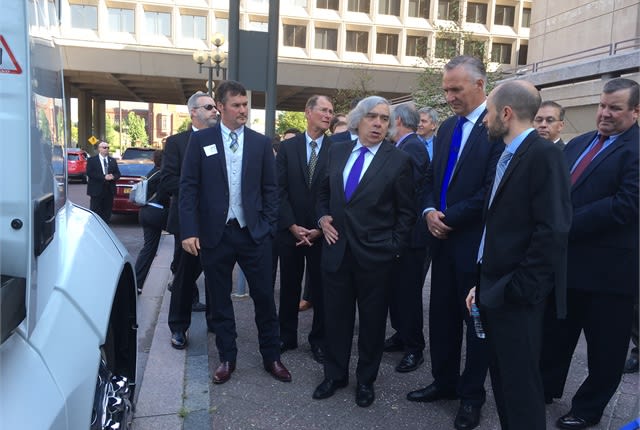
U.S. Energy Secretary Ernest Moniz gets a closer look at the SuperTruck.Photo by Jim Park
While not every technology demonstrated in the Volvo SuperTruck will be commercialized, three of the engine advancements developed through SuperTruck research – the wave piston, turbo compounding system and common rail fuel injection system – are already featured in Volvo Trucks’ 2017 engine line-up. Likewise, a number of SuperTruck-derived aerodynamic improvements – like flared chassis fairings improving air flow around the drive wheels, a redesigned bumper and turbulence-reducing deflectors – can be found on today’s Volvo VNL tractors.
Volvo used computer-aided engineering to reimagine nearly every part of the tractor and trailer without costly prototyping. While the VNL “body in white” was mostly maintained in order to save time and ensure structural integrity, everything else – including the front end, the cab exterior pieces, the chassis fairing and the roof – were completely redesigned to maximize the aerodynamics of the tractor-trailer combination.
Not every idea made it to the concept vehicle. Working with suppliers and academic partners, the team explored the performance and safety of a number of lightweight materials. While some of these, like recycled carbon fiber, were not used in the SuperTruck, the knowledge gained in material science will be applied to future programs.
The DOE recently selected the Volvo Group to participate in DOE’s SuperTruck II program, which will target a 100% improvement on a ton-mile-per-gallon basis, and a powertrain capable of 55% brake thermal efficiency.
Watch for a more detailed report from HDT Equipment Editor Jim Park, who was there for the unveiling of the SuperTruck in Washington, D.C.
More Fuel Smarts

Record Diesel Prices Squeeze Trucking Fleets
Average U.S. diesel prices have climbed to nearly $6 a gallon, surpassing the 2022 record as tight refinery capacity and Middle East disruptions keep fuel costs elevated.
Read More →
How Fuel Delivery Shapes Engine Performance
Fuel delivery depends on more than what happens at the injector. For fleet, maintenance and technical professionals, looking at the full path from pump to injector can provide useful context for understanding engine performance.
Read More →
East Coast Port Launches $45M Electric Truck Push
The Port Authority of New York and New Jersey announced millions in incentives for zero-emission drayage trucks, yard tractors, and new charging hubs near the port.
Read More →

California Bill Could Shed Light on Electric Truck Prices
Why do battery-electric Class 8 trucks remain so expensive? A California bill headed to Gov. Gavin Newsom would give fleets and state agencies more visibility into what manufacturers charge.
Read More →
Detroit Opens Orders for EPA 2027 Engines
Detroit isn’t starting from scratch to meet EPA 2027 diesel emissions standards. Its Gen 6 DD13 and DD15 engines keep much of today’s platform while updating the fuel and aftertreatment systems.
Read More →
Zero-Emission Truck Corridor Planned for West Coast
California, Oregon, Washington, British Columbia and Baja California are coordinating plans for truck charging and hydrogen fueling from Canada to Mexico.
Read More →
A Closer Look at Kenworth’s Electric T880E Vocational Truck [Video]
Learn more about Kenworth's T880E battery-electric vocational truck at the Paccar Technical Center, including its range, applications, upfitting considerations, and PTO options, in this HDT Spotlight video.
Read More →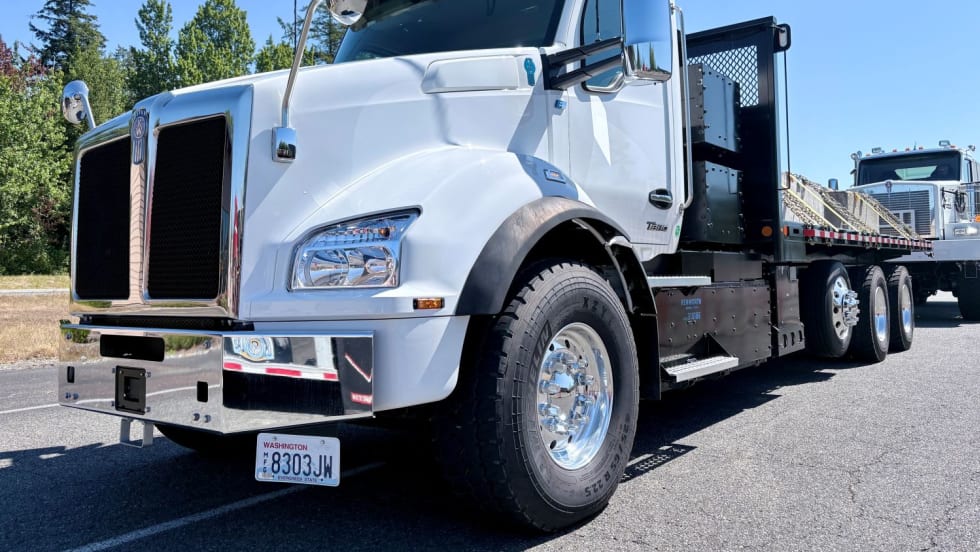
Kenworth T880E Brings EV Power to Vocational Trucks
A closer look at the Kenworth T880E’s range, charging, powertrain and upfit options — and where fleets are showing the most interest.
Read More →
Jennie Abarca Is Proving Electric Trucks Can Do the Job
HDT Truck Fleet Innovator Jennie Abarca is building confidence in fleet electrification one load at a time while openly sharing the challenges she encounters along the way as a small-fleet owner.
Read More →
Cummins Adjusts 2027 Engine Rollout After EPA Proposal
The engine maker will gradually introduce its new Model Year 2027 diesel engines while continuing to offer current models during the transition, citing the EPA's proposed emissions rule changes.
Read More →