




New Report Sounds Wakeup Call on Dangers of Drowsy Driving
A report issued by the Governors Highway Safety Association on the “extreme danger posed by tired drivers” includes a new NHTSA estimate that pegs the annual societal cost of fatigue-related fatal and injury crashes at $109 billion— and that does not include property damage.


Images: GHSA
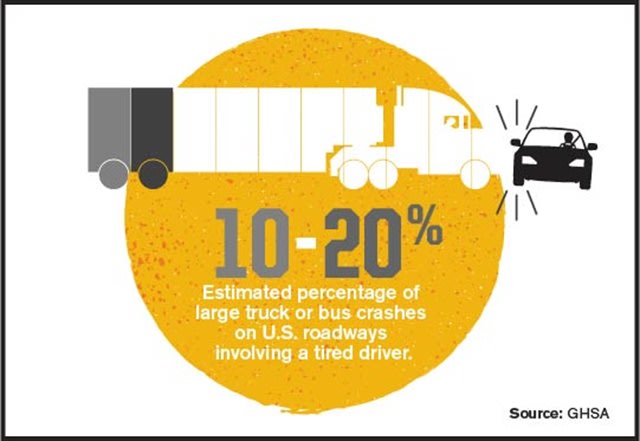
Images: GHSA
A report issued Aug. 8 by the Governors Highway Safety Association on the “extreme danger posed by tired drivers” includes a new National Highway Traffic Safety Administration estimate that pegs the annual societal cost of fatigue-related fatal and injury crashes at $109 billion— and that does not include property damage.
That’s why, according to GHSA, NHTSA has expanded its definition of impaired driving to include not only drunk, drugged and distracted drivers, but also those who are drowsy behind the wheel.
NHTSA states on its website that drowsy driving is a form of impaired driving. “Most people associate impaired driving with alcohol or drugs, but in this situation, sleepiness is the primary cause,” per the agency. “Drowsy driving is not just falling asleep at the wheel. Driver alertness, attention, reaction time, judgment and decision-making are all compromised leading to a greater chance of crashing.”
According to NHTSA’s National Motor Vehicle Crash Causation Study, drowsy drivers involved in a crash are twice as likely to make performance errors as compared to drivers who are not fatigued. “In extreme cases, a drowsy driver may fall asleep at the wheel,” the agency said.
The 73-pg. GHSA report, titled Wake Up Call! Understanding Drowsy Driving and What States Can Do, was funded through a grant from insurance company State Farm. The report was researched and written by consultant Pam Fischer.
GHSA worked with a panel of experts to develop the report and identify the key takeaways and featured programs. Those experts included GHSA and State Farm executives, a NHTSA research psychologist, and medical directors and other professionals engaged in the study of or the practice of sleep medicine.
The report examines the cause and effect of drowsy driving as well as how states and others can best address it. It discusses legislative, enforcement, education, and engineering countermeasures being employed as well as in-vehicle technologies that are available today or seen as on the horizon.
Also provided are examples of state best practices to address the issue, including efforts in Iowa, New York, Texas and Utah.
Author Fischer found that “nearly 83.6 million sleep-deprived Americans are driving every day” and they are responsible for the estimated 5,000 lives that were lost in drowsy driving-related crashes last year.
In press release, GHSA stated that while estimates of deaths caused by drowsy drivers range from 2% to 20% of all traffic fatalities, safety officials agree that the extent of the problem is not fully known.
“There are challenges associated with both measuring and combating drowsy driving,” said GHSA Executive Director Jonathan Adkins. “Law enforcement lack protocols and training to help officers recognize drowsy driving at roadside. And if a crash occurs, the drowsy driver may not report the cause due to concerns about monetary and other penalties.”
Chris Mullen, State Farm’s director of technology research, characterized drowsy driving as a serious highway-safety issue. “We encourage drivers to remember the role that rest plays in safe driving, and to prioritize getting enough sleep before getting behind the wheel. As this report highlights, learning to recognize the warning signs of drowsiness can also help us take appropriate action if we become a drowsy driver.”
To help state highway- safety departments address the behavioral side of drowsy driving and develop strategies to combat it, the report delves into the crash characteristics and drivers who are most at risk.
“Teens and young adults are involved in more than half of all drowsy-driving crashes annually,” said Adkins. “People who work nights or long or irregular shifts are also more likely to get behind the wheel when they are too tired to drive, along with the estimated 40 million Americans who suffer from a sleep disorder.”
Fischer said recognizing that reality merits a change in how sleep is viewed. “Sleep is a restorative and life-sustaining activity that is just as important as eating right and exercising,” she said. “When we skimp on sleep, we’re less able to react quickly– a critical element of safe driving. Our mental and physical health also suffers.”
The report recommends that states partner with other sectors, including public health, business, academia, and nonprofits, to change the culture.
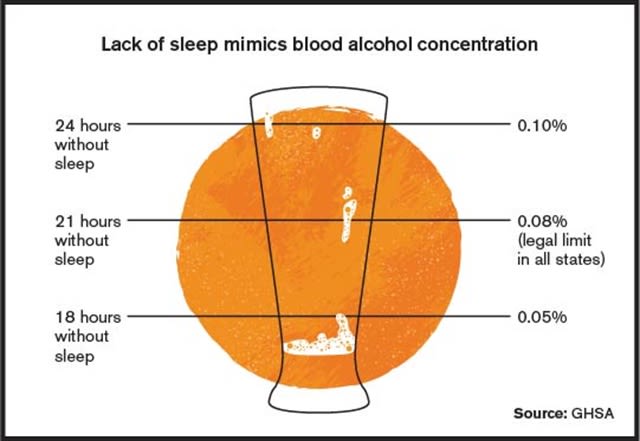
As regards truck drivers specifically, the report states that “Long work hours, irregular schedules and the economic pressures associated with moving goods and people, put commercial motor vehicle operators at risk for not getting sufficient sleep and for developing health issues.”
The report contends that while federal Hours of Service rules establish the maximum number of hours in a day and a week that a CMV operator can drive, as well as rules on breaks and restarts, “repeated efforts to modify HOS regulations have resulted in the suspension of some provisions. Additionally, HOS rules impact CMV drivers differently depending on how they are employed and what they drive. The need to ensure that drivers are well rested and alert before getting behind the wheel remains problematic.”
“Just like drunk driving and seat belts, it’s going to take all of us to get the public to recognize the seriousness of drowsy driving,” said Fischer.
GHSA will hold a webinar to discuss key findings and recommendations of the report on August 11 at 2 p.m. EDT. Click here to register.
More Drivers

From One Generation to the Next: How Mentorship Builds Safer Truck Drivers
After three decades in trucking, Harold Perry shares what he's learned about driver safety, mentorship, and helping the next generation build confidence behind the wheel.
Read More →
Truck Drivers Need More Than Another Alert
Fleets have more visibility into truck health, safety events, and driver activity than ever. The next challenge is turning all that information into useful guidance for the person who has to decide what to do next.
Read More →
FMCSA Removes 110 Truck Driver Training Schools from Certified ELDT List
Federal regulators also are targeting more than 160 additional training providers and launching a nationwide audit of third-party CDL skills testers as part of a broader crackdown on trucking fraud.
Read More →
Hours of Service Pilot Programs: FMCSA Readies for 2027 Rollout
Two pilot programs could eventually reshape hours-of-service rules, giving truck drivers options to pause their 14-hour clock or use longer split sleeper rest periods.
Read More →
Medical Cards, English Proficiency Reshape Roadcheck Violations
Medical-card violations jumped to the top of the driver out-of-service list during CVSA’s 2026 International Roadcheck, while English-language proficiency violations appeared among the leading violations for the first time.
Read More →
Driver Trust Can Make or Break the Success of Fleet Safety Technology
New Teletrac Navman research suggests that onboarding, transparency about driver data, and positive feedback can play a significant role in how commercial drivers respond to safety and coaching technology.
Read More →
EEOC Sues KLLM Over Alleged Sex Discrimination in Driver Training
KLLM is facing a federal sex-discrimination lawsuit over policies the EEOC alleges put female truck driver trainees at a disadvantage.
Read More →
FMCSA Moves to Codify English Language Requirements for Commercial Drivers
By changing regulations on English-language proficiency requirements for commercial drivers, rather than relying on a guidance memo, the FMCSA said future administrations won't be able to walk back the Trump administration's stricter enforcement with just a memo.
Read More →
Drivers Put Western Star Trucks to the Test at Star Nation Experience
Watch to get an inside look at the Western Star trucks, technology, and community behind the Star Nation Experience 2026!
Read More →
Trump Administration Looks to Put More Veterans Behind the Wheel
The Freedom Haulers program pulls together existing and expanded programs at several federal agencies to recruit veterans to drive commercial heavy-duty trucks and cut the red tape for them to get a CDL, training, and employment.
Read More →